
Hegemony and Dissent
The rise of nonconformity in 19th century
Ashton-under-Lyne
Edward Green
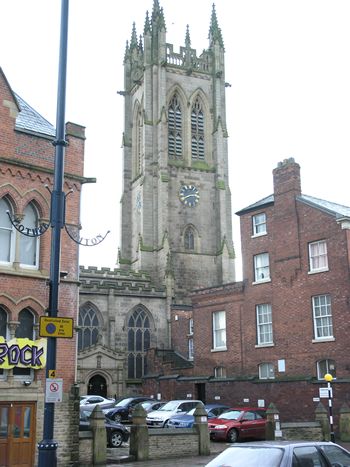 |
| St Michael's Parish Church, Ashton-under-Lyne |
The growth in non-conformity and the vast variety of churches and sects which emerged in the 19th century left a remarkable architectural legacy in the industrial towns and cities of Britain, from the simple preaching house to the most ostentatious Victorian Gothic chapel. The centre of Ashton-under-Lyne in the conurbation of Greater Manchester illustrates this well. It is dominated by two churches: the ancient parish church of St Michael and the splendid Albion Congregational Church a few hundred yards away. Built in 1890-5, Albion Church was the product of the support of wealthy Liberal mill owners, and it is the second largest congregational chapel in the country. As Nikolaus Pevsner commented, ‘with its size and its spire, it places itself in deliberate competition with St Michael’s.’ This intriguing relationship symbolises the tension between the rising nonconformist churches and the established church which ran deep through the fabric of society.
RURAL ORIGINS
Nonconformity
was popular in the Ashton area long before industrialisation, and the first Congregational
chapel was established one and a half miles from the centre of town at Dukinfield
Hall in the mid 17th century. Here the lord of the manor was Colonel Robert Dukinfield,
a staunch Nonconformist and a leading parliamentarian. As early as the 1640s,
after hearing Samuel Eaton preach a fiery sermon at Chester, Colonel Dukinfield
made him his chaplain in the chapel attached to Dukinfield Hall. George Fox made
his first speech at Dukinfield in 1647, before his involvement with the Quaker
movement, and the Dukinfield family later sponsored Samuel Angier, a Presbyterian,
who from 1677 held services in a barn until Dukinfield Old Chapel was built in
1707. The Moravians too set up their first community in Dukinfield in the mid-1740s,
before moving to their present Fairfield Settlement at Droylsden, south-west of
Ashton in 1785. Planned and built by its own people as a self-contained and self-governed
community, Fairfield had its own shop, bakery, public house, laundry, farm, doctor,
fire engine and even its own inspector of weights and measures.
Methodism was first brought to the Ashton area by the Rev David Taylor, a wandering preacher who conducted his first sermon in the town in 1741. It was to be another 40 years before the first Wesleyan chapel was built in Ashton in 1781-2, from money raised by members of its congregation. The fundraising must have been a considerable feat, for records show that the number of members had fallen to as low as 15 in 1780. The success of the effort was largely due to local preacher Peter Walker, who was prepared to travel as far away as Derbyshire to collect subscriptions. The scheme would have been impossible had it not been for James Harrop, the only ‘man of means’ within the local society who almost certainly donated land at Harrop’s Yard, near Cricketer’s Lane for the chapel. A 19th century engraving of the building shows that it resembled an early industrial building – a plain structure, two storeys in height with large windows. There was no communion table inside, as it was regarded as a ‘preaching house’, supplementary to worship within the parish church. As such its services were not to be held at the same time as those in St Michael’s, and chapel members were expected to attend a communion service in the Anglican church four times a year.
Although the chapel only had 15 worshipers at the time of its foundation, its congregation soon expanded and by 1786 a gallery had to be added to accommodate the extra people. In 1787 it had 78 members.
Two other chapels opened in the Ashton area during the 1780s: the Chapel at Red Hall in April 1783 and Mossley Methodist Chapel in 1788.
John Wesley visited the Harrop’s Yard Chapel twice, first in 1782 then in 1788, when aged 85, three years before he died. It was in the years following his death that local Methodists were prominent in the serious dissention that occurred within the church. A group led by Alexander Kilham wanted to have full right to choose who could administer communion. The majority of Ashton Methodists agreed and the ensuing disagreement with the Methodist Conference produced a schism. A breakaway group known as the Methodist New Connexion (MNC) was founded. Although this body was in the minority within Methodism, in industrial Lancashire and Yorkshire the new group was strong.
Following the schism, the Wesleyan Methodists were left with just 25 loyal members in the town and no place of worship, as they now found themselves barred from the MNC Chapel, as did any Wesleyan preachers who were sent to the town. They were forced to worship in a house until 1824, when a small chapel was built for them on the opposite side of Stamford Street to the MNC’s replacement chapel. When in a permanent place of worship. the Wesleyan’s membership almost doubled from 22 in 1803 to 41 in the following year.
INDUSTRIALISATION
In the late 18th and early
19th centuries Manchester expanded rapidly with the growth of the cotton trade
and manufacturing particularly in its smaller satellite towns to the north and
east on the lower slopes of the Pennines. Between 1770 and 1800 the population
of Ashton grew by 300 per cent to 8,000. The industry was essentially domestic
with most men working from home in scattered industrial villages and hamlets.
Although working conditions were often poor, the workers enjoyed many freedoms
and benefits, and various apprentice systems regulated the flow of new labour
into the industry ensuring higher wages. But as elsewhere in England, this domestic
system of industry was rapidly being overtaken by cheaper mechanised processes,
and the handloom weavers also found themselves threatened by the development of
new working practices. The lapse of the Apprenticeship Acts and their eventual
repeal in 1813-14, led to a flood of cheap labour from the depressed countryside
and from Ireland. Weaving was a relatively unskilled job and the number of handloom
weavers rocketed from 50,000 in 1769 to 240,000 in 1820.
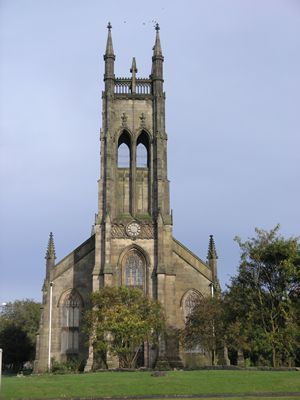 |
| St Peter's Church, Ashton |
The power loom had been invented by Edmund Cartwright who patented the device in 1785, but in the textile areas of south Lancashire and the West Riding of Yorkshire, the rate of its introduction was slow at first (particularly in the woollen area) and for many years the new industries existed alongside the domestic system. By 1806 there were approximately four power looms in England, by 1813 there were still barely a dozen. The process of industrialisation accelerated after the end of the Napoleonic Wars (1793-1815), and in 1817 cotton weavers took to the street in a desperate fight for their jobs. In the ‘March of the Blanketeers’ a group of Lancashire cotton weavers set out to march to London to present a petition to the Prince Regent. The leaders of the march were arrested.
By now the south Lancashire town of Ashton-under-Lyne was a centre of the declining trade, although hand loom weaving still lingered over two decades later. The appalling living conditions of the displaced handloom weaver and his family are described in The Morning Chronicle, the national radical newspaper. In a letter to the paper in 1851, a correspondent described the town’s population as having ‘the reputation of being turbulent and fanatical… The most ultra-political and theological opinions run riot amongst the population.’ Such populations were ripe for the influence of new political and religious ideas, and it was in areas such as Ashton that the Nonconformist churches enjoyed their strongest support.
THE ABSENTEE RECTOR
Although
conditions in Ashton-under-Lyne were ideal for Nonconformist churches to flourish,
dissenting bodies in Ashton found it difficult to establish a foothold. For over
half of the 19th century, the Parish of Ashton was under the control of a notorious
rector, the Rev George Chetwode and his uncle, the Earl of Stamford who was the
largest landowner in the area. George Chetwode gained the Living following the
premature resignation of the previous incumbent, the Rev John Hutchinson. Although
Chetwode spent almost all his time at his other Living of Chilton in Buckinghamshire
where he resided in style in a large mid-18th century country mansion, the Rev
Chetwode received a stipend of £1,500 per annum from his Living at Ashton. From
this income he paid two curates each the sum of £125 per year and lent them the
parsonage. He also subscribed £5 per annum to the churchwardens’ expenses and
gave £2 to the school fund. This expenditure left Chetwode a disposable income
of £1,243. Additional money also came from the sale of coal reserves beneath the
church’s glebe land.
As if the crude financial benefits enjoyed by Chetwode were not enough to anger his Ashton parishioners, their hostility was heightened by the astounding fact that he seldom visited the town. The 1831 census shows that there were a mere 315 souls living in his Buckinghamshire parish, compared with more than 33,500 in the parish of Ashton-under-Lyne. In the year before he died a ‘hale old man of near 80’ it was reported that Chetwode had not been near his church at Ashton for ten years, and had not officiated there for 30 years.
Through his greed and indifference, Chetwode had unwittingly contributed to the success of Nonconformist churches. Despite the weak opposition from the Church of England, Nonconformist churches in the town faced one major obstacle. The principal landowner, the 6th Earl of Stamford, was hostile to Methodism and would not allow the erection of dissenting chapels on his land and even inserted a clause into all his leases to that effect. A major reason for this behaviour was that the church’s Living would lose some of its value if its potential congregation was allowed to fall, by being spirited away to alternative churches.
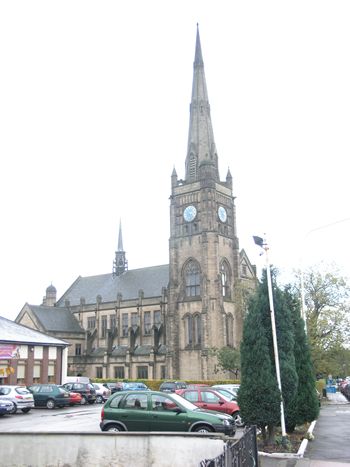 |
| Albion Congregationalist Chapel |
Of
all the dissenting groups in Ashton, it was the Primitive Methodists who fared
the worst. The group had broken away from the Methodist church in 1812, and its
first preacher in the town was harshly persecuted by the authorities. On 8 July
1821, Walter Carver, a Primitive Methodist preached from the steps of the Cross
in Ashton market place to a crowd of attentive listeners. As Carver spoke, his
name was being taken down by a local constable who, acting under the orders of
the Rev Chetwode and the Earl of Stamford, proceeded to assault him, knocking
him down the steps. The constable then attempted to arrest Carver, but was prevented
from doing so by the hostility of the crowd, who demanded that he carried on preaching.
Carver was later summoned to appear before magistrates, but they refused to imprison
him. Not all were so lucky. Chetwode had managed to imprison another Primitive
Methodist preacher, Samuel Weller in June of that year. A Manchester cotton-spinner,
Weller was jailed for ‘holding a meeting' in the King’s Highway at Ashton Cross.
THE RISE OF THE CONGREGATIONALISTS
It was not until 1816 that the Congregationalists finally obtained a permanent footing in Ashton-under-Lyne following the construction of the Refuge Chapel on land that neither belonged to the Earl nor the Rector. They secured the ownership of a small piece of land at the top of a short alley off Crickets Lane. Their first tiny chapel was opened in April 1817 and was enlarged ten years later. This new building soon proved insufficient for their needs, yet any attempt to acquire land from the Earl for the erection of a larger building was still flatly refused.
The
Ashton Congregationalists overcame this obstacle by purchasing freehold cottage
property adjacent to their small chapel. By this clever means the selfish Earl
was outwitted and the new Albion Street Congregationalist Chapel was built. As
the chapel was now both larger and more expensive than its MNC rival, from then
on the Congregationalists became the leading Nonconformist group in the town.
They consolidated their position still further with the erection of the Albion
School in 1862 and the new Albion Congregational Church in the 1890s. The second
largest in England, it challenges the ancient parish church of St Michael’s by
its size and location, and its Sunday school was the largest of its kind in the
country and was known to have catered for 1,500 pupils. This magnificent
Victorian Gothic building still survives, albeit as an office furniture warehouse.
JOHN WROE AND THE CHRISTIAN ISRAELITES
Out
of this hot-bed of dissent rose one of the strangest of all non-conformist sects,
the Christian Israelites. This group was founded by Yorkshireman John Wroe in
1822 from a rump of the followers of the late Joanna Southcott. Wroe believed
that ten of the 12 lost tribes of Israel could be found among British families
and that the town of Ashton-under-Lyne would be the New Jerusalem where the 144,000
elect would gather at the time of the Apocalypse.
During the mid-1820s the Christian Israelites set about establishing the Holy City in this South Lancashire industrial town with the execution of an extravagant building scheme. Their new place of worship, the Sanctuary, opened on Christmas Day 1825, in the then fashionable Church Street area. The huge brick building was plain on the outside with no windows, the whole interior being illuminated by natural daylight through two very large glass domes on the roof. Over two of the three main entrances were huge stone slabs. One depicted the Star of Judah, which was a symbol of the church. The other was inscribed with the words ‘Israelite Society’ in Hebrew characters. The sanctuary cost £9,500, paid for entirely by one of Wroe’s rich industrial supporters in the town, John Stanley. The extent of this lavish expense can be compared with Ashton Town Hall, which cost less than half that amount when it was constructed 25 years later.
Plans
were drawn up to build four gatehouses on the chief entrance points to the town,
in which the Sanctuary was to be its central citadel. These buildings marked the
four ‘Gates to the Temple of the Children of Israel’. However, the description
of these buildings as gatehouses, implying single-storey lodge-type buildings
is quite a misconception. They were substantial detached properties of red brick
with typical late Georgian features. Only one of the buildings in this elaborate
and extravagant millennial architectural scheme still exists; one of the gatehouses
survived as a pub, aptly named The Odd Whim. The building was saved from
demolition in 2003 at the 11th hour by English Heritage which recognised its historical
importance and listed it.
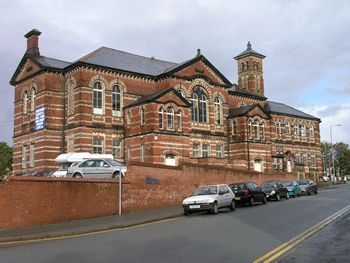 |
| The former Congregationalist School, Ashton-under-Lyne |
OTHERS
Other Nonconformist churches and sects included the Baptists, Anabaptists, Swedenborgians, Mormons and Barkerites. The Church of England did strike back, as early as 1821, with the construction of a new Commissioner’s Church within the Parish, St Peter’s. The dislodged Rev Hutchinson was made its first Curate in Charge.
The rise of Nonconformity in Ashton-under-Lyne illustrates how the chaos of industrialisation left the Established Church in turmoil. The rapid growth of the new factories combined with the decline of cottage industries created the right climate for disparate religious groups to flourish, and proliferate. It also encouraged the spread of secularism.
Recommended Reading
- Winifred M Bowman, England in Ashton-under-Lyne, John Sherratt & Son, Ashton-under-Lyne, 1960
- J Ginswick (ed), Labour and the poor in England and Wales, 1849-1851: the letters to the Morning chronicle from the correspondents in the manufacturing and mining districts, Cass, London, 1983
- Edward Green, ‘Prophet’ John Wroe: Virgins, Scandals and Visions, Sutton Publishing, Stroud, 2005
- William Haslam Mills, Grey Pastures, (1924), The Chapels Society, London, 2003
- Edward Alan Rose, Methodism in Ashton-under-Lyne, 2 Vols, E A Rose, Ashton-under-Lyne, 1969