
Taking the Plunge
18th-century bath houses and plunge pools
Clare Hickman
 |
|||
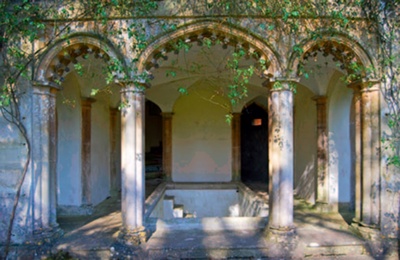
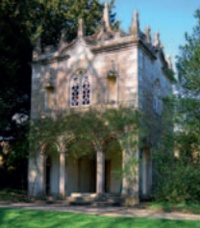
| The Corsham Court bath house (above and below left) was originally designed by Lancelot Brown 1761-3 and later remodelled by John Nash at the end of the century. The front is open to three sides giving views across the landscaped grounds. |
One of the defining features of contemporary western society is its obsession with health fads, whether in the form of macrobiotic diets or 'sweating it out' in the gym. However, this is an age-old concern and in 18th-century Britain the health craze of the day resulted in the creation of plunge pools and cold baths in houses and gardens across the land. These containers filled with cold water could be located within the main house or within a purpose-built structure set in the landscape, such as a grotto, where they often formed part of a circuit of garden features to be inspected. Although they were often aesthetically pleasing, their main purpose was to help facilitate a healthy way of life, and their placement, particularly when they formed part of a designed landscape, was as important in terms of encouraging good health as a dip in the cold water itself.
The popularity of cold baths and plunge pools in the 18th century followed both the trend for coastal and spa bathing, and the aspiration of a long and healthy life. The 4th Baronet and 2nd Sir Watkin Williams-Wynn, of Wynnstay in Denbighshire, combined sea-bathing with frequent trips to his very own cold bath. This was sited in the grounds of his Welsh estate and represented both the desire to include a classical garden structure within his landscaped park, as well as the desperate search for a cure for the disfiguring and painful skin condition from which he suffered all his life. The baronet’s stone bathing tank was rectangular in form, with elegantly curved steps leading down to it from the bath house itself, which served as an icy changing room. The act of bathing required some Spartan bravery, but then that was all part of the healthy process. Unfortunately for Sir Watkin, despite frequently subjecting himself to the healing powers of the Wynnstay bath, he died of his symptoms on 29 July 1789.(1)
 |
However, cold baths were not only viewed as a method of curing disease. Throughout the century there was a renewed interest in following a regimen to achieve good health. According to Virginia Smith, ‘between 1700 and 1770 the medical advice book market expanded intermittently but steadily’.(2) The books often described modes of healthy living that, the authors claimed, would extend life expectancy. One of the many types of routine advocated was the cold regimen, which included spending time out of doors, eating cooling foods, taking plenty of exercise and bathing in cold water. One of the great advocates of this regime was the philosopher John Locke. In the 1703 edition of his tract, Some Thoughts on Education, he argued that:
Every one is now full of the miracles done by cold baths on decay’d and weak constitutions, for the recovery of health and strength; and therefore they cannot be impracticable or intolerable for the improving and hardening the bodies of those who are in better circumstances.
John Floyer, a Staffordshire doctor, was one of the most high-profile medical men actively promoting cold bathing during this period; his pioneering work, An Enquiry into the Right Use and Abuses of the Hot, Cold and Temperate Baths in England, was published in 1697. Floyer’s belief in cold water was not confined to the written treatise, for in the 1690s he constructed his own small bathing spa, St Chad’s Bath at Unite’s Well, about a mile from Lichfield. The restored remains of the spa are in the grounds of Maple Hayes School, near Lichfield.
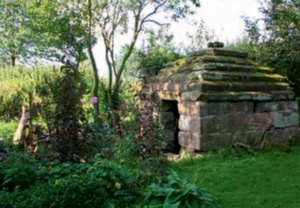
It is perhaps not surprising that cold baths began to appear in several local gardens soon after. One of the first was constructed at Streethay Manor, north of Lichfield. This is a fascinating moated site with strong Floyer associations, as he was the relative and friend of the family that owned the house, the Pyotts. The remains of a late 17th- or early 18th-century spring-fed, stone-cold plunge bath-house (illustrated below right) can still be found in the grounds, no doubt built with Floyer’s encouragement. It was placed between the house and moat and is now free-standing, but the stone foundations of a wall running parallel to its south side have recently been uncovered, suggesting that the pyramidal-roofed structure might have been the wellhead to a much larger cold bath room.
COLD BATH HOUSES AND POOLS IN THE LANDSCAPE
Plunge pools and cold baths took several different forms. The plunge pool at the Georgian House in Bristol was built within the actual villa in the 1790s by John Pinney, a man who wanted his house filled with all the latest modern conveniences. This reflects a desire to explore new technologies and possibly also later medical theories concerning the need to regulate the temperature of the water into which one plunged – something which could be achieved more easily indoors. Similarly, the late 18th-century plunge pool at Greenway, Devon, was also fully enclosed, although in this case the bath house was situated away from the main house, on the banks of the picturesque River Dart.
 |
|
| The remains of the late 17th or early 18th century bath house at Streethay, Staffordshire, which may well have been designed with advice from cold bathing advocate, John Floyer (Photo: Timothy Mowl) |
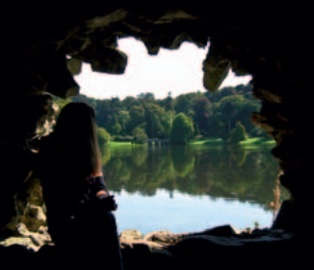
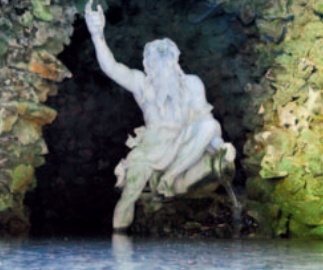
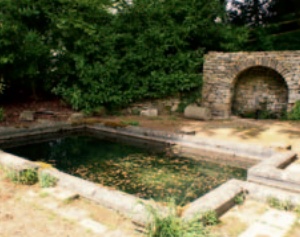
Plunge pools at Painswick in Gloucestershire and Stourhead in Wiltshire, on the other hand, are both external, each differing in their placement. The 18th-century plunge pool at Painswick (illustrated near the end of this article) commanded open views across the landscape. At Stourhead, in Wiltshire, the pool was set within an ornamental grotto containing statues and purposely sited to exploit a designed view across the lake (below left). In 1765 Joseph Spence described how the jagged opening was ‘coverable with a sort of Curtain, when you chuse it’, so that the inner darkness could be transformed at the pull of a drape, and plunge pool bathers could be protected from the prying eyes of visitors on the lake’.(3) In fact, the only way to get the view through the grotto opening is to be at the level of someone standing in the cold bath.
So the question arises, why were many cold baths set within the landscape rather than in the house, as in the case of the Georgian House in Bristol? The most obvious reason is that the bath was filled directly from a spring and it would be easier to place the bath near the source. There was also a belief that the water should be as cold as possible so that water straight from a spring would be colder and therefore more effective than water that had been piped some distance. It would also be purer and retain its chemical properties.
However, this is perhaps not the only reason for the location of the bath within the park. Virginia Smith describes how the 18th-century landscape park was a setting for strenuous activity, with its ‘long informal paths that rambled around the estate towards newly built plunge pools, cricket pitches, stables and carriage rides, fishing lakes, archery butts, boatsheds, and carefully placed picnic pavilions’.(4) As today, exercise was certainly highly advocated, with George Cheyne in his 1743 Essay of Health and Long Life arguing that ‘a due Degree of Exercise is indispensably necessary towards Health and Long Life’. He went on to suggest that ‘Walking is the most Natural and effectual Exercise’, and that in particular ‘House Exercises are never to be allow’d, but when the Weather or some Bodily Infirmary will not permit going abroad; for Air contributes mightily to the Benefit of Exercise’.
 |
 |
||
| Above left: The view through the grotto and across the lake that Henry Hoare and his rollicking visitors would have enjoyed in the plunge pool at Stourhead, Wiltshire (Photo: Timothy Mowl) Above right: The statue of Neptune in the grotto at Stourhead | |||
Therefore, the routine of walking around the landscape in order to reach the bath could be viewed as part of the regimen. Some writers even included walking to and from the cold bath as part of their recommended technique. As late as 1839, James Tunstall in his Popular Observations on Sea-Bathing, and the General Use of the Cold Bath stated that ‘the individual should walk leisurely to the bathing place’ and then on coming out of the water that ‘he should then take moderate exercise – half an hour's walk, or an hour's ride on horseback will add much to the benefit experienced’.
As well as the physical exercise achieved by walking to the bath, the viewing of the landscape en route could also have a beneficial effect on the mind. In the case of Stourhead, taking a bath and viewing the landscape simultaneously could be considered as having a direct impact on both the physical and mental states. In Robert Burton’s influential Anatomy of Melancholy (1626) he suggested that:
… the most pleasant of all outward pastimes is … to make a petty progress, a merry journey now and then with some good companions, … to walk amongst orchards, gardens, bowers, mounts, and arbours, artificiall wildernesses, green thickets, arches, groves, lawns, rivulets, fountains and such like pleasant places, …, brooks, pooles, fishponds, betwixt wood and water, in a fair meadow, by a river side…
 |
||
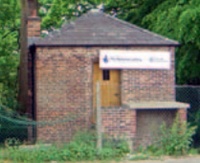
| The cold bath house at Bradshaw House in Congleton, Cheshire which has recently been restored. (Photo: Nino Manci, Congleton Building Preservation Trust) | ||
 |
||
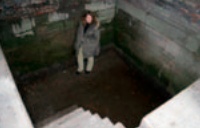
| Marion Mako standing in the Bradshaw House plunge bath which, miraculously, had survived sufficiently intact for restoration to be possible. It is lined with carefully tooled ashlar stone and there are steps down to the plunge pool. (Photograph: Timothy Mowl) | ||
 |
||
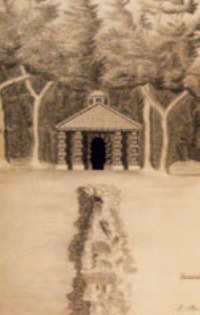
| Richard Woods’ rusticated design for a Cold Bath with cascade
and grove of trees for Wardour Castle, Wiltshire, c1766 (By courtesy of Wiltshire & Swindon History Centre: 2667/18/21) |
Likewise, Joseph Addison writing in The Spectator in 1712 states that:
Delightful scenes… have a kindly influence on the body, as well as the mind, and not only serve to clear and brighten the imagination, but are able to disperse grief and melancholy, and to set the animal spirits in pleasing and agreeable motions.5 These views suggest that there was a philosophical basis for an 18th-century belief in the concept that gardens and beautiful landscapes had the power to lift the spirits.(5)
In the case of Stourhead, where Henry Hoare took up full time residence in 1741 after a series of bereavements, including that of his son, mother and then his wife in 1743, the garden with its cold bath may well have been designed to help disperse his personal grief and melancholy. He described using the bath in a letter of 1764 during the heat of summer: ‘… a Souse into that delicious Bath and Grot filld with fresh Magic, is Asiatick Luxury & too much for Mortals or at least for Subjects,…’.(6) Professor Timothy Mowl has described how Hoare ‘would bathe here naked with a group of rollicking visitors whom he had met the night before at the hotel built for them in the village, all to the sound of two French horns, playing in near perfect acoustics’.(7) This is all considerably more extravagant than the bracing tonic advocated by Locke and Floyer.
Of course, the landscape surrounding the pools and baths might not always have been enjoyed during the actual immersion. Bath houses often surrounded the pools and thereby partially enclosed the view or blocking it completely, as at Greenway, Devon, and at Bradshaw House in Congleton, Cheshire (above right) where a summer house was placed above a plunge pool. However, these buildings could also provide picturesque incidents within the landscape, whether rustic, as at Wynnstay, or classical, as at Corsham Court in Wiltshire (top two illustrations).
The temperature of the water would also mean that plunge pools and small baths would no doubt have been the scenes of brief activity only. Larger pools, however, would have allowed for swimming, something which Locke and others were very keen to promote. In 1834 Mr Haddon wrote that ‘it will be observed, that as affording opportunity for gentle exercise, and by the more efficacious immersion of the whole person in the water, of the more certain cleansing, re-establishing and invigorating functions of the skin, the swimming bath is mentioned,…’.(8) In this way cold baths, particularly public ones, can perhaps be viewed as precursors of the later fashion for open-air swimming pools and lidos.
Another reason for placing the cold bath outside in the landscape seems to relate to the desire to return to a more natural way of life. In terms of garden design, according to Kenneth Woodbridge, ‘behind Addison and Pope was the philosophers’ appeal to a natural order; Shaftesbury’s ‘rude Rocks, the mossy Caverns, the irregular wrought Grottos and broken falls of water with all the horrid Graces of the Wilderness itself’ were valued ‘as representing nature more’.(9) Given this argument, the grotto at Stourhead can be seen to be symbolic of a natural element within the garden, as can Richard Woods’ rustic design for the cold bath at Wardour Castle, Wiltshire, which even had falling water in the form of a cascade running beneath the bath (illustrated right).
Private cold baths were not alone in this relationship to nature. In 1737, John King, an apothecary, wrote a pamphlet expounding the virtues of cold bathing, with particular reference to his spa at Bungay, Suffolk. Towards the end he included a description headed; ‘A few lines transcribed from a Letter to a young lady by a Gentleman at your Bath’.
The letter stated that:
Near the bottom of this is placed the Grotto or Bath itself, beautified on one Side with Oziers, Groves and Meadows, on the other with Gardens, Fruits, Shady Walks and all the Decorations of a rural Innocence. The building is delightfully plain and neat, because the least attempt and artful Magnificence, would by alluring the Eyes of Strangers, deprive them of those profuse Pleasures which Nature has already provided.
Again nature seems to play a prominent role. Although the gardens are created through artificial design, like the grotto at Stourhead, they are seen as more natural than the artifice of the bath house.
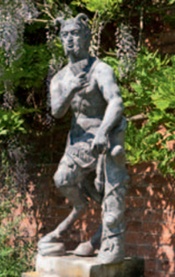
This desire for a more natural experience was associated with the knowledge that cold bathing went back to ancient times. Floyer argued that, ‘I publish no new doctrine, but only design to revive the Ancient practice of Physick in using cold baths.’(10) Many of the writers use this historical lineage as evidence of the veracity of cold bathing, and at Painswick the statue of Pan used to stand guard over the cold bath. However, one should perhaps not take this association too literally. Pan could relate to both ideologies; classical and natural. As Robin Price has suggested, the link with antiquity ‘is likely to have been no more than an added and subliminal recommendation to those already wishing to return to the primal simplicity of nature’s laws’.(11) At Stourhead there is a more complex use of classical iconography with statues of the river god and a sleeping nymph behind the cold bath. All of this is complicated still further by the religious meaning found in John Wesley’s advocation of cold bathing and Floyer’s statement that he saw bathing as a baptismal cleansing. These can be seen in correlation to the growing non-conformist movement and, as late as the 1800s, the Quakers running Brislington House, an elite lunatic asylum on the outskirts of Bristol, were using cold baths as a central therapeutic agent in their attempt to cure madness.(12)
 |
|
| The mid 18th century plunge pool at Painswick, near Stroud is unenclosed, giving views across the Rococco gardens (Photo: John Horsey); pool-side activities were originally presided over by Jan Van Nost’s magnificent statue of Pan, below right. (Photo: Paul Foch-Gatrell) |
There were also concerns over the weakening of health through the indulgence in luxurious lifestyles. Cheyne and Jean-Jacques Rousseau were among those who raised concerns about the link between mental health and the onward march of civilization. Rousseau postulated that as civilization developed, men alienated themselves from nature and that primitive man was superior, and less likely to develop mental illness, because he was closer to his natural state. A dip in the cold bath in a garden setting could, therefore, be considered a method of connecting with an earlier, more primitive, and ultimately healthier, way of life.
Other writers used examples of the hardiness of other nations to argue in favour of the benefits of cold bathing. Locke wrote: ‘let them examine what the Germans of old, and the Irish now, do to them, and they will find, that infants too, as tender as they are thought, may, without any danger, endure bathing, not only of their feet, but of their whole bodies, in cold water. And there are... ladies in the Highlands of Scotland who use this discipline to their children in the midst of winter, and find that cold water does them no harm, even when there is ice in it.’
This represents an idea of Spartan living and of hardening one’s physical state which is quite different to Henry Hoare’s rollicking in the cold bath at Stourhead. However, the use of all these structures represents the age old search for health and longevity. Among other examples, it is still with us in the form of open-air lidos and the annual Christmas day wintry swim of the Serpentine Swimming Club.
~~~
Acknowledgements
With thanks to The Leverhulme Trust (www. leverhulme.ac.uk), without whose generous support through funding The Historic Gardens & Landscapes of England Project, the research for this paper would not have been possible. Thanks also go to Professor Timothy Mowl of Architectural History & Conservation Consultants (www.ahcconsultants.co.uk), and Laura Mayer for reading early drafts and providing helpful suggestions.
Notes
 |
1 Thanks to Laura Mayer for permission
to include this element of her doctoral
research relating to Wynnstay
2 Smith, 2007
3 Mowl, 2004
4 Smith, 2007
5 The Spectator, 411, 1712
6 Quoted in Woodbridge, 1970
7 Mowl, 2004
8 Anonymous, The Constant Use of the Cold
or Swimming Bath of Great Importance in
the Prevention of Disease and Preservation
of Health, J Haddon, London, 1834
9 Woodbridge, 1970
10 J Floyer, An Enquiry into the Right Use and
Abuses of the Hot, Cold and Temperate Baths
in England, R Clavel, London, 1697
11 Price, 1981
12 Discussed in its
political context in Jenner, 1998
Recommended Reading
- F Cowell, Richard Woods (1715-1793): Master of the Pleasure Garden, Boydell, Woodbridge, 2009
- C Hickman, ‘The “Picturesque” at Brislington House, Bristol: The Role of Landscape in Relation to the Treatment of Mental Illness in the Early 19th-Century Asylum’, Garden History, 33:1, 2005
- M Jenner, ‘Bathing and Baptism: Sir John Floyer and the Politics of Cold Bathing’, Refiguring Revolutions: Aesthetics and Politics from the English revolution to the Romantic Revolution, ed K Sharpe and S Zwicker, University of California Press, Berkeley, 1998
- T Mowl and D Barre, The Historic Gardens of England: Staffordshire, Redcliffe, Bristol, 2009
- T Mowl, Historic Gardens of Wiltshire, Tempus, Stroud, 2004
- R Price, ‘Hydrotherapy in England, 1840–70’, Medical History, 25, 1981
- V Smith, Clean: A History of Personal Hygiene and Purity, OUP, Oxford, 2007
- K Woodbridge, Landscape and Antiquity: Aspects of English Culture at Stourhead, 1718 to 1838, Clarendon, Oxford, 1970