
Beakhead Ornament
and the Corpus of Romanesque Sculpture
Ron Baxter
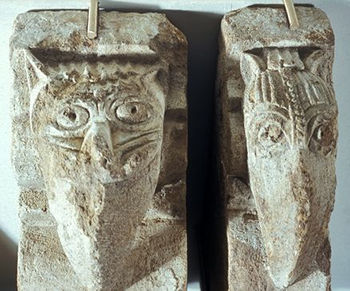 |
|
| Figure 3. Bird beakheads from Old Sarum cathedral and Sherborne Castle. (Photo: Courtauld Institute of Art) |
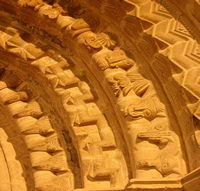
Beakhead ornament, which is found decorating the arches of Norman and Romanesque churches in many parts of Britain, is one of the most bizarre and intriguing forms of sculpture. Nightmarish heads of birds, beasts or monsters stare down from the arch as if to frighten the visitor, their beaks clenching the moulding on which they are carved. Human heads occasionally appear, with their tongues or beards lying across the angle roll of the arch, as at Lincoln Cathedral, while on the chancel arch at Tickencote (Rutland) a rich variety of human, animal, monstrous and even foliate forms are given the beakhead treatment (Figure 1).(1)
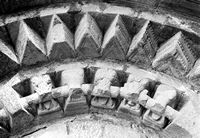
Beakheads appear in Romanesque sculpture in the British Isles, as well as in Anjou, Normandy and northern Spain. In Ireland there are six examples of arches decorated with heads, but not all are beakheads. Some of the finest Irish beakhead is found on the west doorway of the Nuns’ church at Clonmacnoise (Offaly), and it is unusual in that the roll clasped by the beasts’ heads is free-standing and gripped between their upper and lower jaws (Figure 2).(2)
This treatment of the ornament has parallels with continental beakhead like that at Saint-Fort-sur-Gironde (Charente-Maritime) rather than with English examples, which led Zarnecki to suggest that the pilgrimage to Santiago de Compostella may have been an important factor in the introduction of the motif to Ireland.(3)
On mainland Britain, beakhead is overwhelmingly English; there are no Welsh examples, and only one in Scotland – close to the English border at Kelso. Within England the distribution is extremely uneven. Of more than 160 sites where it occurs there are no beakheads in Kent, Hertfordshire or Dorset, and only single examples in Lancashire, Bedfordshire, Northumberland, Shropshire, Leicestershire, Warwickshire, Somerset and that hotbed of the English Romanesque, Herefordshire. In Yorkshire, however, there are no less than 57 sites with beakhead, and there are a further 39 in the area between the Chilterns and the Cotswolds, covering the counties of Berkshire, Oxfordshire, Gloucestershire and Buckinghamshire.(4)
 |
|
| Figure 1. Chancel arch of St Peter’s, Tickencote: a wide variety of forms are treated as beakheads. (All photos by Ron Baxter unless otherwise stated) | |
 |
|
| Figure 2. West doorway Nuns’ church, Clonmacnoise (Ireland): unusually, the roll grasped by the beasts’ heads is free-standing. (Photo: CRSBI) |
Reading Abbey, founded by King Henry I as his mausoleum in 1121, is usually seen as the fountainhead of beakhead in this country.(5) At Reading, beakhead was used to decorate the arches of two ranges of the cloister. This has been demolished now, but 34 beakhead voussoirs and five double springers have been excavated at Borough Marsh just down the Thames, where stones were carried from the abbey ruins in 1548.
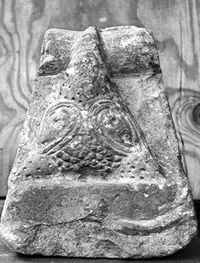
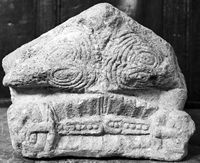
Although Reading was one of the first places where beakhead was systematically used to decorate arches, the carving was already varied and inventive, with birds, beasts, monsters and demonic human figures forming the heads. The most common type, at Reading and elsewhere, shows the head of a bird with its long beak pointing towards the inside of the arch, with its tip resting on the angle roll at the intrados of the order (Figure 3).
Zarnecki has suggested that the bird beakhead was an adaptation of Anglo-Saxon biting birds from manuscript illumination to the decoration of an arch,(6) and it is true that there are conceptual similarities between the birds gripping initials in their beaks in a group of late 10th-century Canterbury manuscripts and the Reading bird-head voussoirs.(7)
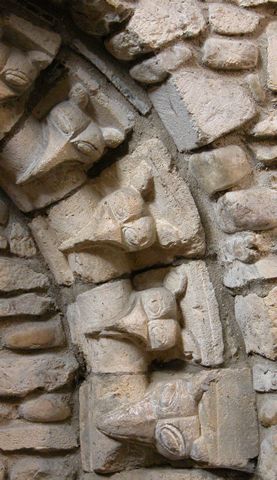
At Reading these bird beakheads alternate in the arch with a much scarcer type, rather like a shuttlecock. The rounded head of a beast is carved upside-down on the inner angle with a pair of scalloped leaves issuing from its mouth (Figure 4). Further decoration is often carved between the leaves: a pinecone, or sometimes a second head. A simpler version of this unusual motif is found at an early date at Tavant (Indre et Loire) in southern Normandy (Figure 5), where Henry held lands before he came to the throne, and its introduction to England at Reading may be a direct result of Henry’s patronage. In England this type of arch decoration was copied from Reading, on the inner order of the doorway at Great Durnford (Wilts).(8)
The spread of beakhead from Reading may also be linked to patronage around the court of Henry I. Roger of Salisbury was one of Henry’s principal courtiers: Bishop of Salisbury from 1102 and Justiciar of England during most of Henry’s reign. In his buildings at Old Sarum cathedral and the castles of Sarum, Sherborne, Devizes and Malmesbury he followed his king’s example in producing magnificent architecture, lavishly decorated.(9) Very little of it survives, but it is not surprising to find that the other examples of early beakhead, dating from the 1130s, come from Roger’s buildings at Old Sarum and Sherbourne.(10) A bird beakhead from Old Sarum belonged to the arch of a doorway (Figure 6), while the Sherborne beakheads, carved with birds’ heads on either side of a roll, originally decorated the vault of a hall or chapel.
 |
|
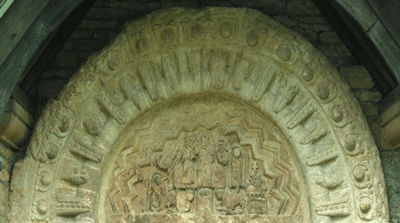
| Figure 4. Beakhead and beaker clasp on the south doorway at Quenington (Gloucs). (Photo: Jonathan Taylor) |
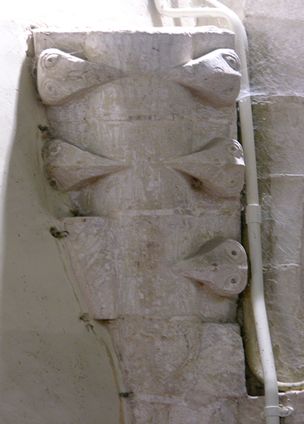
Roger’s nephew Alexander was to become Bishop of Lincoln, and his remodelling of the west front of Lincoln cathedral also includes beakhead ornament. (11) As well as this kind of courtly and dynastic transmission of the ornament, the beakhead used at major sites like Reading and Old Sarum was copied locally in parish churches, especially on doorways, but occasionally too on chancel arches and vault ribs, like those in the church of SS Mark & Luke at Avington, only some 20 miles from Reading (Figure 7).
Although the deepest seams of beakhead are to be found in Oxfordshire (including for example Iffley, Barford St John, Cuddesdon and Burford) and Yorkshire (Healaugh, Brayton, Barton-le-Street and Stillingfleet for example), unsuspected links of patronage or emulation can throw up surprisingly rich displays in counties that are otherwise lacking in the motif. Little Stukeley church in Huntingdonshire was entirely rebuilt from the 13th century onwards, but there are beakhead voussoirs from the Norman church inside the tower, set there by Hutchinson who restored the church in 1887 (Figure 8).
EARLY ORIGINS
The search for the origins of beakhead has led scholars like Zarnecki in the direction of Anglo- Saxon manuscript illumination, but there are obvious difficulties in accounting for the transmission of late 10th-century manuscript motifs into stone carving more than a century later, and without anything in the way of convincing intermediaries.
 |
|
 |
|
| Figures 5 and 6. Reading Abbey: bird and beast beakheads now in Reading Museum and Art Gallery; those below are on a double springer. |
A more fruitful line of enquiry for beakheads in general might again be via the patronage of Henry I, and the crucial monument may be the keep of Norwich Castle, started by William II, but probably substantially built by Henry I before the foundation of Reading Abbey.(12) The main doorway was decorated with a simplified proto-beakhead design, ingeniously christened 'beaker clasp' by Heslop, both in the archivolt and on the jambs,(13) a type of ornament that was to gain some popularity in its own right. It consists of a series of tapered and chamfered stone bridges like drinking-beakers resting on the angle roll (Figure 9). The south doorway of Avington church has a simple form of the beaker ornament, carved on the jambs,(14) and in the south doorway of Quenington church (Gloucesteshire), beaker-clasps alternate with bird beakheads in the arch (Figure 10). Both of these examples are almost certainly versions of something copied from Reading by local sculptors.
The beaker ornament was widely used at Norwich Castle for decorating window arches and blind arcading on all four main facades. The motif produces alternations of light and shadow across the arches which are effective in conveying a feeling of richness and solidity, and which echo similar effects produced by the corbel tables and battlements. In this view of the development of beakhead ornament, the figural carving of the beakheads is an embellishment of a motif whose original purpose was to provide texture through the alternation of light and shadow, in much the same way as the chevron ornament with which it is often combined.
Even if the original purpose of beaker clasp was the creation of light effects, there is no doubt that the beakhead that developed from it became an important way of introducing grotesque and monstrous images into the decoration of arches. Just why 12th century sculptors and their patrons considered this appropriate for sacred buildings is a question that has exercised commentators since Bernard of Clairvaux, questioned its purpose in cloister decoration in the 1120s.(15)
The Abbé Auber, writing in the 19th century, considered that gargoyle waterspouts were devils conquered by the church and set to perform menial tasks, and later in that century and in the early part of the next it was fashionable to look for moral messages by identifying monstrous creatures with the animals described in Bestiaries, which had Christian ethical messages attached to them in the text.(16)
A more convincing explanation, developed in the work of Camille, is that these terrifying creatures represent the sin and vice that fills the world, which must be rejected by the man of God.(17) The predatory birds and fierce beasts of Reading cloister; the grotesque and obscene corbels that surround so many churches, and the foul creatures that cluster around their doorways are there to remind us that the world is really like that, however beautiful and serene it may appear, and that the only refuge is to be found in the Church.
 |
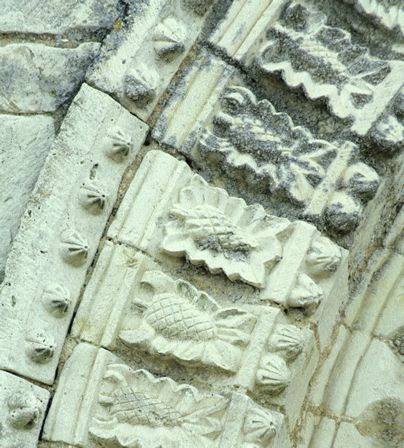 |
| Figure 7. Avington (Berkshire): chancel vault rib | Figure 8. Tavant (Indre et Loire): west doorway |
 |
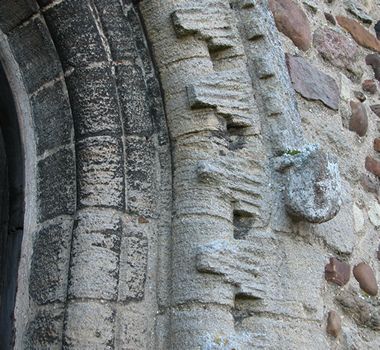 |
| Figure 9. Little Stukeley (Huntingdon): reset beakheads | Figure 10. Beaker clasp ornament at St James’s, Spaldwick (Huntingdon) |
~~~
Notes
1 The standard works on beakhead are still J Salmon, 'Beakhead
Ornament in Norman Architecture', Yorkshire Archaeological
Journal XXXVI (1946), 349-57, and especially G Zarnecki
and F Henry, 'Romanesque Arches decorated with Human and Animal
Heads', Journal of the British Archaeological Association,
XX-XXI (1957-58), 1-35
2 On the Nuns’ Church at Clonmacnoise, see J Ni Ghradaigh, '"But what exactly did she give?": Derbforgaill and the Nuns’
Church at Clonmacnoise', HA King (ed), Clonmacnoise Studies
II (1998), 175-207
3 Zarnecki & Henry (1957-58), 17
4 Zarnecki & Henry (1957-58), 20
5 R Baxter & S Harrison, 'The Decoration of the Cloister
at Reading Abbey', L Keen & E Scar (eds), Windsor: Medieval
Archaeology, Art and Architecture of the Thames Valley (British
Archaeological Association Conference Transactions XXV,
2002), 302-12. English Romanesque Art 1066-1200. Exhibition
catalogue, Arts Council of Great Britain, Hayward Gallery, London,
1984, 174
6 Zarnecki & Henry (1957-58), 25
7 Zarnecki notes the Aldhelm, De Laude Virginitatis (Lambeth
Palace 200, f70r)
8 Zarnecki & Henry (1957-58), 22
9 On Roger of Salisbury, see R Stalley, 'A Twelfth-century
Patron of Architecture. A study of the buildings erected by Roger,
Bishop of Salisbury 1102-1139’, Journal of the British Archaeological
Association 1971, 62-83
10 English Romanesque Art 1066-1200, p174
11 G Zarnecki, Romanesque Lincoln: The Sculpture of
the Cathedral, Lincoln, 1988, 16-19
12 TA Heslop, Norwich Castle Keep: Romanesque Architecture
and Social Context, Norwich, 1994, 8
13 Heslop, 1994, 34, 70
14 N Pevsner, The Buildings of England: Berkshire,
Harmondsworth, 1966, 75 (described the decoration as beakhead
'planned, but not carried out')
15 Bernard of Clairvaux, Opera (ed J Leclercq & H Rochais),
III, 106
16 R Baxter, Bestiaries and their Users in the Middle
Ages, Stroud 1998, 1-28
17 M Camille, Image on the Edge, London 1992 passim