Bird Damage to Historic Buildings
Adam Abouzeid, David Channon and Phil Sever
 |
|
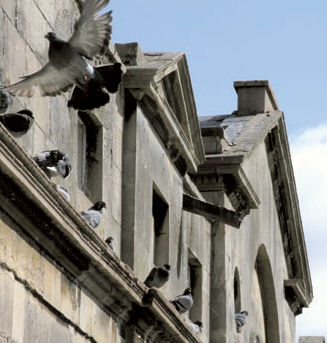
| Pigeons perching on Robert Adam's Pultney Bridge, Bath (Photo: Jonathan Taylor) |
The damage that bird fouling causes to historic buildings can be extensive. Apart from the obvious unsightliness, the main problem is acids released from their excrement. These can cause irreversible damage to building surfaces resulting in the scarring of building fabric, damaging appearance and, potentially, causing thousands of pounds worth of damage. Studies have shown that the corrosive effects can continue for a long time after the stone has been contaminated, even if the fouling is removed.
Pigeons are also known to pose a significant health risk to the public. There have been 176 documented transmissions of illness from feral pigeons to humans (Weber, 1979). Pigeons are known to harbour 60 different diseases, though only seven of these diseases can be transmitted to humans. Research has shown that aerosol transmission accounted for 99.4 per cent of incidences of disease transmission between pigeons and humans. The most commonly transmitted pathogens are Chlamydophila psittati and Cryptococcus neoformans. Pigeon droppings are known to transmit histoplasmosis, a disease which primarily affects the lungs. Histoplasmosis is caused by Histoplasma capsulatum, a fungus which grows in soil and material contaminated with bat or bird droppings.
About 99 per cent of the bird-control problems on buildings encountered by the authors of this article arise from the activities of just two species: feral pigeons (Columbia livia) and herring gulls (Larus argentatus). These birds fall into the general category of 'pest bird' species, all of which are listed on schedule 2 part 2 of the Wildlife & Countryside Act 1981, and they are therefore exempt from the protection offered by the Act.
Buildings constructed of limestone or a calciferous sandstone are most vulnerable to the effects of acids released from bird excrement. Its acidic nature is largely the product of the organisms that live on and in the excrement. Work done by Bassi and Chiantante (1976) indicated that the fungi which live on pigeon excrement are the actual cause of stonework corrosion rather than the excrement itself. The mycelium (similar to roots) of the fungi enter the stone, transporting the naturally-produced acids, which are strong enough to dissolve stone (especially calciferous stone) to form soluble salts. This process increases the porosity of the stone’s structure, allowing water to penetrate more readily. During winter, if the water in the stone interstices freezes, the expansion of ice crystals can weaken the stone and cause spalling. In addition, the soluble salts themselves cause secondary problems as they are dissolved and absorbed by the masonry, re-crystallising at the point of evaporation. This can appear visually as efflorescence, a bloom of salts on the surface of the stone. Where crystallisation occurs just below the surface, the growth of the crystals exerts pressure on the pores of the masonry causing the fabric to crumble.
The way to reduce the threat of building damage is to identify the problem bird and the main problem areas, treat and clean any fouling that may be in place, and then install deterrents that will prevent the pest bird from fouling the same place again.
There are a number of high-profile locations that have been affected by pigeon fouling. In London, damage caused by pigeon droppings to monuments in Trafalgar Square is well documented and there have been a number of reports and scientific papers on the problem. EC Harris (1996) suggested that there is a definite health risk in there being such a large population of pigeons concentrated in this location, and the damage to paving and statuary is considerable both in terms of the problem it causes and in the cost of its removal. The Historic Buildings and Monuments Commission in 1986 calculated that the annual cost for cleaning statuary was £14,000 and the annual cost for cleaning paving was £91,000. Harris found that proofing of buildings by netting or spikes was the best way to protect buildings from bird damage.
 |
|
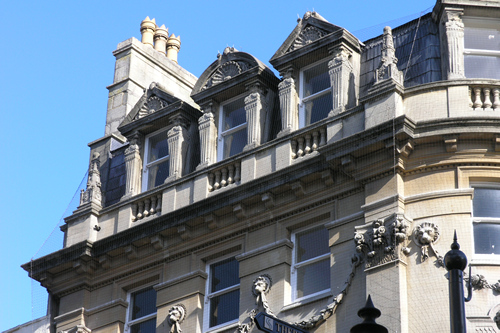
| Exclusion netting over dormer windows |
However, proofing carried out in isolation has not solved the pigeon problem in Trafalgar Square; it has simply moved it on to other buildings. Pigeons in this area exhibit what is known as an 'ideal free distribution' (Fretwell and Lucas 1970). This is an ecological term that describes the way in which animals distribute themselves between several patches of resources. The theory states that individual animals will aggregate in various patches proportionately to the amount of resources available in each patch. Pigeons will travel around Trafalgar Square and the surrounding area searching for resources: particularly feeding, nesting and roosting sites. Harris believed that it is likely that resources such as nesting or perching sites available to feral pigeons elsewhere in London are broadly similar to those in Trafalgar Square, and that the only major difference is the availability of a super-abundant and reliable source of food. Therefore, food availability is the main limiting factor of feral pigeon populations in London. Culling and providing nests so that eggs can be collected and destroyed have been proposed for controlling pigeon populations but these are controversial and more importantly not effective or appropriate in every location.
Since it is clear that feral pigeon populations in London are almost entirely controlled by food availability, if pigeons in Trafalgar Square were culled or removed, the niche left vacant by the culled pigeons would be immediately filled by other pigeons from the surrounding areas. These forms of control would not achieve the desired results. However, a combination of removing superfluous food and proofing the buildings would both reduce the population to an acceptable level and reduce damage to the buildings.
In some unique cases culling may work when there is a small population to be removed, but in terms of the protection of buildings, culling or nest removal is not an entirely effective measure.
ANTI-PERCHING DEVICES
 |
|
 |
|
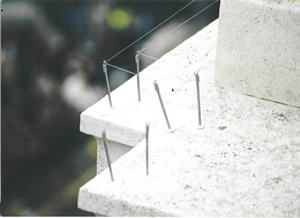
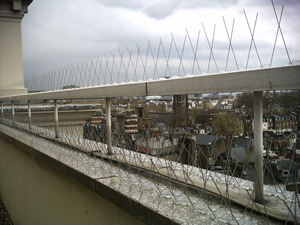
| Anti-perching
devices: top, sprung wires on vertical posts fixed to a cornice
(top) and spikes glued to a parapet and its guard rail. |
Bird deterrents fall into a number of groups: anti-perching devices and anti-entry devices. Anti-perching devices are the most commonly used method for protecting building surfaces from damage caused by the acidic components of bird fouling. These devices work by preventing birds from landing and roosting, and therefore from fouling certain areas. There are three main forms; anti-perching wire (sprung wire), antiperching spikes and anti-perching gel.
Anti-perching wire (sprung wire) is a commonly used device which is proven to be most effective in many situations. The wire consists of nylon-coated stainless steel with a diameter that is too small for either pigeons or gulls to grip. The wires are attached by tension springs to either horizontal or vertical posts. The springs cause the wire to 'bounce' when birds try to land on them, therefore disorienting the bird and subsequently putting them off landing in that particular site. The wires are relatively low in visibility and are therefore more suitable for protecting historic buildings given their ability to conform to the contours of a building. As well as being very discreet, all the components of the system are rustproof and therefore do not create rust marks on the building surface, and the plugs into which the posts are fitted ensure that rainwater does not penetrate and later damage the masonry.
Anti-perching spikes are designed to prevent birds from landing in certain areas. Spikes are most commonly used on surfaces such as the leading edges of sills and ledges. Birds tend to sit on the leading edges of these surfaces in order to look for food and at the same time foul the face of the building. However, if they are unable to do so they will only perch in this area for a number of seconds, realise they cannot get a comfortable view for seeking out food and therefore fly away. Spikes are glued to the surface using a silicone-based adhesive. The glue does not cause damage to the building surface, which it does not penetrate, and it can be completely removed at a later date if required, leaving the surface completely intact.
Anti-perching gel consists of a polybutylene gel sealed with a skinning solution. The gel never sets hard. When a bird lands on the gel its feet break through the skin and onto the sticky polybutylene gel underneath. The pigeon or gull then flies off with some of the gel attached to its feet. As the birds do not have the means to remove it, the gel will remain stuck to the bird's feet for a while and create an uncomfortable feeling. The unpleasant experience deters pigeons from subsequently landing on any surface that looks like gel. As the gel is very difficult to see once installed, it has little impact on the aesthetics of a building. However, this particular form of proofing is unsuitable for use on historic buildings because the gel tends to bleed into the stonework over a period of time, trapping moisture, possibly resulting in spalling. It also has a very short lifespan because dust and debris soon get stuck to it and absorbed into the surface. In order to maintain its effectiveness it should be removed and re-applied annually.
ANTI-ENTRY DEVICES
Exclusion netting is best suited for keeping pest birds out of central courtyard areas, and is also deployed as a screening device for features such as balconies, windows, pipework and airconditioning units.
The net's lifespan may be expected to be ten years or more, depending on the degree of exposure, as it is treated with a UV-resistant coating. In a sheltered location, some nets have lasted as long as 20 years. Mesh sizes vary with 19mm-mesh nets for sparrows, 28mm-mesh nets for starlings, 50mm-mesh nets for pigeons and 75mm-mesh nets for gulls.
Once the netting has been installed it is relatively inconspicuous and does not noticeably reduce the light reaching any windows behind it. It must be maintained regularly to keep it clear of windblown leaves and rubbish, which can create a real eyesore. An annual inspection is usually sufficient. The netting excludes the birds from the premises' voids and they have to look elsewhere for nesting and roosting opportunities.
HERRING GULLS
Herring gulls do not damage heritage buildings in the same way as pigeons. They are not vectors of disease, although they have been associated with Salmonella transmission. Generally in the urban environment they do not live in large, closely grouped flocks, although they do flock together to feed on playing fields. Gulls make a considerable amount of noise, which can be a nuisance. Gulls leave some fouling on the buildings where they nest and in the surrounding areas. This fouling can stain and damage masonry. Because they are territorial when nesting, gulls tend not to congregate close together in such large numbers or with such regularity to either nest or roost. Gull droppings don't accumulate in quite the same way as with feral pigeons. Nesting gulls can be particularly aggressive and will drive off anything, including people, they perceive to be a risk to their nest. Naturally, herring gulls nest in colonies on the coast where they compete aggressively for space. In the urban environment they generally nest in single pairs, spread over a wider area. Nest defence is carried out by males (McVey et al, 1993). Gulls form lifelong pair bonds and tend to return to the same nest year after year, and site fidelity increases with age (Elrich et al, 1988). This means that problems left unresolved become worse each year. Occasionally in urban areas, colonies of gulls have become a major nuisance where expanding nesting groups have spread over several rooftops, causing fouling, and the additional problems of noise and mobbing people.
A particular issue for residents is the gulls' habit of calling to affirm territory and the location of other gulls. This can take place from the early hours to late at night disturbing anyone in the vicinity.
Pigeon and gull control may be undertaken for many reasons, including: prevention of the spread of disease; preserving public health; safety; or, most frequently, for the protection of buildings, building surfaces and the prevention of nuisance. When dealing with historic buildings, the installation of proofing devices is better left to professional companies who can provide a high-quality product that both protects the building from bird damage and does not damage the building during the installation process or subsequent operation. While there are products, such as spikes, that can be bought and applied on a DIY basis, these are not normally approved for placement on the facades of listed buildings.
Recommended Reading
- D Channon, ‘Feral Pigeon Excrement On Heritage Stonework’, International Pest Control, 46:1, January/February 2004
- M Bassi and D Chiantante, ‘The role of pigeon excrement in stone biodeterioration’, International Biodeterioration Bulletin, 12:3, 1976
- P Ehrlich et al, The Birder’s Handbook: A Field Guide to the Natural History of Northern American Birds, Simon & Schuster, New York and London, 1988
- S D Fretwell and H L Lucas, ‘On territorial behavior and other factors influencing habitat distribution in birds’, Acta Biotheoretica, 19, 1970
- M McVey et al, Wildlife Exposure Factors Handbook Volume 1, US Environmental Protection Agency (EPA/COO/ R-931187a), 1993
- WJ Weber, Health Hazards from Pigeons, Starlings and English Sparrows, Thomson, Fresno, California, 1979