
Security and Historic Buildings
Richard Ellis
 |
|||
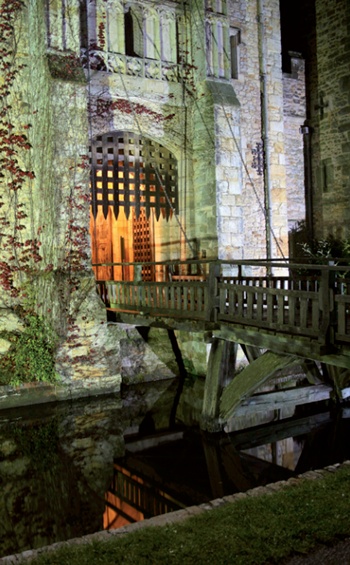
| Hever Castle, Kent: the days are long gone when the security of your property could be guaranteed by lowering the portcullis and raising the draw bridge, indeed one burglar is known to have crossed a moat at night using a canoe brought for the purpose (Photo: Guy Gentry) |
There is a story that staff at one historic house used to row around the moat on cold winter nights to prevent it from freezing, so would-be intruders couldn’t walk across the ice to break in. True or not, it illustrates the need to anticipate the resourcefulness that is now the hallmark of modern professional criminals, and the need for careful forward planning if owners of historic houses are to keep one step ahead of them.
The security of any building requires balancing conflicting priorities. With the high cost of maintaining a historic building consuming the lion’s share of resources, the security budget is often limited. A full security review carried out by a recognised expert is an excellent starting point. Although the solution favoured by the expert might be ruled out on grounds of cost, it is only through considering all the options that an owner or manager can be sure of selecting the most effective security measures available for the budget.
LAYERED PROTECTION
Security, it has been said, is like an onion: the more protective layers that have to be peeled away by would-be intruders, the longer it will take and the more difficult it will become to reach their objective. Account must be taken of the location and lay-out of the property and the value of the contents. Special attention needs to be given to the vulnerability of any collections within the property and to the likelihood of a successful attack on the premises. The security review needs to take account of rights-of-way, public footpaths and proximity to roads, all of which give easy access to potential intruders. Today, as a result of websites such as Google Earth, the remoteness of a building is no longer a defence, and once-hidden paths are visible to all.
The first consideration should be the physical security of the building. It is essential to ensure that all external doors are fitted with two mortise deadlocks and hinge bolts, providing four securing positions into the doorframe. Windows should be fitted with locking catches and where shutters exist they should be used and securely fastened with shutter bars that lock into the reveal wall. This will ensure that they provide the maximum support to the shutters should any attempt be made to force them.
Glass in windows and display cases can be strengthened significantly by the application of security films. These also reduce the risk of flying glass causing damage to the objects, and by filtering ultraviolet light they can also provide additional environmental protection for the historic collections and fabric within. It is important to use a filter of the right specification for your particular needs, so the advice of an expert should be sought.
ELECTRONIC DETECTION
It is in the area of electronic security that technology has made the greatest advances, and here the advice of a qualified electronic engineer is essential. As with all appliances, alarm systems should be regularly maintained but there is a tendency for some alarm companies to recommend an update to their existing system, without necessarily taking into account the needs of the client and the property. Before opting for an upgrade, it is good practice to first undertake a full security review and risk assessment and to seek the advice of an independent security adviser who will be able to recommend the most appropriate systems to meet your needs. For larger properties it is advisable to have not only a security review, but also a ‘statement of requirement’ (SoR) prepared by your consultant, and to use installation and maintenance contractors who have been accredited by the National Security Inspectorate to the NSI Gold standard. It is all too easy to spend a lot of money on your security system only to find that it does not deliver the kind of high quality security that you think you have invested in.
 |
||
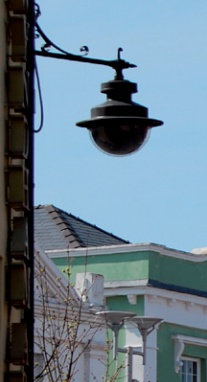
| The design of CCTV cameras for historic buildings is
always a contentious issue. Some, like this wall-mounted
dome camera, are designed to resemble traditional light fittings, albeit with limited success. |
Again, using the onion skin analogy, electronic security systems can create multiple security layers from the outer perimeter of the property to the protection of individual items in a collection. Buried pressure sensors, electromagnetic fields, CCTV, infrared, laser and wireless systems can be deployed to create the most effective early warning and intruder alarm systems.
Last year a number of country house burglaries were prevented because vibration detectors had been fitted to the windows. The would-be burglars attempted to remove the glass by cutting it from the frames but were forced to flee empty handed when the vibration was detected and the alarm raised. ‘Break glass’ alarms, which detect the sound of glass breaking, should be installed alongside internal intruder alarms to provide confirmation of a break in and information about where in the property the burglary is occurring. Such information ensures an immediate response to the alarm and can lead those responding directly to the point of entry, saving vital minutes.
CCTV AND MOVEMENT DETECTION
The value of professional advice can be seen when considering the vast range of detection and monitoring systems available. The SoR can stipulate not only the camera type, lens type, metals used and signal output but should also detail the correct cables and cable containment and which optical fibres are to be used. CCTV images need to be clear and to ‘evidential standard’ so that identifications can be made from them which can be used in court. The days of the grainy and poorly focused CCTV images that were once the staple of television programmes like Crime Watch are behind us.
The effectiveness of CCTV cameras can be enhanced by integrating them with a movement detection system, so that cameras quickly change angle to show the area where movement is detected. This type of system can use passive infrared (PIR) detectors or dual technology devices. PIR detection is achieved by monitoring changes in the infrared levels in the sensor’s field of view. A sensor activates when a person moves against a background that is emitting more or less radiation. Dual technology devices combine two independent detection technologies to sense movement, with PIR monitoring changes in passive infrared energy levels and microwave sensors monitoring the difference in frequency between transmitted and reflected microwave signals. This combination greatly reduces the incidence of false alarms because microwave detection works best when the movement is towards or away from the sensor while PIR detection is achieved when movement is across the sensor’s field of view.
Another option is lasers, which work by measuring the distance to an object, triggering an alarm or other procedure (such as moving a camera) when this distance changes. When set vertically in the roofline of the building they create an invisible curtain through which any movement is immediately detected, enhancing the perimeter security. When fitted internally they can be used to protect wall hanging exhibits. By fitting the laser at ceiling level the curtain can be set a few feet in front of an exhibit, triggering an alarm as soon as a visitor steps too close and penetrates the curtain.
When lasers are set horizontally they ‘map’ the area covered and objects within the mapped area are protected. Not only are intruders detected but should the distance between the laser and any of the objects covered by it change, for example if a statue is moved, the alarm is triggered. Lasers can also be used to protect garden statues and other architectural features. Outdoor laser detectors set vertically can create a detection ‘curtain’ some 60 metres high. Horizontal settings can create a detection zone with a radius of 30 metres and an arc of 190 degrees. The detector will map the detection zone overcoming issues for complicated area shapes. Sensors will pick up and track all movement, but the height can be set to avoid registering small animals such as dogs, cats and foxes. Sensitivity can be adjusted so that birds or rain will not trigger the sensors or, conversely, so that they will detect even small movements, which makes this type of system very versatile.(1)
STAFF AND COMMUNICATION
Another important question is: who will respond when the alarm is raised? In many cases this will be the homeowner and the monitoring company to which the alarm is connected. But for properties with their own security control rooms, such as museums, galleries and other important buildings which are open to the public, considerable thought must go into design and planning for them to be effective. Thought must also be given to the security of the control room itself because, if the room were to be targeted by intruders, the security of the entire building would be compromised. Where possible, access to the control room should be adapted to create an ‘air lock’ by securing the outer door and an inner door so that it is not possible for both doors to be open simultaneously.
 |
||
| Make use of existing window shutters, which should be securely fastened with shutter bars that lock into the reveal wall |
Control rooms are usually the points at which visitors and staff check in to a property and where the various keys to other parts of the building are held. The reception window should be fitted with bandit-proof glass with provision for communication and transactions similar to the service windows found in banks.
For any security system to operate efficiently there needs to be a staff training programme in place which not only covers the operational procedures but also ensures that all security and household staff are fully conversant with the property’s ‘disaster plan’: what to do in the event of fire or flood, how to respond to an intruder alarm and what to do if confronted by an intruder. Skills must also be maintained: training is not a one-off event.
Knowing how to respond to the various threats that a historic house can be subjected to is vital, otherwise all of the physical and electronic security in place is potentially worthless. For larger properties that open their doors to the public, the use of wardens and security guards is an important factor in the overall security of the building. Communication between the control room and the mobile staff is vital.
A system being developed by the Art Management Group called Interlink will directly link staff to their existing electronic systems enabling unrestricted mobility and instantaneous response to any given situation at a pre-determined level. The system combines bespoke hardware and software and is designed and installed to take into account the client’s current systems and control room. It can be adapted to any situation where human security resources are involved. For example, a programme can be designed to enable the mobile security staff to be linked to CCTV and/or other alarm facilities, improving levels of protection and providing a more economic and flexible use of human and technical resources. Wire-free, battery-operated movement and vibration detectors can be harnessed together so that they can be deployed rapidly and easily. (Wire-free devices are particularly suited to temporary situations, for example when an area is closed due to a lack of staff or when external scaffolding facilitates entry into usually inaccessible areas.)
The system can also be integrated with other hard-wired digital monitoring facilities, such as CCTV, by using mains wiring to transmit alarm information to a control system. Onward signalling would be achieved by using everyday network signalling and low cost web cams to supply mobile staff with up to the minute CCTV images and information on small hand held monitors, mobile telephones or similar devices with larger screen sizes.
DETAILED RECORDS AND INVENTORIES
 |
||
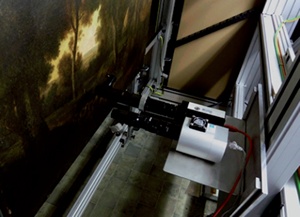
| A 19th-century landscape painting being scanned at the Art Access & Research laboratory. The scanner acquires small, high resolution infrared or visual spectrum images which are then composited into a single, large image. This highly detailed information can be used to identify stolen artworks beyond question (Photo: Art Access & Research Limited) |
An important element of the security measures for a collection is a detailed inventory, supported by high quality photographs and other information on each of the objects.
Over the last decade, systems have been developed which can acquire high-resolution multispectral images of paintings and other works of art. Now, a new generation of image scanning technology is available which is capable of operating at higher resolutions across a wider range of the electromagnetic spectrum. (Visible light is just a small part of the electromagnetic spectrum.) From a security perspective, the use of this high-resolution scanning technology ensures that the maximum amount of information is extracted about an object, enabling identification to be made with certainty if it is stolen.
Microphotography is another non-invasive technique that is recommended as a method of recording the details of an object for security purposes. Highly detailed images are taken recording the microscopic features of cracks and brushstrokes. This recorded information functions as an ‘internal barcode’, a profile as unique as DNA, which is impossible to recreate and can be used to identify the item beyond question.
SECURITY MARKING
Security marking of the objects themselves is also an option and it is acknowledged that signs stating that all objects within the property are security marked act as a deterrent to criminals by making the property identifiable and therefore harder to dispose of.
A number of security marking systems have been developed mainly aimed at tagging works through bar-codes, DNA and microdot tags and Radio Frequency Identification methods. However, these commonly suffer from a range of difficulties such as the need to avoid the removal of tags, and issues over whether materials applied conform to strict conservation criteria, including reversibility. This last issue is very likely the reason why security marking has not taken off in respect of art and antiques, although these methods are very effective for more robust objects or electrical equipment.
COLLECTION MANAGEMENT SYSTEMS
 |
||
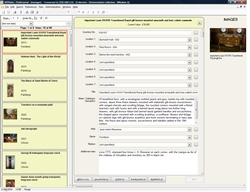
| Collection management programmes like ARTfoleo have security as well as cataloguing and conservation applications: they allow detailed information about stolen objects to be circulated quickly (Photo: Chaddleworth Software Limited) |
Finally, a number of collection management systems have been developed which can be invaluable aids for owners and curatorial staff, allowing them to maintain information and images in customised, searchable fields.
Collection management systems range from highly sophisticated applications for large institutions which can automate all aspects of collection management, from site management to the conservation of specific artefacts, to smaller scale, user friendly collection management systems for private clients.
If used effectively, collection management systems can also provide a secure management tool that enables detailed information about stolen objects, including photographs of them, to be rapidly retrieved and circulated. If the stolen objects cannot be recovered, the information can also be invaluable in supporting insurance claims. If the right security systems are in place from the start, however, this last aspect of security management should remain unused.
~~~
Notes
(1) Performance data based on the Redwall Laser Scan Detector manufactured by Optex Ltd