
Churchyard Chest Tombs
Jonathan Taylor
 |
|
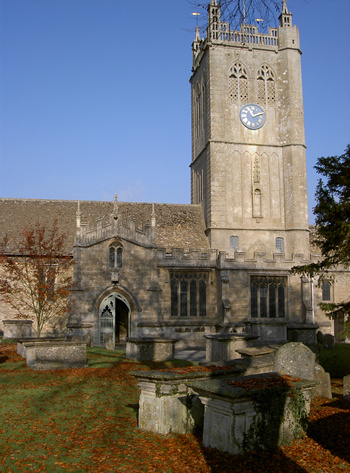
| The parish churchyard of Sherston, Wiltshire has over 40 pre-Victorian chest tombs of interest and beauty, many of them listed. |
Churchyards in this country provide a rich treasure of public monuments and sculpture, many dating from the Middle Ages. No other space in the public domain can rival these landscapes. Their value is priceless, their importance incalculable. ‘God’s acre’ as the churchyard has been called, is also often a safe haven for nature, with wild flowers, lichens and wildlife rarely exposed to modern pesticides. All this is set against the backdrop of the church itself, and provides the setting for the church, a building which is often by far the most important and spectacular in the area.
In addition to their aesthetic value and interest, churchyard monuments and memorials give a tangible connection with our history in a manner which history books can never achieve, bringing people physically in touch with their ancestors and their history, and providing clues to important (local or national) historical events which shaped our country and our landscape. Some are well visited by people from all over the country, particularly if they include memorials to famous people or if they are in areas renowned for their churches and churchyards.
This article examines one particular feature of the churchyard, the chest tomb, a type of memorial which has been used in this country for the past 600-700 years at least, and is now under threat not only from the weather, ivy, accidental damage and vandalism, but also from a lack of maintenance. Too few churches have the resources to maintain their own building, let alone their churchyard monuments.
Essentially, a chest tomb is a memorial shaped like a stone box or cist, the whole of which is above ground. The body of its subject was usually buried beneath the memorial, not in the chest itself. The chief advantage of this type of memorial is that it is more obvious than a headstone, and it provided its sculptor with five surfaces for decoration. Those commonly found inside medieval churches and cathedrals are usually topped by effigies of the subject, often husband and wife, lying with their hands clasped in prayer and provide a tantalising glimpse of the clothes and fashions of the time. Outside in the churchyard, effigies are omitted, and the chests are usually decorated on their sides only, and perhaps the edge of the lid, but there are some spectacular exceptions, such as the ‘bale’ tombs of the Cotswolds, so called because the top was thought to represent bales of wool.
A BRIEF HISTORY
Until the appearance of the railways, churchyard memorials were constructed of local stone by local craftsmen. Early designs were all individual, with a vast variety of different approaches, reflecting local custom first, and national styles second. What was fashionable in London was not necessarily fashionable in Cheshire or Edinburgh. Some fashions travelled well, but others remained local. Thus the use of such memento mori as skulls and hour glasses fell out of favour in some areas in the early 18th century, but continued to be popular in the Cotswolds and many areas of the country until the end of the century. Pattern books and designs published by, for example, Batty Langley and the furniture designer Thomas Chippendale promoted new tastes, but the polite classical and romantic forms they inspired often appeared alongside those in the local traditional style: theirs was a quiet revolution, dependent on local craftsmen to interpret their designs in local materials.
By comparison, the revolution that followed in the 19th century had the roar of a steam engine, fuelled by a vast expansion in the population, the growth of large dedicated cemeteries in the major cities, new technology for cutting stone, a national distribution network of railways, and the rise of monumental masonry as a distinct industry. Craftsmanship did not die, despite the protestations of the mid 19th century medievalists like William Morris, but it was very different.
Stylistically, it is convenient to consider the design of pre-Victorian chest tombs in three distinct periods: Tudor, Stuart and Georgian.
EARLY AND TUDOR CHEST TOMBS
The origins of the chest tomb as a distinct form of memorial are difficult to trace, since churchyard memorials are exposed and vulnerable not only to the elements, vandalism and accidental damage, but also to constant use. If there were just eight burials per year, an ordinary parish churchyard would have had 6,400 burials since the 12th century, requiring an area of at least 1.8 acres of burial space. Competition for space was therefore intense, reducing the incentive to retain and repair old and damaged memorials.
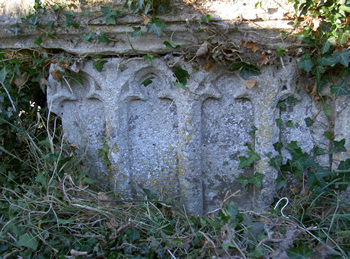
The oldest table tomb in an English churchyard is believed to be the Perceval Monument at Weston in Gordano, Somerset. According to its plaque, this is the tomb of ‘Richard Perceval, commander in the crusades, who fought under King Richard and died in 1202’. It is plain with a very thick, simply shaped lid. There are a couple of 14th century examples; one at Necton, Norfolk is unique in that it is surmounted by the effigy of a woman, and is otherwise plain; the other, at Loversall, South Yorkshire (illustrated in The Buildings of England) is superbly ornamented with fine tracery in the Gothic perpendicular style.
From these few examples it is impossible to draw many conclusions about the design of the earliest chest tombs, or how comon they were. However, there are a few more examples in the South West in the perpedicular style which are believed to date from the 15th century (one of which, at Bishops Canning, is illustrated below) and the development parallels that of chest tombs inside the church.
Fine tracery continued to be used into the 16th century, but later designs tend to be plain, or simply ornamented with geometric emblems and shields, as at Badgeworth near Tewkesbury, Gloucestershire. Another, at Podimore, Somerset has simply fluted pilasters, and the rim of its heavy lid is ornamented with dentils.
The thickness of the lid is a useful guide to the age of a tomb. It was not until the 17th century that the construction began to become significantly lighter.
THE STUART PERIOD AND THE POST-RESTORATION HEYDAY
The vast majority of churchyard chest tombs are believed to date from the 17th century onwards. Many are simply but elegantly detailed, like fine joinery, sometimes with fielded panels. Others are much more elaborate.
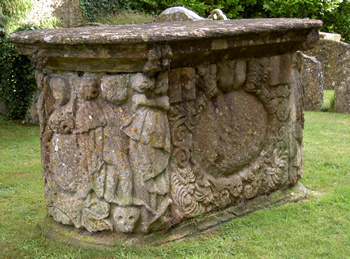
The Restoration in 1660 marks the start of arguably the most spectacular period of craftsmanship and some of the finest carving can be seen on chest tombs of the period. In some cases, every available surface was covered with ornament. In the example from Northleach, Gloucestershire (illustrated below), the ornamentation includes a skull, visible bottom right, as well as cherubs, drapery, fruit and floral motifs. Memento mori such as this were intended to remind people of the fragility of life and the importance of preparing for the afterlife. At Plemstall, Cheshire, a tomb is decorated with a complete skeleton on both sides, set in a frame with ornate brackets and the rim of its lid is heavily gadrooned (a scrolling bead-like pattern commonly used by silversmiths at this time). On one side the skeleton holds an hourglass and an arrow, and on the other a palm frond and an arrow. All are common devices on the more elaborately carved headstones and tombs of the period. The hourglass represents the passing of time (and our lives), the arrow represents death, and the palm frond is believed to represent victory over death.
 |
|
| A 15th century chest tomb at Bishops Canning, Wiltshire, decorated in relief with fine tracery in the perpendicular Gothic manner. The tomb was completely covered by a dense mat of ivy before this photo was taken. | |
 |
|
| An exuberantly moulded design from the Cotswold village of Northleach, Gloucestershire. Every inch is packed with ornamentation, including cherubs, fruit and foliage, as well as such memento mori as the skull. | |
 |
|
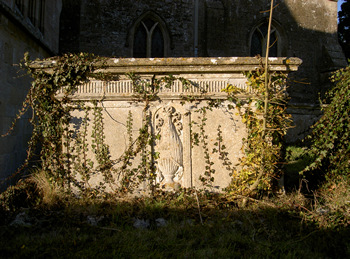
| A magnificent example of the neo-classical style, at Bishops Canning, Wiltshire. |
THE GEORGIAN PERIOD
As the 18th century progressed, designs became less exuberant, with a predominance of heavy architectural mouldings and balusters until, with the rise of palladian architecture, designs began to become lighter and more neo-classical, characterised by fluted cornices and pilasters, often with geometrical flower-like devices known as paterae where the cornice intersects with the pilasters. A form of chest tomb known as the pedestal urn emerged, with a tall, narrow chest (the pedestal) surmounted by an elegant neo-classical urn.
Traditional classical forms continued to flourish throughout the regency period but these were supplemented by a wide variety of other architectural sources, including Greek, Gothic and Egyptian – a style which proved particularly popular following victory against Napoleon at the battle of the Nile in 1805. Examples of all these styles can be seen in the new cemeteries of the major cities.
CONSERVATION
Almost from the moment they were created, these churchyard monuments were under threat from the elements. In some cases, wind, driving rain and frost rapidly erode the surface of the masonry, obliterating the inscriptions and carving. Some stone used was simply unsuitable, peeling off in layers, or crumbling away as the moisture absorbed from the rain freezes. Most tombs are pinned together with iron cramps which rust and can split the stone. Those early examples which have survived were well constructed and are the most durable. But these too are threatened, particularly by the roots of ivy and trees, if neglected.
Today, many churches are struggling to cope with maintaining the primary church buildings, let alone the churchyard monuments, with resources dwindling even faster than their congregations. Furthermore, many of the best monuments are in the ancient parish churches of small country towns and villages with the lowest populations to support them. Most churchyards now rely on volunteers for their maintenance, and often all that gets done regularly is the lawn mowing.
The importance of chest tombs is easy to overlook. Although often lavishly ornamented, they remain small structures – some even smaller as they have sunk below ground – attracting least attention. The 15th century tomb at Bishops Canning for example was recorded for the Images of England database in 2001, looking pristine. Two years later, not one inch of it was visible beneath a dense mat of ivy, and the volunteer mowing the lawn had no idea what was underneath it. Chest tombs are relatively inexpensive to repair and maintain. However, churchyards which have chest tombs tend to have lots of them. Sherston, for example, has over 40 pre-Victorian chest tombs of interest and beauty, many of them listed. For churches such as these, funding presents an almost insurmountable problem.
~~~
Recommended Reading
- Frederick Burgess, English Churchyard Memorials, Lutterworth Press, Cambridge, 2004
- Mark Child, Discovering Churchyards, Shire Publications, Aylesbury, 1982
- Margaret Cox, Grave Concerns, Council for British Archaeology, York, 1998
- Hilary Lees, English Churchyard Memorials, Tempus, Stroud, 2000
- Julian Litten, The English Way of Death, Robert Hale, London, 1991
Tomb Repairs |
SOME NOTES FROM GLOUCESTER DACGloucester, Wiltshire and the Cotswolds have, between them, the greatest number of chest or ‘table’ tombs in the country, and the Gloucester Diocesan Advisory Committee has become increasingly concerned by the scale of the problem faced in repairing and maintaining them. These notes provide useful advice. Gloucester DAC is anxious about many of the tombs in its diocese which are suffering from structural instability and general old age and dilapidation. Quite apart from being a potential safety hazard, these tombs are of obvious architectural quality (many are listed) and historical value, and more must be done to stave off their demise. In view of the pressing claims on PCC finances, the Diocese recommends that funds would be best used on those tombs which are either physically dangerous (bearing in mind the PCCs’ legal responsibilities) and especially on those which are unstable but which retain attractive carving and detailing, often in surprisingly good condition. Where, in other cases, the stonework is in an advanced state of decay, it may be that attempts to arrest dilapidation would be unjustified, and the resources better used elsewhere. We have to accept that it may not be possible to conserve all our tombs. Problems
and remedies
In many cases comparatively simple (although physically heavy) repair work may well avert disaster and give otherwise well-preserved tombs a chance of survival for many decades to come. This work needs an approach which combines practicality and sound workmanship with a sympathy for old materials. There are traditional builders and specialist stone conservators who have had experience of similar work. Appropriate methods and materials are essential. In particular, any new metal fixings must be non-ferrous, and appropriate lime mortar must be used. Vegetation needs to be removed thoroughly but with care, and this may involve at least partially dismantling the tomb in order to get at all root growth. The use of herbicides will in most cases not be appropriate, as it poses problems for wildlife, and its effects over a period of time may in fact damage the stability of the tomb. Sometimes it will be necessary to provide a new solid base for the tomb, however this should not be done as a matter of course. Levelling should only be required where the tilt of a tomb poses a threat to safety. Rebuilding of belowground structures may need archaeological supervision. Replacement of missing stone is a problem which can be approached in different ways. Limited replacement of decorative stone may be appropriate - for example to replace missing corner pillars on classical chest tombs, or missing pieces of lyre-shaped ends. It may be possible to reuse and consolidate broken stonework, but if a complete side is missing, rendered brick may be acceptable as an economical and traditional solution to the problem. It will often be helpful for the PCC’s inspecting architect to be consulted, and to discuss with the contractor or stone conservator an appropriate solution to these problems. He or she could prepare a specification for the work, or you could consider a specialist conservation report. Conservation
report Preparation of a report of this quality will usually cost at least £500 plus VAT. However the Council for the Care of Churches is often willing to cover most if not all of this cost, from its reports fund. The DAC secretary can advise on the desirability of a report in any given case. |