
Fire, Fire!
Jonathan Taylor
 |
|
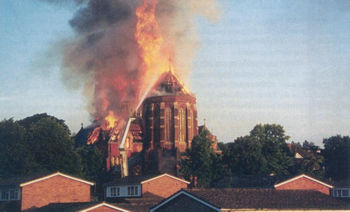
| All Saints, West Dulwich in 2000. The fire was caused by a fan heater which was left on overnight. |
Within the historic environment there can be few sights more tragic than a blazing church or cathedral. Not only is it the physical fabric of the building itself which is lost, but also the personal memories of the community which has worshipped there, in some cases for generations. It is also the loss of so much history, so quickly. Decay, by comparison, may be equally destructive, but it is slow, insidious and invisible, and when discovered there is often the hope that much can be saved. With a fire, the destruction is so much more visible.
All too often, those responsible for the church discover that the fire was caused or made worse by their own action or inaction. How would you feel if you knew that your action, or the inaction of your congregation had contributed to so much loss? It could happen. It does happen, 2,000 times every year.
ARSON
Most fires in churches in the UK are caused by accident, not arson. The insurance group Ecclesiastical recorded 64 incidents of arson in UK churches in 2001 with a total value of £4.1 million, and 67 incidents in 2002 with a total value of £1.1 million. By comparison, 1,450 incidents of accidental damage by fire were recorded in 2001 with a total value of £4.3 million, and 2,439 incidents in 2002 with a total value of £5 million. However, the cost of arson tends to be far greater. The average cost recorded by Ecclesiastical for the years 2001 and 2002 was £2,400 per accidental incident, and £40,000 per incident of arson.
Generally, incidents of arson fall into three categories; burglary-related arson, accidental vandalism and deliberate vandalism.
Burglary-related fires are generally started by the burglar on leaving the building in an attempt to cover his or her tracks. Historic churches are particularly vulnerable, as in many cases there will be times when it is obvious that the building is unattended and vulnerable, particularly if there is no burglar alarm, or if the building is open all day (and therefore with its burglar alarm, if fitted, switched off). However, a locked door is a less significant deterrent than one might imagine, as once in, the burglar has the run of the place with minimal risk of detection. A church and its contents are safest when the church is open, attended and busy.
Accidental vandalism tends to be caused by people – often children – ‘messing about’ in the building. The fire may be started deliberately, perhaps as a prank, usually without any real intention to cause significant damage. Some churches are an easy target, particularly in places where an open and deserted church offers protection from wind and rain, and well away from the supervision of responsible adults.
Deliberate, gratuitous arson, carried out with the sole aim of destroying the building or its fabric, is thankfully rare, but it remains a very real risk, as the recent fire at Peterborough Cathedral shows.
ELECTRICAL CAUSES
After arson, electrical faults are perhaps the most damaging. Many churches have not been rewired since the ‘60s and in some parts of the country pre-war wiring is rife. The scale of the problem is not known, but it is generally accepted that the quality of church wiring has improved substantially in recent decades, and that the situation is continuing to improve slowly.
The cause of the problem is as much the lack of awareness as the lack of funds. Most churches have adopted the Church of England’s excellent system of carrying out condition surveys every five years (known as ‘quinquennial’ inspections), but these tend to focus on the envelope of the building with the aim of keeping out the elements. Mechanical and electrical surveys are beyond their scope. Nevertheless, the architect or surveyor may recommend that the electrical installation or heating system is surveyed, but if the electrical system is still functioning the parish may not feel under any compulsion to do so, particularly if they have more immediate problems to attend to. It would seem that it is all too easy to overlook the importance of the electrics, not only at the parish level, but also at the diocesan level, as most DACs include specialists to advise on such ecclesiastical subjects as stained glass and bells, but electrical expertise on the DAC is much less common.
As well as faulty electrical circuits, inappropriate use of electrical equipment is also a significant cause of fire. All heaters can cause a fire in certain circumstances, and it is not uncommon to find bar fires still being used despite their obvious risk. The fire at West Dulwich, for example, (illustrated above) may have been caused by leaving a fan heater unattended.
Temporary wiring solutions are another cause of fires. An extension lead placed under a mat, for example, will eventually wear through if left there long enough, exposing bare wires; and long extension leads which are used while still coiled can heat up while under load.
CONTRACTORS
All buildings are vulnerable during building works. Naked flames are commonly used for some work, such as melting solder and bitumen, warming lead and stripping paint from timber. Many of the chemicals used are highly flammable. If these perils aren’t enough, there is also the increased risk of arson posed by a reduction in security and the availability of additional materials for a fire.
RISK MANAGEMENT AND FIRE PROTECTION
The starting point for risk management is education. Many risks can be reduced simply by good management, and cost nothing to implement if people are aware of the issues. Those which involve significant capital expenditure need to be thoroughly understood if precious funds are to be well spent. Also, not all risks can be reduced or prevented in practice, and it is important to know which issues can be dealt with, and how to approach them.
Various books and guidance notes have been produced by various organisations which are specifically written for those responsible for maintaining churches to help them through the process, and to make them more aware of the issues at stake. The Council for the Care of Churches also has an exceptional website (www.churchcare.co.uk), making essential information available to all churches wherever they are.
Quinquennial inspections and surveys carried out by insurance companies provide an additional source of information on a range of issues including electrical safety.
Arson is almost impossible to entirely prevent. Even in a busy cathedral there may be times when parts of the cathedral are unsupervised, as the fire at Peterborough showed. In a smaller parish church it may be difficult to organise constant or even regular supervision. Nevertheless, the risk of arson may be significantly reduced by making sure that the building is open to the public and attractive, ideally creating an atmosphere which suggests that people may walk through the door at any moment, even when it is empty. A church which is locked and deserted may attract more vandalism than one left open, with the lights on and fresh flowers on display.
The chance of a fire being started can be reduced significantly by good housekeeping, making sure that the ‘fire load’ in any area is kept to the minimum. Stores of paper, candles, lamp oil and other flammable material should be kept to the minimum. Waste bins should be emptied daily and dustbins should be kept away from the building. It is surprising to find that some churches still keep their lawnmower in the vestry, along with petrol and even matches.
When building works are required, the contractors must make provision for storing all flammable materials away from the church or taken home at night. They should not be stored in the church. A ban on naked flames should be imposed and, ideally, the church should be represented on site by, for example, a clerk of works, to ensure that standards are maintained.
Old boilers and chimney flues also pose a significant risk, and it is particularly important that they are checked regularly and that the flues are swept.
ELECTRICAL
Old, lead-covered cables aged badly and most have now been replaced. PVC cables which were introduced in the late ‘50s fared better, but with a lifespan of 20 to 30 years, many of these installations are now well past their sell-by date and are in urgent need of replacement. These cables are vulnerable to accidental damage and rodent damage, and should be in conduits, not run across the interior surfaces unprotected. For churches, the type of cable preferred today is mineral-insulated, ‘MICC’ cable, which is protected from fire and mechanical damage by a copper sleeve and an inert mineral insulant. These cables are extremely tough and durable, but they take longer to install and require specialist installation techniques. As a result these systems can be very expensive to install.
As the main deterrent to rewiring is cost, some alternatives to MICC cables are widely considered as acceptable alternatives. These include Pirelli’s FP200 and Draka UK’s Firetuf cables which are much easier to install than MICC, and are more durable, tougher and are more fire-resistant than PVC covered cables. However, unlike MICC, they have to be protected by conduits at a low level. This can result in ugly conduits around light switches particularly at the entrance to the church.
All electrical systems should be installed to current IEE standards by electrical contractors enrolled with the National Inspection Council for Electrical Installation Contracting, or with the Electrical Contractors Association. They should be inspected every five years in accordance with IEE regulations and an inspection certificate obtained. Appliances should be checked regularly for broken plugs, frayed cables and other obvious defects by those responsible for the day-to-day running of the church, and if a portable heater is required, only convector heaters with a thermostat should be used. Organs are another potential fire hazard.
Although the introduction of fire alarms is encouraged by discounted insurance premiums (five to 15 per cent by Ecclesiastical), the state of a church’s electrics is not reflected in the same way. Ecclesiastical is in the unique position of dealing with clients who are prepared to pay a little more on their premiums to support those less able to help themselves. As Ian Wainwright put it, ‘the needs of the few are borne by the many’. However, he concedes that there may need to be a move towards encouraging electrical improvements with discounted premiums in the future for those able to demonstrate lower electrical risk.
FIRE PROTECTION SYSTEMS
All churches should have at least two portable fire extinguishers; one with water for putting out fires of organic material such as wood and paper, and a carbon dioxide extinguisher for fighting electrical fires. These should be checked and refilled at least annually under a maintenance contract. Just as important is that the equipment is easy to find, not hidden from sight or locked away in the vestry, and that staff and volunteers know how to use it. Contact the local fire brigade for free advice.
Fires often start when nobody is around. The most important element here is early detection. Usually this will involve some form of smoke detectors connected to a local alarm on the church and by radio or telephone to a fire alarm monitoring centre, so that when the alarm does go off it won’t be ignored. In addition, in some churches it may also be possible to introduce some compartmentation to ensure that fire in one part of the building – the vestry or a store, for example – does not spread to another.
In churches, particular consideration needs to be given to the location of smoke detectors, because in a large space, smoke may not necessarily travel straight up. Point detectors like the common domestic smoke detector may be appropriate for small rooms, but large volumes are best served by either an air sampling unit or an optical beam system. Whichever system is chosen, it is important to examine the natural airflow in the building before deciding where detectors should be installed. This may be done with smoke tests.
The air sampling system involves a main fan-powered unit hidden out of sight, connected to small flexible pipes with holes along their length. If smoke is drawn into the unit an alarm is sounded. The disadvantage of these systems is that even a quiet fan can be audible in a church, and it may be difficult to install pipes without either causing damage to historic building fabric, or having an unsightly network of pipes snaking across visible surfaces.
The optical beam system involves a beam source on one side of the space and a detector on the other: if the beam is broken, the fire alarm goes off. Using battery-powered systems linked by radio to a central receiver can reduce the extent of electrical wiring.
The greatest degree of fire protection will be achieved by introducing a fire suppression system, such as water sprinklers. However, there is a natural reluctance to introduce any additional water into an historic building, particularly one which is not occupied all of the time, and the pipework required may not be easily concealed.
Fire protection systems pose one obvious means of reducing a fire risk. But they are not cheap, and it is important to bear in mind that they represent only one element of an effective fire protection strategy. Before considering installing one, it is important to look at all the risks including the use of electrical appliances and the condition of the electrical system, and how the building is maintained, managed and presented. Like so many aspects of the care of historic buildings, a holistic approach is essential.
Recommended Reading
- Francis Kidd, Heritage under Fire, The Fire Protection Association, London, 1995
- Peter Warm and Richard Oxley, Guide to Building Services for Historic Buildings, Chartered Institute of Building Services Engineers, London, 2002
- Ecclesiastical Insurance, Guidance Notes for Churches, Gloucester, 2001
- Council for the Care of Churches, Wiring of Churches, London, 1997