
Clay Plasters
Philip Allen and Neil May
Clay plasters have been used extensively in buildings in the UK and indeed all over the world, for thousands of years. Although it is not widely known, there are probably over a million buildings with clay materials in their structure in the UK, and a great many of these have clay plasters. Very often clay plasters are not recognised because they are painted or have a thin lime putty skim coat over them, both internally and externally. Many clay plasters are still performing well after many centuries, both in vernacular buildings and in higher status properties (including their use in mouldings, ornamental shields and so forth). The point of this article is to demonstrate not only that clay plasters are important historically, deserving proper repair and preservation, but also that clay plasters are a viable and high quality material for use in standard conservation and renovation work, the extension of historic buildings, and even within modern building contexts such as for new buildings in conservation areas and elsewhere.
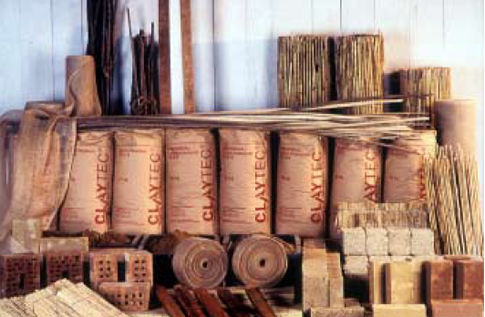
WHAT ARE CLAY PLASTERS AND HOW DO THEY COMPARE WITH OTHER PLASTER TYPES?
 |
| Clay undercoat plaster and, below, clay topcoat plaster |
 |
'Clay' refers to the binder in the plaster, just as lime, cement or gypsum refers to the binder in their respective plasters. Clay is therefore a better description than 'earth', as earth also contains aggregates and other materials which may be found in all types of plaster. The clay used in buildings is generally a graded mixture of particles in the clay and silt size ranges, which exhibit cohesion and plasticity. The clay-sized particles can be either finely ground rock or clay minerals.
The presence of the clay minerals exerts a considerable influence on the properties of the material, usually out of all proportion to the percentage content. There are various types of clay mineral formed from combinations of stacked crystalline sheets of silica and alumina. The most common minerals are kaolinite, illite, and montmorillonite. These have very different qualities due to the different arrangement of the stacked sheets and the different strength of the bond between the sheets. Basically, kaolinite has the strongest bonds (of hydrogen) and forms the most stable, least shrinkable clay, but it has weaker binding qualities and it is less hygroscopic (see below). Montmorillonite forms weaker bonds between its sheets (which are linked by water molecules as opposed to hydrogen molecules). Montmorillonite clays therefore have better binding qualities, exhibit considerable shrinkage and swelling and can absorb more water both through capillary and hygroscopic actions. The characteristics of illite clays fall somewhere between these two.
It is important to note that the clay is unfired, so it is not the same as the fired clay particles added to some lime plasters as pozzolans to make them set hydraulically. Fired clays have very different qualities.
Clay plasters (and mortars) also distinguish themselves from other plasters (and mortars) by the way that they bind and then harden or cure. For cement, gypsum and to some extent hydraulic limes, the process of curing is through a hydraulic reaction between the binders and water. For non-hydraulic limes, and to a lesser degree for hydraulic limes and cement, the process of curing is through carbonation, the conversion of calcium hydroxide to calcium carbonate by the absorption of carbon dioxide from the atmosphere. Clay plasters, however, become solid as excess water added during mixing is lost and the electrically charged surfaces of the clay particles move closer together. The relative strength of the forces of attraction and repulsion between clay particles is responsible for the amount of cohesion and binding force of clay in the plastic state and for the compressive and tensile strength in the solid state. The strength of the attraction between the clay particles can increase if the particles are brought closer together by external pressure (usually by a trowel or float, or if thrown) or if the water surrounding the particles has a higher concentration of positive ions (for example by the addition of additives such as urine). In addition to these electrostatic charges there are also capillary, electromagnetic, frictional and cementitious forces at a molecular level.
WHAT ARE THE QUALITIES OF CLAY PLASTERS COMPARED TO OTHER PLASTERS?
Clay plasters have very specific and, in many ways, unique qualities which are extremely well suited to historic building conditions for a number of reasons. These may be dealt with under the headings: breatheability, flexibility, reversibility and aesthetic qualities.
Breatheability
In terms of their ability to 'breathe', clay plasters not only
have excellent vapour permeability (a  factor of around eight
- that is to say, only eight times the equivalent thickness of
air), but also extremely good hygroscopic qualities. What is significant
here is not only the amount of moisture that can be absorbed from
the air but also the rate of absorption. In most materials hygroscopic
qualities relate to the capillary structure of the material, whereas
in clay plasters, moisture can also be drawn in and held by ionic
bonding with the clay particles themselves. For this reason the
type of clay is highly significant, as explained above. Kaolinite
clays have less hygroscopic qualities, while montmorillonite clays
have the ability to take in moisture very rapidly from the atmosphere
when humidity rises. On the other hand, burnt clay and expanded
clay have very poor hygroscopic qualities.
factor of around eight
- that is to say, only eight times the equivalent thickness of
air), but also extremely good hygroscopic qualities. What is significant
here is not only the amount of moisture that can be absorbed from
the air but also the rate of absorption. In most materials hygroscopic
qualities relate to the capillary structure of the material, whereas
in clay plasters, moisture can also be drawn in and held by ionic
bonding with the clay particles themselves. For this reason the
type of clay is highly significant, as explained above. Kaolinite
clays have less hygroscopic qualities, while montmorillonite clays
have the ability to take in moisture very rapidly from the atmosphere
when humidity rises. On the other hand, burnt clay and expanded
clay have very poor hygroscopic qualities.
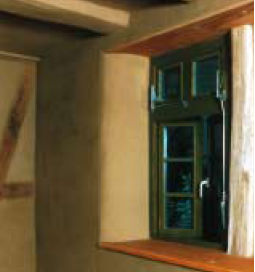 |
| Clay plasters in a historic timber frame house |
Because the rate at which clay plasters absorb moisture is much higher than that of other materials (timber, for example, takes in and releases large quantities of moisture but over a much longer period), clay plasters can act to protect vulnerable organic materials (and in particular timber) from high levels of relative humidity, when microbial and insect attack can be triggered. This can be an important strategy in the control of excess moisture in vulnerable buildings, threatened by increases in moisture level caused by showers, general indoor living, draught-proofing measures and the switch from open fires to central heating in particular. In addition to the building benefits of clay, the hygroscopic qualities mean that moulds caused by condensation are minimised, and that a relative humidity of 50 to 60 per cent is maintained. This is the ideal level for mucous membranes of the human body, and also for the control of dust mites and other organisms which affect human health.
Clay plasters also have very good capillary qualities. They actually have less capillary draw than materials like lightweight brick, and even certain cement products, but more capillary draw than most types of timber. This means that within an exposed traditional timber frame building they will draw water droplets away from the timbers. By comparison, hard renders (including those containing eminently hydraulic lime or a high proportion of Portland cement) are notorious for drawing in moisture at the crack where it abuts the timber and holding it there, causing the timber to decay.
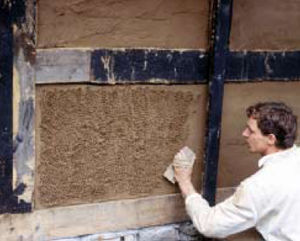 |
| Decorative clay plasterwork prior to lime washing |
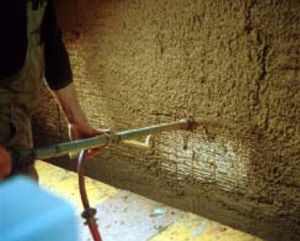 |
| Spray plastering clay undercoats onto reed boards as part of a historic bulding renovation |
Flexibility
Clay
plasters are flexible in relation to their fibre content. In this
sense they are similar to fat lime plasters. Their inherent soft
and pliable qualities mean that fibres such as straw, flax, and
hair are able to hold together the plaster without cracking in
situations of minor or gradual movement, provided there is sufficient
quantity of fibre. This is a significant quality in old buildings.
Reversibility
Clay plasters, to an even greater extent than fat lime plasters,
are reversible. Unlike lime, cement and gypsum, clay is also reworkable,
provided it is not contaminated (particularly by salts). Clay
plasters are not only easy to remove, but they do not have the
staining or caustic qualities of lime. Because of their 'breathing'
qualities they can protect more vulnerable parts of structures,
and absorb large amounts of moisture, salts and pollutants where
these are a danger - in other words, they can be used sacrificially.
Aesthetic
Unpainted clay plasters have a very particular aesthetic. Due
to the shrinkage of the clay particles on drying, the plasters
always have an open texture even when polished. This means that
light reflects and refracts on the surface in such a way that there
is always variation and never a gloss sheen. This is particularly
noticeable in the modern self-coloured plasters that are becoming
more commonly available.
CLAY PLASTERS IN PRACTICE
Earth materials were used extensively in historic buildings of all sorts prior to the 19th century. Their disappearance was partly an effect of the separation of agriculture from construction as a result of the industrial revolution. The disappearance was not because the material was considered primitive or inadequate in any way, but because of the changing economic conditions of the time. This is an important fact to remember when looking at clay plasters in practice. These are not primitive materials, even if they are not synthetic or a result of high energy processes. Similarly the raw ingredients are not simple, even if they are commonly available.
Clay plasters have many complex qualities and require a proper understanding. Given that understanding, they can perform very effectively, and are durable and attractive.
Preparation
Clay plasters can either be made from local soil, or can be bought
in a proprietary form. If in a proprietary form, they come dry
bagged and are mixed with water to a plastering consistency, prior
to application. If the plasters are being made on site or from
local material, a number of issues must be addressed, such as
the type of clay, the size of aggregate, the proportion of clay,
the even dispersion of clay (a problem if the clay is wet), the
addition of fibres and many others. If this approach is to be
taken, then soil analysis, good crushing and grinding machinery,
possibly drying machinery and a lot of patience and knowledge
are required. All clay plasters can be stored dry indefinitely.
If already mixed up with water the only material that will go
off will be the fibre, and this will take several months.
Application
Clay plasters may be applied like any other plaster, by hand or
by spray application. As with other plasters, background suction
must be carefully controlled by wetting it, but without saturating
it, and for top coat application the suction should be even across
the surface. A very important point to note is that clay plasters
should not be over-wetted during the plastering process. Too much
water will increase the shrinkage on drying and then the plaster
will crack or powder when it dries: lightly wetting just prior
to application and then working wet on wet is the best strategy.
 |
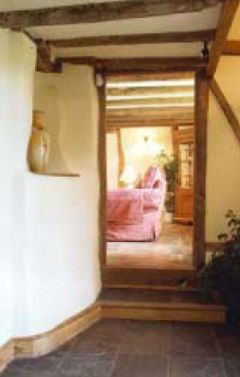 |
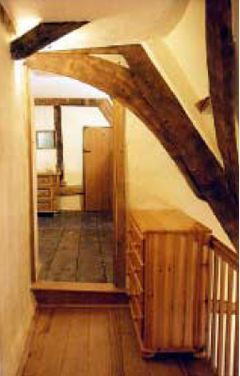
| A 15th century mixed timber frame and stone house in Garsington, Oxon, built originally with clay mortars and plasters throughout and renovated by Neil May Builders in 1999, using entirely clay undercoat and topcoat plasters. | |
Clay plasters cure by the evaporation of water. If there is insufficient background suction, heat or air movement then they will not dry, but will stay soft. After some time moulds may also develop, particularly if there are natural fibres in the plasters. This is natural and can be reversed by carefully controlling the temperature and the amount of ventilation to improve the drying conditions. However, if there is too much suction, heat or air movement the plasters can dry too quickly and this can cause a separation from the substrate, and powdering of the surface. If this occurs then the product can be reworked as appropriate, either on the wall, or by being removed, knocked up again with water and reapplied.
If a mesh is required then hessian or glass fibre is best. Metal beading (galvanised or stainless) can also be used, but the heavy metal beading common for gypsum plastering is not suitable. On angle beads in particular a thin wire bead should be used and the clay plaster should cover the corner bead entirely. For 'tight', less open grained plaster finishes a fine slightly damp sponge is used to consolidate the clay. For polished finishes specialist plastic trowels are used. If a steel trowel is used at this stage then the clay can be disfigured.
Limitations
and protection requirements
Although clay plasters and renders are more vulnerable than lime
renders if incorrectly detailed and protected, they can be used
in all locations internally and externally without protection
except where they are subject to direct spray. When used externally
they do need a limewash or a fine lime plaster skim to protect
them against driving rain, depending on levels of exposure. Rain
resistance can also be substantially improved by controlling the
proportion of clays and fibres in the mix, and by additives such
as casein.
Where exposed to direct spray internally (for example in showers, just above sinks and in other vulnerable areas), it is necessary to use tiling or some other impermeable material. It is also suggested that timber is preferable to clay plaster for lining the reveals around cold windows where condensation occurs frequently on the frames. Where clay plasters get wet only occasionally, then a coat of casein or silicate paint, or limewash is usually sufficient protection.
Clay plasters
can also be coated with matt emulsions and other more conventional
paints, so long as these paints are reasonably vapour permeable
(a factor of no more than 300). However, a build up of successive
coats of emulsion will reduce their permeability, and rubbing
down between coats can abrade the surface of the plaster. Non-vapour
permeable coatings and harder coatings will cause problems in
the long term for the plasters, and obviously affect their breathing
qualities. Clay plasters have good impact resistance, equivalent
to that of many lime plasters, but they are not robust enough
for all situations. Where a wall is subject to hard use or frequent
impact (such as in an entrance lobby or at floor level for example)
skirtings, dado rails, or panelling should be used.
Clay plasters are often overlooked or even purposely ignored in the repair and conservation of historic buildings. The reasons for this are partly a lack of understanding about the technical qualities of clay and partly a lack of available (clay) materials for repair. These reasons should no longer be regarded as valid, however. It is vital for both the technical performance and the integrity and character of historic buildings that clay plasters and renders are respected, preserved appropriately and repaired where necessary with authentic (like for like) materials. It is to be hoped that, in the not-too-distant future, clay technology will, once again, become a major part of the preservation of our historic building heritage.
Recommended Reading
- Gordon T Pearson, Conservation of Clay and Chalk Buildings, Donhead, Shaftesbury, 1992
- Gernot Minke, Earth Construction Handbook, WIT Press, Southampton, 2000
- Hubert Guillard and Hugo Houben, Earth Construction, Intermediate Technology Publications, London, 1994