
Clay-tiled Roofs
Stephen Boniface and Tony Redman
 |
|
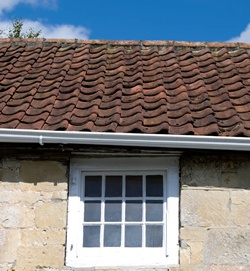
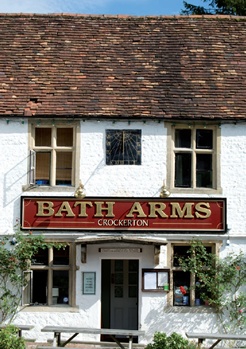
| Pantiles on a Georgian coaching inn in Wiltshire |
There is plenty of evidence that the Romans used clay tiles extensively on their properties. Although the use of clay tiles diminished somewhat during the Saxon period, by the 12th century there are records of clay tile use being encouraged particularly in place of thatch for fire safety. The size of tile (10½" x 6½" x ½") was standardised in 1477.
In the early years the use of clay tiles, like many other building materials, was limited by cost. Nonetheless, for those who could afford it, clay tile was often the material of choice.
Another limiting factor was transport. Prior to the advent of mass transportation systems it was rare for clay tiles (or any other materials) to be transported any significant distance, typically not more than a day’s cart journey. Exceptions were made for the roofing of churches and the homes of the very rich, who often had access to clay fields and kilns further afield, and employed the labour, which made the costs much cheaper.
As a result the pattern of clay tile usage correlates closely with the areas in which clay and ‘brick earth’ are found, and it is perhaps not surprising to find that the manufacture of clay tile from the later medieval period was closely aligned to that of brick-making.
By the late medieval period a more stable social, economic and political climate resulted in an increase in wealth, generally enabling more people to afford materials such as brick, glass and indeed clay tiles.
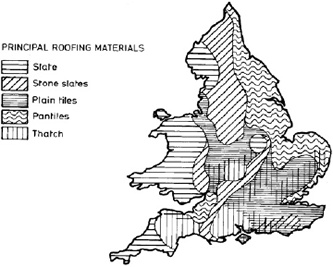
From the 17th century clay tile became the ubiquitous roofing material for large parts of the country where the raw material was close at hand – mainly the southeast and east of England and the Midlands.
 |
|
 |
|
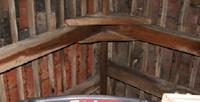
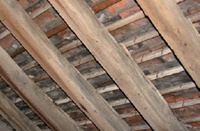
| Modern nib tiles (bright red) and peg tiles hung
on nails are visible in the top picture (although
quite a few
have no fixings). Below, the nails
used to fix the peg tiles
can be seen more clearly. |
Greater wealth in the 19th century, improved transportation and the introduction of taxation on fired building products such as tiles and bricks to fund the Napoleonic wars led to a reduction in the use of clay tiles and the increasing use of other roofing materials, particularly slate. However, it was the advent of the railway more than anything else that caused the roof map of England to change from red to grey. During the 19th century slate tended to be cheaper and thus it overtook clay tiles as the roof material of choice for the rapidly developing urban landscape.
During the 20th century mass-production of machine-made clay tiles resulted in a resurgence of clay-tiled roofs, particularly during the inter-war period. However, increase in competition from man-made tiles such as concrete tiles and man-made slate resulted once again in a downturn in the use of natural clay tiles. In more recent years homeowners have rediscovered the beauty of the material and there has been something of a resurgence in the use of handmade clay tiles.
The tile typically found throughout this period is the double-lap tile (one where the overlap between courses of tiles is greater than the length of a tile) but one should not forget the single-lap tile where the tiles interlock at edges only. Although today we are used to seeing the single lap tile in the form of concrete roofing materials, the history of single lap tiling goes back many centuries. The most common form is what we generically refer to as ‘pantiles’. These should not be confused with genuine Roman tiling, which in fact has not reappeared in any significant manner in this country since the 4th century AD.
The use of pantiles is not as widespread as clay tiling generally and it tended to focus on the eastern side of the country. Records indicate that pantiles arrived somewhere around the 17th century, with home-produced pantiles appearing from about 1700. Because the tiles were originally imported, their distribution tends to focus on the ports of the eastern seaboard. The exception is Bridgewater in Somerset, where pantiles were certainly established by the late 1750s and where a prolific pantile-making industry later emerged, supplying tiles throughout Somerset and the neighbouring counties.
MANUFACTURE
 |
|
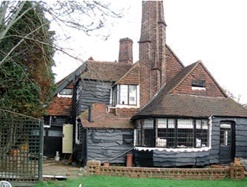
| Peg tiles cover the roof slopes of this Arts & Crafts house in North London and hanging tiles cover its gables. |
The manufacture of clay tiles is relatively straightforward. Traditional handmade tiles are a mixture of clay with aggregates rolled out and cut or moulded to simple rectangles (sometimes shaped) with two holes at one end for fixing. These are then fired in a kiln. Sometimes the ends were extended at right angles to form a nib, but the majority of clay roofing for many centuries was simply a baked clay rectangle.
Due to the firing, flat tiles would come out slightly convex and this added to their character. Uneven temperatures in the kiln and the nature of the hand-making process also contributed to variations in shape and form, and the quality of the clay resulted in rough and therefore textured surfaces. The colour would be determined partly by the clay and the mix of aggregates but also by the temperature and length of firing in the kiln.
Sometimes shaped tiles were produced and occasionally glazed tiles and pantiles can be seen. During the Victorian period there was much experimentation and occasionally one comes across multi-coloured examples. With modern machine-made tiles, dyes are added to bring greater consistency of colour.
FIXING
Plain clay tiles are laid in regular courses with each tile lapping two others, leaving approximately four inches exposed. The precise method of fixing depends on the nature of the tile itself. In the case of the more basic form of tile, simple tapered wooden pegs were pushed through the two holes at the top of the tile so that the tile could be hung over battens fixed horizontally across the tops of the roof rafters. The tops of the pegs would be trimmed flush to the surface of the tiles so that the next course would lie flat.
 |
|
 |
|
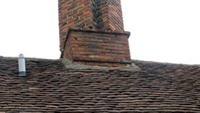
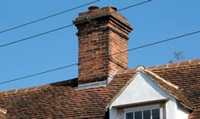
| Mortar fillets are commonly used at the junction between peg tiles and a chimney (top), but lead flashings (above) are much more reliable. |
Lime mortar, sometimes with straw and
other aggregates, would often be applied to
the internal face of the tiles to fill the gaps and
help improve the general fixing of the tile. This
mortar fillet is often referred to as ‘torching’.
On many roofs the pegs would be limited to
only one per tile. Indeed, roofs can often be
seen with no pegs at all, or at least pegs only in
occasional courses. Although this can be due to
the pegs rotting away, sometimes tiles were laid
bedded in lime mortar with no pegs. In such
situations the fixing of the tile relied as much
on friction and the weight of tiles above as on
any torching or mortar bed.
If a tile had been made with nibs these would be used to hang the tile over the batten, and pegs would not be required. With modern tiling the nibs themselves have holes to enable nail fixing to the battens, although not every course is nailed in place.
As the use of slate increased, the need for nails to fix them also increased. The consequent increase in the production of nails resulted in their increasing use to fix clay tiles as well: nailing was quicker and avoided the need to trim the timber peg before laying the next course.
Today we find a wide variety of tiles
available to us, including
traditional peg tiles
but also handmade tiles with nibs to facilitate
fixing.
TYPICAL DEFECTS AND REPAIRS
It is often said that clay tiles have a limited life of up to 60 years or thereabouts. However, walking around the countryside you will often come across peg-tiled roofs that are several hundreds of years old, so this is clearly not a reliable guide.
The failure of the tile itself will depend on many different factors, including the original manufacture, the make-up of the material within the tile and its firing in the kiln.
 |
|
| One of the most common problems of a tiled roof is slippage due to rusting metal fixings and decaying battens. The best solution is to re-lay the tiles, salvaging and reusing as many of the originals as possible. The alternatives (see below) can be disastrous. |
Because tiles are much thinner in section than brick, they are less susceptible to variations in firing. Nonetheless, there will always be some tiles that are from the cooler parts of the kiln and therefore more vulnerable to early failure, particularly as a result of frost damage. That said, as a rule handmade tiles tend to have great durability and, if well-fired, tend not to be particularly vulnerable to frost damage. Only after many years will the best examples eventually weather, exposing the softer and more porous clay body below to frost damage.
Other factors which can influence the longevity of tiles (and, in fact, any roof covering) will be the orientation of a building, the steepness of the roof and indeed the microclimate around the building. Clay tiles are best used on roof pitches of 40° but some single lap tiles can be used down to 25° pitches.
Other more controllable factors include such matters as tree branches brushing up against the roof covering and dislodging or breaking tiles, climbing plants being allowed to grow over and into tiling to dislodge and damage it, and clumsy workmen treading on the tiles.
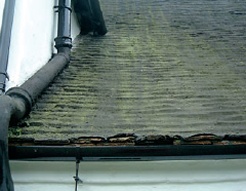
Due to the rough texture of a clay tile surface it is likely to harbour lichens and mosses. These plants should not necessarily be regarded as harmful. Although lichens produce acidic secretions and moss can hold moisture and lead to frost damage, they are unlikely to cause much damage. Indeed moss can provide a protective layer and lichens contribute to the characteristic colouring of tiled roofs. However, significant moss growth can increase the weight on the roof structure generally, and when it dies and rolls into the gutter it can cause quite serious gutter blockages.
If moss is to be removed, care should be taken. Simply pulling moss from the roof surface is more likely to cause damage than by letting it die naturally or by appropriate chemical removal means (biocidal treatment). However, care should be taken with chemical removal methods to ensure that the chemicals do not run down to the gutter and into the surface water system.
The defects that most often affect tiled roof coverings are in fact the sort of defects that affect all roof coverings: failure of battens (rot, woodworm etc); failure of the batten fixings (nail corrosion); deterioration of the tile fixings (rotting pegs, corroding nails or crumbling torching); failure of or defects to the roof frame; defects to perimeter details (soakers, flashings, etc); defects to roof details (valleys, verges, eaves, etc); and wind uplift.
 |
|
 |
|
 |
|
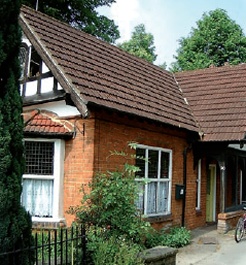
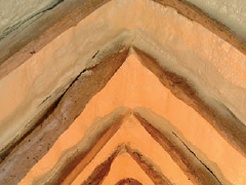
| Modern interlocking concrete tiles spoil the appearance of a small lodge (top), while the ‘turnerised’ coating of hessian and bitumen (centre) not only looks awful but traps moisture and invites frost damage. A recent development, spray-on foam (above), may secure the tiles, but this too traps moisture and is extremely difficult to remove, making it unlikely that any of the original tiles on this roof will ever be reused. |
Problems that can affect the tile surfaces, apart from those rare occasions when moss or lichen cause damage, are usually brought about by matters such as pollution, the premature failure of poor quality tiles, saturation from leaking pipes or drips from overhanging details such as TV aerials.
Frost damage can occur where moisture is retained on the surface and this sometimes happens at the laps. Sometimes localised frost damage can cause a tile to break at the head lap. Machine-made tiles are particularly prone to frost damage as the surfaces are more even and regular, enabling moisture to be trapped on the underside. Handmade tiles on the other hand have a natural variation which is both less moisture-retentive and more pleasing to the eye.
Other problems can arise due to poor laying in the first instance. Such problems include inappropriate detailing at verges and hips, poor setting and laying of the ridge and poor detailing of abutments such as chimneys and walls. Abutments need particular care. Local vernacular may dictate the use of tile creasings, or else mortar fillets, or lead. Lead flashings are usually the more reliable and mortar fillets the least. Whichever detail is used, lead soakers should always be incorporated between each tile to resist the passage of rainwater horizontally.
Another common failure with clay-tiled roofs is brought about by the failure of the fixings or battens due to rot or rusting. The battens often use sapwood, which is much more vulnerable to decay than heartwood. Pressure-treated battens should always be used for repair and replacement. If care is taken, many of the tiles themselves can usually be salvaged and reused. A word of warning, however: because peg tiles tend not to be pegged every course and therefore rely on friction and/or the torching, there is a risk of mass failure and slippage if a careless roofer steps onto the roof. Before attempting to repair a clay tile roof it is important to check the fixings below in case the attempt at repair itself causes more damage.
When repairing a tiled roof it is important to obtain as close a match as possible to the original in terms of texture and colouring. Non-ferrous fixings should be used to reduce corrosion risks. Any lime torching should be continued across new areas of work, and with the existing torching properly reinstated.
Most roofs can be satisfactorily patch-repaired rather than having to be completely stripped and re-covered. However, if complete re-covering is to take place, every attempt should be made to salvage the tiles and as a rule of thumb one would hope to salvage approximately 70 per cent.
Complete stripping and re-covering requires the new work to comply with building regulations, and this would often mean the use of a lining over the rafters beneath the battens and tiles. Such linings restrict airflow into the roof space, and the roof space then has to be positively ventilated or a modern breathable lining used.
It should be noted that where there is a double-lap roof covering, a lining is not strictly necessary for weathering purposes. Homeowners often attempt to line a roof because they believe it to be appropriate or perhaps to stop unnecessary draughts. However, attempting to line a roof from the underside (within the roof space) can lead to a number of problems. Because the lining is then not laid over the rafters it will direct any penetrating water into the eaves where it will cause rot and damage. Careful thought and installation is needed with regard to retrospective lining and it is best avoided.
In recent years there has been an increase in the use of expanded foam applications to the undersides of tiles. These are often marketed as providing a solution to insulation problems, securing loose tiles in place and reducing draughts. However, the use of such material should be viewed warily and it is suggested that such material should be regarded as a last resort only, particularly for historic buildings. Foam stuck to the underside of the tiles means the tiles cannot be salvaged for re-use at a later date. The practice also makes it very difficult to undertake patch repair in future because of the difficulty in getting individual tiles out. There is also a possibility of reducing the life of the tiles or slates if they are a bit porous, as it reduces the evaporative surface area: water absorbed when it rains will no longer be able to evaporate from the lower surface. The risk of frost damage is therefore greater.
 |
|
| John & Jane Penoyre, Houses in the Landscape, Faber and Faber, 1978 |
Spray-on foams also perform poorly as a means of insulating roofs. The blocking up of ventilation and the lack of a moisture barrier can lead to condensation problems. Building regulations require a ventilation gap above insulation or a vapour membrane under the insulation, but with spray-on foams neither are provided.
From an aesthetic point of view these foams can also be a problem, as it is often difficult to prevent the foam spilling out between gaps in the tiles (particularly pantiles). Such foams are therefore a short-term form of repair that could increase the long-term cost of later work. If tiles are slipping it is better to undertake a proper repair.
Of course these negatives should always be balanced against
the
difficulty of access and perhaps the expected future lifespan of the roof.
If the building is listed, however, such work would require consent and
many conservation officers would probably refuse consent for use of such
products.
Traditional clay tiles create beautiful roof coverings that are full of character due to the individual nature of the tiles. Provided they are carefully and properly maintained there is no reason to expect them to perform poorly. Many of the typical problems found can be resolved without loss of the tile itself. Before embarking on any work to a roof seek professional advice on what is required. If altering or extending the roof of a listed building, ensure the appropriate consent has been obtained.