
Cleaning Decorative Plaster
Richard Ireland
 |
|
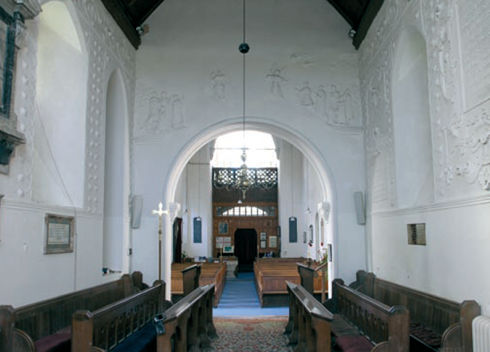
| 17th century plasterwork at St Mary's, East Knoyle, Wiltshire. Some of the figures were vandalised by Roundheads during the Civil War, and the rector, Dean Christopher Wren (father of the pre-eminent architect), narrowly escaped jail for creating them. |
Paint removal from enriched architectural surfaces is a sensitive area. Firstly, removal erases the historic record embodied in the paint layers. Secondly, physical damage to the underlying material can and often is caused by either the cleaning agent or the tools used. Where plasterwork is concerned, no matter how sensitively undertaken, removal of softened paint with conservators' tools inevitably damages surfaces. Leaving well alone is often more beneficial to overall preservation. The harm caused to important underlying decorative schemes and mechanical damage far outweigh the benefits of any aesthetic reinstatement or dressing up. Nonetheless, excessive paint build-up obliterates fine decorative detail, transforming the finest ornament to dull and pedestrian shapes of little interest to all but the most knowledgeable viewer. Removal can revitalise and uncover technical virtuosity and re-ignite both public and scholastic interest in decorative interiors that might otherwise languish in obscurity or, worse, fall prey to neglect and decay. As with all interventionist conservation, perceived benefits and risks must be carefully weighed up.
On outer walls and other surfaces subjected to persistent condensation or moisture ingress, applied coatings may be acting as a barrier to evaporation. As a result, evaporation concentrates at any cracks or gaps in the paint and at the edges of the painted area, causing high local concentrations of salts. Sulphate salts, for example, can be leached from later cement renders and internally from gypsum, leading to eruption of salt crystals at the plaster and paint interface.
Increased moisture levels in the plasterwork may also lead to rusting and expansion of ferrous armatures and possible fungal attack of organic materials. In cases such as these, paint removal can be essential to arrest the rate of decay and reduce loss of plaster enrichment. Before undertaking such an irreversible step, it is essential that a responsible programme of recording be undertaken using photography and microscopic paint analysis. A small section of the full paint thickness should also be retained in an appropriate area of the plasterwork for future reference and investigation.
Where salt attack is particularly severe, it is worth undertaking salt analysis prior to paint removal. In one instance the removal of paint from early 17th century plasterwork led to the sudden crystallisation of salts, hitherto in solution as the structure dried out. The result was the rapid erosion of the plaster surface and the irretrievable loss of decorative plaster. In such cases paper pulp poulticing may be the only means of ameliorating damagingly high salt concentrations without physical removal of the plaster.
Where paint removal is undertaken, the use of methylene chloride (such as Nitromors Green Label) is controllable and effective on organic coatings such as oil based paints and modern coatings, leaving the inert lime and gypsum plaster chemically undamaged. The translucent liquid and thickening waxes incorporated in these cleaning agents do not obscure the work in hand, enabling the conservator to proceed with care. Importantly, if this process is carried out with the necessary care and skill, any particulate residues may subsequently be removed with nothing more than a gentle dusting with a soft bristle brush.
Alkali pastes in particular should be avoided, especially on porous historic fabric. They can inflict great damage to plasterwork. Not only does the plaster absorb potentially harmful soluble salts, but there is also an increased risk of physical damage from tools due to the thickness and opacity of the paste which blind the conservator to the enrichment. Lack of chemical control and the necessity to wash away residue with water should be enough to suggest their use has no place in the treatment of historic surfaces.
 |
|
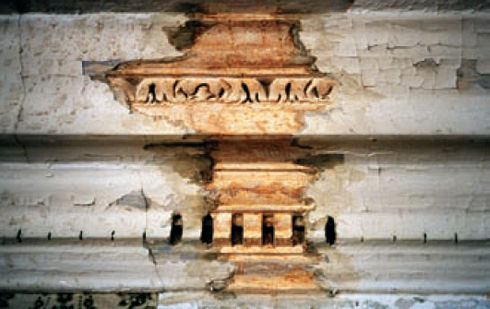
| The fine detail of a Georgian cornice obscured by paint |
Some coatings, such as casein-bound distempers, have little or no organic binder and may prove particularly difficult to remove safely. In these cases water and small tools may prove to be the only effective method of paint removal. Other techniques such as the use of heat and steam generally lack sufficient control for them to be considered for use on delicate historic fabric. It must also be accepted that no matter how desirable, in some cases paint removal is neither practical nor feasible.
Other common problems associated with paint removal include the uncovering of poor repairs and previous intervention which must be subsequently dealt with. Examples are poor cast reproductions of existing elements, often reinstated on a shoe string budget following large scale failure in the past, such as war time bomb damage.
Papier mâché, composition or other fragile and organic-rich applied decorative elements may also be present, especially on 19th century work, which might be destroyed by an otherwise acceptable paint removal technique, so it is vital to investigate what is being dealt with prior to specifying work, let alone commencing work.
Test areas and trials of any suggested technique are essential to ensure the suitability of any chemical agent, the skill of the operatives, the quality achievable and the effect on the plasterwork and adjacent related substrates and coatings. Programme time available can also be a decisive factor and should not be dismissed from the equation.
DECORATION
Decorative coatings fulfil two particularly relevant functions. One is purely aesthetic, relating to colour, texture and overall visual qualities, like opacity and transparency. The other is performance related and how the coating functions physically. Factors of relevance here include permeability, compatibility, durability, flexibility, reversibility, protection, weight, thickness, surface tension, drying, ageing, preparation requirements and the number of coats required. Added to this are the means of application and the cost.
In the field of conservation it is usual for historic fabric to be repaired and reinstated on a like-for-like basis, using materials and techniques that match those used originally as closely as possible. However, where plaster is concerned, renewing the original finish may be desirable, but it may also be impractical for a number of reasons. In some cases the choice of coating is dictated by circumstance; in others, the options may be less clear cut. In any event, the conservation and preservation needs of the fabric should be foremost.
For example, soft distemper (a chalk-based paint with a binder of size) can be applied by brush to a newly stripped ceiling of especially deep and fragile modelled plasterwork to recreate its original colour and texture authentically, using water soluble reversible materials. The bonus is a surface that can be readily cleaned when its details eventually become clogged with paint again. Such an approach presents a beguilingly straightforward, ideologically sound conservation solution.
However, the water soluble stains that inevitably accumulate in the plaster from persistent moisture ingress may be impossible to cover without the use of an impermeable solvent-based sealing coat. Yet impermeable paints are generally undesirable, particularly where future risk of moisture ingress cannot be precluded. Moreover, brush application carries a high risk of further mechanical damage to delicate and fragile ornament. At least three coats of distemper may be required to achieve satisfactory decoration. What of later maintenance or redecoration? Water soluble reversible coatings like distemper will, at some stage, require mechanical removal with brushes prior to further redecoration. This too subjects fragile modelling to the certainty of further damage and loss. It also imposes a responsibility and duty of care that the owner of the building may not wish to shoulder. This can result in the later overcoating of all the good work with a totally inappropriate, easier to use coating that starts off the cycle of decay all over again.
In many instances, it may be more beneficial to spray using a variable 'high volume low pressure' (HVLP) turbine. Spraying precludes further unnecessary physical contact. Coating thickness can be better controlled on intricately detailed plaster and redecoration intervals may be extended by specifying a coating with the most appropriate attributes.
 |
|
 |
|
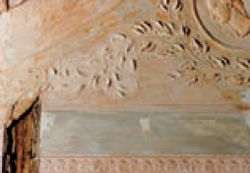
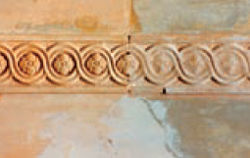
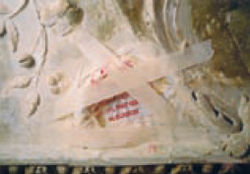
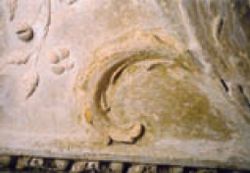
| The removal of paint does not always reveal the fine finishes expected. Bad repairs may also lurk beneath the paintwork. | |
 |
|
 |
|
| Proprietary paint removal systems can damage fine plasterwork by introducing harmful salts, and the thickness and opacity of some pastes blind the operative to the enrichment beneath, reducing control and making them difficult to remove safely. |
Many specifications needlessly emphasise 'breathable' coatings in the misguided belief that this equates to conservation and a responsible approach. Although vital when applied to bare surfaces subject to continued moisture vapour movement, permeability is an irrelevant attribute when applied over impermeable systems.
'Reversibility' is also frequently specified, and in general specifications the term is taken to mean soluble in water. This attribute may not be a good thing when used in close proximity to fragile existing coatings that may be easily damaged or altered by water, and it can easily be avoided by using a non-traditional coating which is soluble in a synthetic solvent. Advice should be sought to ensure that specifications adequately account for the real needs of the historic fabric. Oil paints may be less than a fifth of the thickness of modern emulsion paints. At Castletown House near Dublin, microscopic paint analysis has revealed two modern emulsion decorations accounting for more than 70 per cent of the total thickness of the previous oil painted schemes since the house was begun in 1722. Generally, much of the heavy paint build up on plasterwork today is a product of the late 19th and 20th centuries.
Limewash, a simple dilution of lime putty with water, coloured with the addition of alkali resistant pigments, is eminently suited to lime renders, externally or internally. It should be applied sparingly as a wash, as a thick paint-like coating is liable to fail and flake. Water based and equally vapour permeable is soft distemper, which is for internal use only. Although perhaps the most common plaster finish well into the 19th century, and easy to remove, it may not always be the best choice for conservation work. In particular, the use of oil and casein bound distempers are precluded by their thickness and the difficulty of subsequent removal. Their additives are intended to decrease dusting while increasing permanence and durability rarely suiting them for use on pure conservation grounds.
Despite coating thickness, there is much to recommend the use of 'contract' emulsion paints particularly when applied to patch repairs in plain run mouldings and flatwork, where sharpness is not an issue. These materials have the highest vapour permeability and are specifically formulated for use on new plaster. Not only are they relatively cheap and widely available, crucially they are alkali resistant. This makes them eminently suitable where the use of lime repairs precludes the use of oil paints for a minimum of 12 months: the time necessary to ensure sufficient carbonation of lime and reversion of the surface to a neutral ph to avoid a reaction (saponification). Vinyl emulsions do not have the higher vapour permeable qualities of contract emulsion. Invariably vapour permeability decreases with an increase in gloss and weather resistance for modern water thinned products of this nature.
Oil paints may be restricted by programme time, as noted above, requiring a full 12 months before application direct to any new surface containing lime. This also applies to modern alkali resistant primers whose use will not generally be endorsed by manufacturers without a similar time lapse. Another alternative is Classidur Super Classic, which originates from Switzerland. This is a non-conventional solvent-based system which has a number of attributes that suit it particularly well as an alternative to distemper for interior decorative plaster. Chiefly these include lack of surface tension with high vapour permeability, a very matt finish, which can be tinted to the same intensity as distemper, and the minimal number of coats required. Indeed, soot, nicotine and most other water and oil soluble stains can be painted over without priming or sealing coats, and its high opacity allows strong colour changes in only two coats. The minimal preparation required and lack of tension especially suit it to badly stained substrates and fragile existing coatings. Care should be taken for persistently damp areas as mould resistance may not match that of less organic coatings such as whitewash and limewash, especially in relation to large volume spaces like churches.
Silicate paint, such as Keim mineral paint, is another coating originating from overseas, appearing in Germany in the late 19th century where its use has a strong tradition. Although there is no tradition of its use in the UK, the material is widely specified, particularly for use on external renders. It is irreversible and so should be specified with care in situations where its particular attributes will be beneficial to the conservation of the fabric. It should not be used simply as a low-maintenance substitute for limewash.
PRINCIPLES
The treatment of any culturally important historic building or artefact is necessarily encumbered with a multiplicity of opposing needs. Ultimately, preservation is paramount to serve the needs of enlightenment, education and the wider enjoyment and appreciation of the past. Inevitably, the very act of conservation is interventionist, having far reaching consequences on the continued survival of an object, so all unnecessary alterations should always be avoided.
Addressing this issue is especially pertinent when considering the removal of paint from plasterwork. An easy decision when coatings are actively assisting decay, the pros and cons are much less defined when removal is proposed for largely aesthetic grounds. Damage is inevitable, yet when undertaken sensitively for appropriate reasons, the effects can be startling. Plasterwork detail can be dramatically revealed, enhancing appearance and bringing important attention which may itself be sufficient to ensure continued investment and survival. Conservation should never be purely prescriptive. Each case must be carefully balanced to ensure an appropriate response that best addresses the many conflicting needs of preservation.