
The Sleeping Policeman
Role of Compartmentation in Fire Protection
Peter E Jackman and Howard Passey
 |
|
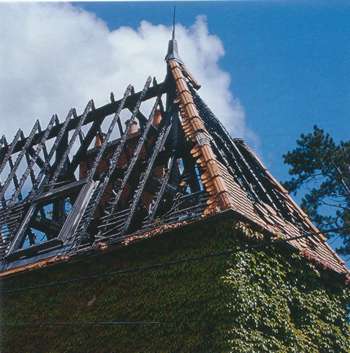
| Badly charred roof members following the passage of fire into a roof void. |
Although the single largest threat to our heritage is not fire but common damp and decay, it is usually fire which captures the headlines. For the totality of its destruction, nothing can compete with it.
To achieve the necessary protection for the occupants of the building, its contents and its fabric, the historic building owner is faced with a bewildering range of options all claiming to satisfy the fire safety requirements. Unfortunately, fire safety consultants tend to specialise in particular approaches, and it is rare to find an individual or organisation with the expertise in all of the various options and who can offer a balanced approach.
Usually the options to be considered will include:
Active Measures
- the installation of alarm and detection systems
- the provision of fire fighting equipment
- the installation of fire suppression systems
Passive Measures
- the provision of fire resistance.
Each of these options will have a different function and effect as described below. In this article we shall specifically address the category of ‘passive measures’ and in particular compartmentation issues. Many people in the industry refer to these measures as the ‘sleeping policeman’.
ALARM AND DETECTION
Early warning is vital for saving lives, particularly in large rambling buildings where there may be visitors or personnel who are unfamiliar with their surroundings. However, apart from alerting people who may be able to bring the fire under control, as at Windsor Castle the alarm will do very little in the short term to prevent property damage. In this respect, the amount that it contributes depends upon such factors as the initial detection time and rate of fire growth, the fire brigade’s arrival time, the type of equipment they have to hand when they arrive, their familiarity with the property and so on. It must be remembered that fire fighters often only have water available, which in a historically sensitive property may be as damaging as the fire itself.
'FIRST-AID' FIRE FIGHTING EQUIPMENT
The availability of equipment such as fire extinguishers on site will have a greater role in protecting property because it can enable a developing fire to be put out at an early stage. However, to be truly effective it needs to be supported by staff training, as a fire extinguisher can be quite ineffective in untrained hands. Also, the provision of hose reels may well encourage people to stay within a burning building for longer than is sensible, so this type of equipment is fairly controversial. Where fire fighting equipment is to form part of the protection programme, training needs to focus as much on developing awareness of when to stop fighting and leave, as on how to use the equipment.
FIXED SUPPRESSION SYSTEMS
Generally in the form of sprinklers, these systems are probably the most controversial of the measures available where historic buildings are concerned due in part to the inherent risk of damage that may result from the use of water. To some degree this risk is exaggerated by the fear that sprinklers could be triggered accidentally - by burning the breakfast toast for example. In fact, the sprinkler head itself has to be directly exposed to the heat of a fire before its glass phial bursts and opens the valve. Accidental discharge is therefore almost impossible in an environment that is free from forklift trucks and cranes.
A more realistic concern is that, in a large hall, the fire would have to be too far developed by the time the heat reaches the sprinkler in the ceiling for the fire to be controlled, and this is perhaps the greatest limitation of fire suppression systems. Therefore they are generally most suitable for smaller areas at high-risk.
The appearance of sprinklers also raises some concern. Consequently, conservationists may find sprinklers aesthetically unacceptable even if they are suitable technically.
Where fire suppression systems are acceptable, and historic fabric may be damaged by the introduction of large volumes of water, a water mist system should be used.
 |
|
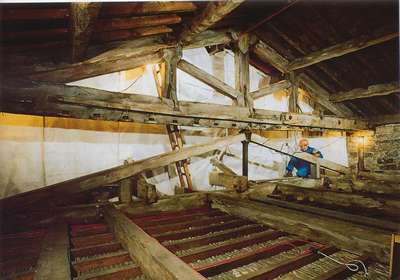
| Typical cavity barrier installation in a roof space at Chatsworth House, which is designed to give a specific integrity performance. To prevent heat radiation igniting adjacent material, the barrier is set back from the roof truss, timbers passing through the barrier are protected for some distance on either side, and the roof space is kept clear of debris. |
COMPARTMENTATION
The division of the building into discrete fire zones offers perhaps the most effective means of limiting fire damage. Designed to contain the fire to within the zone of origin, this approach provides at least some protection for the rest of the building and its occupants even if first aid fire fighting measures are used and fail. It also delays the spread of fire prior to the arrival of the fire brigade.
In the event of a fire within a building protected by compartmentation, the size of the damaged area would depend upon the layout of the fire resisting barriers within the building. Almost every building has its own natural compartment lines which, with a little attention, are capable of providing upward of 30 minutes protection against a fully developed fire, and often provide an hour or more. Fire compartmentation should therefore form an important part of any damage limitation strategy.
Ideally, halls and landings would be separated from staircases to prevent a fire from travelling vertically up the stairwell to all floors. However the creation of new lobbies can have a devastating impact on the character of a fine historic interior, and is often unacceptable. There also need to be practical limitations on the number of compartment lines because an over-compartmented building can become restrictive in its daily use. To be effective, compartmentation does need to be planned and implemented properly. There is no point in upgrading the fire resistance of a door and then not protecting the plywood duct by the side of it which runs through to the floor above, or even through to the adjacent room.
In deciding upon a compartmentation strategy it is important to have full knowledge of the voids that exist within the building: many historic properties do have hidden voids often purely as a result of the method of construction. It has been said, in respect of the Windsor Castle fire, that effective fire fighting could have been achieved with explosives as much as with water! The fire unfortunately kept breaking out ahead of the fire fighting operation as it exploited unsealed voids.
The most important elements to be upgraded are the doors, floors and walls, penetrations through floors and walls, and cavity barriers in the roof spaces. Some simplified guidance as to how compartmentation should be implemented is given below.
FLOORS
The upgrading of floors is always considered to be a daunting task. The
general perception is that all floorboards have to be lifted and that either
a low density concrete or net supported mineral wool slab system must
be installed in every nook and cranny. In some cases this is true, but
there are many buildings that already have inherently high levels of fire
resistance, where only relatively minor improvements may be required.
In order to ascertain just what the likely natural fire resistance performance
is, it is always worth having a structural and non-structural fire safety
survey carried out before embarking on a floor-upgrading programme. Historic
floors often incorporate pugging (a dense material introduced to reduce
noise transmission between floors) and this in itself can help provide
additional fire protection.
Recent developments have shown that it is now possible to use a 4mm highly
protective membrane as a ceiling lining which can readily be over-decorated
with a conventional lining paper and emulsion paint system. If the current
fire resistance of the floor is known then the membrane can be applied
to make up any difference. Where cornices and other fine plasterwork will
not be affected, the use of a membrane may be less invasive than removing
flooring and more acceptable to a conservation officer.
DOORS
The upgrading of doors to make them fire resisting is a topic in its own right. As a general observation, however, many upgrading measures solely address the burn-through of thin panels and the failure of ordinary glass, but ignore their distortion in heat, which is often the primary cause of integrity loss. This can be addressed by careful selection of pressure-forming or gap-filling intumescent seals and perhaps also by the introduction of additional or alternative hardware. As a result any measures used to upgrade the panel details would not be negated by the door distorting out of the frame.
Upgrading can be a very destructive process, involving splitting panel frames and inserting insulating materials, grooving out door edges and/or frames to accommodate intumescent seals, or, in non-listed buildings, losing the aesthetic look of panelled constructions by overlaying them with fire resistant boards. However, in recent years there have been a number of major developments in the design of face-fixed materials which make them more acceptable, both for sealing the door edge gap and also to overcome the risk of burn-through in the panel or in panel/stile interfaces. Some partially insulated glasses are also available which can often fit into existing rebates without spoiling the decor. The whole process is to be considered as a package and proper approval should be obtained if the system is to provide the protection required and value for money.
VOIDS
Sealing voids to maintain the compartmentation strategy should be performed with caution and with an empathy for the building as a whole. It is all too easy to seal all voids with mineral wool or even cementitious products, while ignoring the fact that the building needs to breathe. Indeed, there have been many occasions when the use of 'fire-stopping' (a non-combustible barrier) has created a micro climate which has encouraged rampant wet and dry rot. The use of intumescent systems whereby gaps can be left to encourage air movement, but which will close up when the fire tries to exploit them has enormous advantages, but again, getting the gap-to-intumescent ratio right is a job for the specialist. In sealing around pipes and cables one must never forget that these themselves will conduct heat along their length and as a consequence improved levels of insulation may also be required. It must be borne in mind that such insulation can in some circumstances cause cables to overheat. Fire stopping in a heritage building needs to be done more sympathetically than it does in a modern building.
ROOF VOIDS
Compartmentation of the roof void is an absolute necessity. Even fires in modern buildings show just how vulnerable the roof is in helping the fire to spread once it penetrates the roof void. There are several methods by which such barriers can be built. The choice of design will need to take into account the affect of heat radiation through the barrier and the durability of the structure to which it will be fixed.
There is a growing trend to use fabric cavity-barriers, but one has to be assured that the radiation level through them is not going to be such that roof members some distance from the barrier will not ignite on the exposed face. Non-insulating cavity barriers may be useless if proper consideration has not been given to the susceptibility of the structure to radiation-initiated fire spread. Installing barriers that do not line up with other compartment lines can also be a complete waste of time and money.
Cavity barriers should only be installed in roof voids in conjunction with the advice of a structural engineer who appreciates just what will happen to the structure when it is being exposed to temperatures of 800-1,000°C. At these temperatures even steel joists holding water tanks, for example, have a very low level of fire resistance. Consideration should also be given to the tolerance of such barriers to falling debris. Many materials become extremely brittle and weak when exposed to fire, and a more robust solution may be desirable in certain situations.
Of the many measures that can be introduced under the heading of ‘fire protection’, it is the compartmentation measures and the application of valid fire protection systems which are most effective in helping to contain the ravages of fire at least to the area in which it breaks out. Such measures would have avoided the total gutting of such lovely buildings as Uppark.
When deciding on a compartmentation strategy, the installation and materials need to be considered in some detail. It is easy to spend a lot of money and achieve little, as a result of poor design and specification. The whole strategy needs to be developed on the drawing board, drawing lines through the building to see exactly how the strategy should be set.
The good news is that many of the treatments now available are far less invasive than they used to be. Whereas it has been normal to have to make major disruptions to the elements being upgraded, the intelligent use of modern materials in the full understanding of their limits of application can mean that compartmentation is far easier to achieve than in the past.