
Conservation Consent
A brief guide to conservation area and listed building consent
Jonathan Taylor
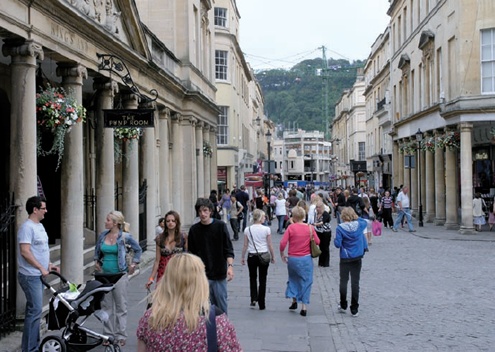 |
| The Southgate development in Bath affects both the conservation area and the setting of listed buildings, and illustrates the impact of development on the relationship between buildings. |
New buildings and extensions need planning permission, as do some of the more significant alterations to existing buildings. The impact of these forms of development on our surroundings is obvious, and the appearance of the design proposed is one of the most important issues considered by the local authority when deciding whether or not to grant planning permission. However, many alterations cannot be controlled by planning permission, even though they can have just as dramatic an effect on the appearance of the place as a new building, and over time the character of an area is affected, not always for the better. Demolishing a building, for example, can leave a hole in a townscape or street scene that ruins its appearance, and the scar left can be extremely ugly, blighting a neighbourhood. Yet, unless the building is a protected historic building or monument or lies within a conservation area, local authorities cannot restrict demolition on any aesthetic or cultural grounds.
Minor alterations can be also made by the owners of unlisted houses without applying for planning permission because they enjoy ‘permitted development rights’. These include changing the windows, doors, roof coverings, finishes and details – in fact almost all the features which contribute to the character of the building’s surroundings.
Quite simply, the principal conservation designations and the planning legislation that applies to them extend the scope of the local authority to control change. They do not rule out change, any more than the need for planning permission prevents development.
WHAT IS A CONSERVATION AREA?
Conservation areas are designated by the local authority, and there are now approximately 10,000 in the UK. Typically they include historic urban areas of character and interest which the local authority wishes to protect and enhance, but they may also include the whole spectrum of landscape and townscape features which affect the character of a place, whether natural or man-made, whether industrial or residential, or whether a homogenous urban centre or the widely varying landscape of a rural village, including the surrounding landscape.
A special consent known as ‘conservation area consent’ is required for the ‘substantial demolition’ of any building in a conservation area, and it is a criminal offence to demolish (or substantially demolish) one without consent. This, however, has proved inadequate to protect the loss of features like windows, roofing materials and chimneys which are vital to the character of a conservation area, because it does not cover minor demolition work. To address this problem, the local planning authority can introduce Article 4 Directions to control specific alterations to houses which would otherwise be automatically approved under permitted development rights. A typical example would require homeowners in a particular conservation area (or in a particular part of the conservation area) to apply for planning permission for the alteration of windows, doors and other specified external features, and would encourage like-for-like repairs.
The designation of a conservation area by a local authority is usually backed by policies and initiatives aimed at promoting preservation and enhancement. As a result, a development proposal which requires planning permission may have to meet specific criteria set out by the council in policies, often on a street-by-street basis.
WHAT IS A LISTED BUILDING?
Buildings considered to be of special architectural or historic interest may be listed by the arm of central government responsible for conservation. These are English Heritage (a commission), Historic Scotland (an executive agency of the Scottish government), and Cadw (a Welsh Assembly government body). The lists include approximately 440,000 entries, but as some list entries include several buildings, the total number of listed buildings is much larger.
Listings are graded according to the relative importance of the building. In England and Wales the most important grades are I and II* which account for less than five percent of all listed buildings, and the rest are Grade II. In Scotland the grades are Category A, Category B or Category C(s). (The ‘s’ stands for ‘statutory’ to distinguish these from the former C category of buildings which predates the current system of protection.) Fewer than 10 per cent are in the top category, and most are listed Category B.
Any proposal to alter a listed building in any way that affects its special architectural or historic interest, inside or out, requires special consent known as ‘listed building consent’. Carrying out such works without this consent is a criminal offence.
It is important to note that protection extends to the whole building, including its interior and structures attached to the exterior, as well as to free-standing structures within its curtilage.
ECCLESIASTICAL EXEMPTION
Most churches in England and Wales operate
their own internal systems of control under
the Ecclesiastical Exemption (Listed Buildings
and Conservation Areas) Order 1994, and do not have to apply for listed building consent
and conservation area consent. To qualify for
the exemption, the building must be in use
as a place of worship and it must be in the
ownership of a church with an agreed system
of internal control. These are: the Church of
England, the Church in Wales, the Roman
Catholic Church, Baptist Union Church,
Methodist Church and the United Reformed
Church. However, external works which
materially affect the external appearance of
a church (and this need not necessarily be
limited to extensions) still require planning
permission.
In Scotland all the denominations remain exempt, although some denominations have agreed to a voluntary arrangement whereby they apply for listed building consent for works to the exterior of their churches and chapels.
WHAT OTHER TYPES OF PROTECTION ARE THERE?
It is very rare for a habitable building to be scheduled as a monument, as monuments do not generally have any viable use. However, owners of historic building may find that features in the landscape are scheduled. These range from prehistoric standing stones and earthworks to Second World War pill boxes. Under the Ancient Monuments and Archaeological Areas Act 1979 all works to them (not just alterations) require special consent – in this case ‘scheduled monuments consent’. Again, breaking the law can lead to a criminal conviction and a fine. In this case, it is a criminal offence to damage a scheduled ancient monument either deliberately, recklessly, or by carrying out work without the appropriate consent.
Some protection is also given to trees. In a conservation area the local authority must be notified before a tree is cut down, lopped or pollarded, and a tree preservation order may be introduced by the local authority to protect trees elsewhere.
There are also statutory registers of historic parks and gardens. However, inclusion on the registers does not bring any additional protection, and alterations to parks and gardens generally do not require statutory consent unless they involve development work requiring a planning application, listed building consent, or scheduled monument consent, or they affect a tree covered by a tree preservation order. The Register of Parks and Gardens of special historic interest in England is maintained by English Heritage, the Register of Parks and Gardens of special historic interest in Wales is maintained by Cadw and ICOMOS, and an Inventory of Gardens & Designed Landscapes in Scotland is maintained by Historic Scotland.
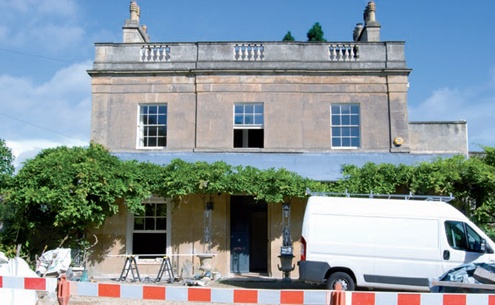 |
| All alterations to a listed building require listed building consent, including many aspects of repair work. This should not be seen as inhibiting work; it simply ensures that proposals are carefully thought through to avoid needless damage to sensitive fabric. |
ALTERATIONS TO LISTED BUILDINGS
Advice on the alterations which can be made to listed buildings is primarily contained in government guidance listed at the end of this article, although local authority policies should also be read. Defining exactly what constitutes an alteration can be tricky, particularly where repairs are concerned, since even replacing a single stone is, technically, an alteration. However, like-for-like repairs are encouraged and can generally be carried out without consent. For complex repairs and most alterations it is essential to include a design statement with the application, outlining the history of the building, its significance, the need for the work and the approach to be adopted by the conservators. There are three principles which you should be aware of when undertaking any repairs or alterations to a listed building or to historic fabric:
Minimum intervention conserve as much of the existing fabric as possible and avoid unnecessary alterations and risks
Honesty alterations should be sympathetic
to the existing fabric in terms of performance
and character, but making new work appear
old, or ‘restoring’ elements which may never
have existed in the past, simply confuses the
historical interpretation of the fabric and can
create the appearance of a fake, devaluing
original material
Reversibility wherever possible, use only
repair and alteration techniques that can be
reversed later, so that, if necessary, the object
could be returned to the state in which it was
found without harm.
Finding solutions which satisfy all three principles without conflict, and without harming the character of the building, can be impossible, so the solution adopted often represents a compromise between competing requirements. Consider for example the common problem of repairing a visible timber beam which has rotted at its junction with a damp outer wall. A traditional solution might be to replace the end with new timber, cut to the profile of the existing and fixed with a scarfed and bolted joint. This solution may be easily reversible, but it might involve the loss of more timber than the use of more modern alternatives, and if the problem which caused the decay in the first place recurs, it may be unsustainable. Recreating the rotted end with resin reinforced with steel, for example, could save more fabric, but the use of hard-setting resins makes this less easy to reverse. A third option might be to replace the rotted beam end with steel alone, bolted to the sound timber, producing an honest but ugly repair, harming the character of the interior.
Whichever solution is adopted, the reasons for choosing it will have to be clearly explained in the application for listed building consent.
Choosing a consultant who has the
experience required to help at both the design
and the application stage is important, as
complex issues such as these arise in many
aspects of work to historic buildings and in
the design of new buildings and other features
in conservation areas. It is also important to
engage the consultant throughout the process
on site, to ensure that the right materials and
techniques are used by the contractors, and to
deal with any problems that emerge once work
commences.
~~~
Recommended Reading
C Mynors, Listed Buildings, Conservation Areas & Monuments, 4th edition, Sweet & Maxwell, London, 2006
Legislation
Planning (Listed Buildings and Conservation
Areas) Act 1990
Planning (Listed Buildings and Conservation
Areas) (Scotland) Act 1997
Policies and Guidance Documents
England:
Planning Policy Guidance Note 15: Planning
and the Historic Environment;
Planning Policy Guidance Note 16:
Archaeology and Planning
Northern Ireland:
Planning Policy Statement 6, Planning,
Archaeology and the Built Heritage
Scotland:
Memorandum of Guidance on Listed
Buildings and Conservation Areas
Wales:
61/96 Planning and the Historic Environment:
Historic Buildings and Conservation Areas;
1/98 Planning and the Historic Environment:
Directions by the Secretary of State for
Wales