
Conservation
An Evolving Concept
Paul Drury
 |
||
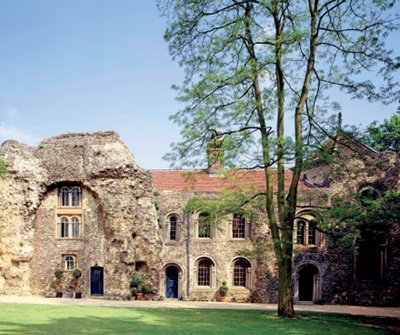
| Changing attitudes: English Heritage oversaw the conservation and regeneration of derelict 18th-century houses that infill the ruins of the West Front, Bury St Edmunds Abbey, which the Ministry of Works had once proposed stripping away. (Photo: Fisher Hart Architectural and Interiors Photography) |
Building conservation is distinctly different from the physical processes of repair and adaptation. It is an attitude of mind, a philosophical approach, that seeks first to understand what people value about a historic building or place beyond its practical utility and then to use that understanding to ensure that any work undertaken does as little harm as possible to the characteristics that hold or express those values. Conservation now needs to be explained in such terms, rather than by technical directives (that is to say, to be operative rather than prescriptive), because of the diversity of the buildings and places that people have come to value and wish to hand on to future generations.
Practising conservation involves judgement guided by professional ethics and public policy. it is based on an understanding of the relative importance of the heritage values attached to a building or structure, how they are represented in its fabric and the effects on them of different approaches to repair. The intellectual arguments for conservation originally put forward by antiquaries and critics, often prompted by the threatened destruction of valued buildings, have gradually developed into professional statements of ethics and good practice. The concept has evolved over a long time, but the language used to articulate it is changing. As conservation becomes a more complex and public activity, approaches to the conservation of buildings are seen as being closely linked not only to the conservation of objects but also to sustaining cultural values in the historic environment as a whole.
Throughout Europe, the cultural significance of historic buildings and places is now generally recognised as a public interest in property, regardless of who owns it, justifying the use of law, public policy and public investment to protect that interest. There are differences, however, about which buildings and areas are valued sufficiently to warrant legal protection, both quantitatively (the number of buildings and areas) and qualitatively (the values ascribed to them). Although the values of some places have long been recognised and tend to become more clearly established over time, attitudes to others (often of more recent date) may change, sometimes quite rapidly, within an evolving culture. Conservation thus requires an awareness of the mutability of heritage values. Policies and good practice about what should be conserved and how that should be done therefore represent a snapshot of contemporary understanding and approach, rather than a set of unchangeable truths.
FROM MINIMUM INTERVENTION TO CONSERVATION PLANNING
The intellectual position of building conservation at the end of the 19th century was expressed with poetic force in William Morris’ 1877 Manifesto of the Society for the Protection of Ancient Buildings. Its emphasis on the primary importance of sustaining inherited fabric and its opposition to restoration are still highly influential in British conservation. It is worth bearing in mind, however, that the manifesto’s primary subject matter was medieval buildings, by then at least three centuries old. A huge expansion in the type, age range and number of buildings and areas recognised as having cultural heritage value during the 20th century has made their conservation a much more complex activity, which now needs to take into account public as well as professional opinion.
Buildings of the 16th and 17th centuries, mostly still in everyday use, were included in the remit of the royal commissions established from 1908 to record them; the terminal date was soon extended to 1714. Statutory protection, effectively introduced in 1947[1] by the Town and Country Planning Act and Town and Country Planning (Scotland) Act, included Georgian buildings from the outset, soon adding a small number of Victorian buildings. While remaining highly selective of more recent buildings, inter-war and finally post-war buildings have been added to the lists. A ‘30-year rule’ was set, and soon reduced to ten years for buildings deemed to be of ‘outstanding’ importance and under threat.
 |
||
| Changing values: Once considered controversial, many post-war listings are now cultural icons: Leonard C Howitt’s 1957 Hollings Building, Manchester, which was listed Grade II in 1998, now adorns a coffee cup. (Photo: www.peoplewillalwaysneedplates.co.uk) |
This closing of the gap between (present) cultural value and (past) cultural heritage was perhaps an inevitable consequence of the emphasis from the outset (in the selection criteria for listing) on architectural rather than historic interest and thus on design value as well as fabric. The statutory lists now represent each nation’s collection of architecture to which it attaches sufficient cultural value to wish to pass it on to future generations as part of their heritage. The incremental shift could not have been achieved without public support. listing only began to be effective in protecting buildings during the late 1960s as public opinion moved against comprehensive redevelopment, a turning point being the introduction of conservation areas in 1967.
European Architectural Heritage Year (1975), a Council of Europe Initiative, was a catalyst for thinking about how historic buildings, valued not only for their recollection of the past but also, and perhaps principally, for their contribution to the present and future, could be sustained in use. International statements of best professional practice, particularly The Venice Charter (1964), were still concerned primarily with monuments whose exceptional significance was evident at national, and often international, level and where ongoing use was desirable, but not essential, to survival. The Council of Europe Convention on the Protection of the Architectural Heritage (Granada, 1985) took a wider view. In the UK, pragmatic guidance became annexed to successive planning policy documents and supplemented by advice from national heritage agencies.
The idea of ‘conservation planning’ was pioneered by James Semple Kerr in Australia and underpinned (with The Venice Charter) The Burra Charter, which was adopted by ICOMOS Australia in 1979. While The Venice Charter and its precursors prescribed what was necessary to protect a relatively narrow range of heritage values, The Burra Charter set out a process for identifying the values people attach to places as the basis of managing change in ways that seek to retain ‘all aspects of [their] cultural significance’. The heritage values of places were seen as often both multiple and mutable. Heritage practitioners therefore needed to become advocates and enablers as well as conservators, particularly in relation to the values attached to places by the communities that identify with them. The European Framework Convention on the Value of Cultural Heritage for Society (Faro, 2005; yet to be ratified by the UK) now places heritage in this wider political and social context.
Often promoted as a democratisation of heritage, addressing values beyond those of an expert elite, Kerr’s work soon began to be referenced by practitioners in England and the ‘conservation planning’ approach was taken up by the Heritage Lottery Fund. The idea is a simple one: understand the range of values that people attach to a place and seek to manage the place to sustain as many of those values as reasonably possible. This idea, as well as established English conservation practice and public policy, provided the background to the drafting of English Heritage’s Conservation Principles, Policies and Guidance for the Sustainable Management of the Historic Environment (2008). This document attempted to domesticate the concepts of conservation planning and a values-based system of assessment, promoting an integrated approach to managing any and all valued elements of the historic environment.
The scope of designation and recognition of historic buildings and areas has widened to include those significant for their design or associations, rather than simply their age, and which are sustained by remaining in use. In parallel, there has been a de facto (but not universal) acceptance that ‘minimum intervention’ does not, of itself, necessarily provide an adequate response to the range of conservation issues faced by practitioners or regulatory authorities. This wider concept of heritage demands discrimination and a sense of proportion, to inform attempts to identify and balance conflicting public interests (the essential concern of public policy) in a methodical and transparent way.
EVOLVING POLICY
Public policy and professional practice have inevitably responded to changing concerns more rapidly than underlying legislation, complicating an integrated approach to managing cultural heritage values in the historic environment. In England, a draft heritage protection bill was published in 2008, but not taken forward, leaving integrated policy (Planning Policy Statement 5: Planning for the Historic Environment, 2010) informed by the ideas in the Conservation Principles but disconnected from the details and terminology of underlying legislation. At the time of writing, a high level National Planning Policy Framework seems likely to replace topic-based Planning Policy Statements, including PPS5. This is intended to leave good practice to be established through standards and guidance produced by professional bodies and organisations. More weight might then be attached to the revision, recently announced, of the British Standard (BS) Guide to the principles of the conservation of historic buildings (BS 7913:1998).
The Welsh Assembly Government has published its own Conservation Principles for the Sustainable Management of the Historic Environment in Wales (2011), adapting the English version, and has announced its intention of bringing forward a Heritage (Wales) Bill. Scotland has high level policies applicable to all heritage assets,[2] including reference to conservation planning, but grounded in existing legislation, to which some amendments have been made.[3] Policy in Northern Ireland still follows a similar format to the recently-superseded English PPG15.[4]
KEY CONCEPTS IN CURRENT POLICY AND GUIDANCE
Significance is the starting point: it is the reason why, from a heritage perspective, the future of a place may be a matter of public interest. English Heritage’s Conservation Principles defines it as ‘the sum of the cultural and natural heritage values of a place, often set out in a statement of significance’. Breaking this down, a value is ‘an aspect of worth or importance, here attached by people to qualities of places’. They are grouped under four broad headings, not intended as a checklist, but as a prompt to thought:
- evidential, deriving from the potential of a place to yield evidence about past human activity
- historical, deriving from the ways in which past people, events and aspects of life can be connected through a place to the present
- aesthetic, deriving from the ways in which people draw sensory and intellectual stimulation from a place
- communal, deriving from the meanings of a place for the people who relate to it, or for whom it figures in their collective experience or memory.
English public policy in PPS5 adopts a similar definition of significance, ‘the value of a heritage asset to this and future generations because of its heritage interest’, but limits it by the qualification ‘that interest may be archaeological, architectural, artistic or historic’. This is the sum of the types of ‘interest’ included in the underlying legislation.[5] If one reads ‘archaeological’ for ‘evidential’, and accepts that architectural and artistic values fit within the broader concept of aesthetic values in the Conservation Principles, the main difference lies in the absence of the idea of communal values, although arguably they can be understood as a subset of historical values.
 |
||
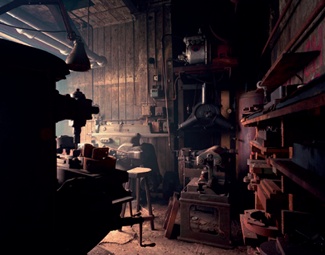
| Evidential value: The atmospheric power-press room in a workshop in Vyse Street, in the heart of Birmingham’s Jewellery Quarter, captures the emotive power of past human activity. It is above all a primary source of information about how jewellery and small metalwork were made. (Photo: English Heritage) |
‘Significance’ can be considered as broadly equating, in terms of the Planning (Listed Buildings and Conservation Areas) Act 1990, with ‘interest’, as in ‘special architectural or historic interest’, but in an integrated approach to managing values, its scope tends to be wider, inclusive rather than specific. Works of alteration or extension for which listed building consent is required are those ‘which would affect its character as a building of special architectural or historic interest’. In this context, ‘character’ (meaning ‘distinctive nature, distinguishing quality or qualities’) might be considered as the attributes that carry or express that special interest or significance.
Heritage asset is the portmanteau term used in PPS5 for ‘a building, monument, site, place, area or landscape positively identified as having a degree of significance meriting consideration in planning decisions. Heritage assets are the valued components of the historic environment. They include designated heritage assets (as defined in this PPS) and assets identified by the local planning authority during the process of decision-making or through the plan-making process (including local listing)’. The English Heritage Conservation Principles prefers ‘significant place’, defined as ‘a place which has heritage value(s)’, while the Welsh Principles use ‘historic asset’, defined as ‘an identifiable component of the historic environment. it may consist of or be a combination of an archaeological site, an historic building, or a parcel of historic landscape. Nationally important historic assets will normally be designated’. Scotland uses ‘historic asset’ and, less commonly, ‘heritage asset’[6] as generic terms.
Conservation can be defined in many ways. The difference between prescriptive and operative definitions is evident from comparing the current BS 7913 (1998) with Conservation Principles. The BS definition is generic: ‘action to secure the survival or preservation of buildings, cultural artefacts, natural resources, energy or any other thing of acknowledged value for the future’. But paragraph 7.1.2 goes on to state ‘a conservative approach of minimal intervention and disturbance to the fabric of an historic building in which there is a presumption against restoration is fundamental to good conservation’. There are many buildings for which this is entirely true, but, arguably, others where a values-based approach would lead to a different conclusion.
The operative definition in the Conservation Principles is ‘the process of managing change to a significant place in its setting in ways that will best sustain its heritage values, while recognising opportunities to reveal or reinforce those values for present and future generations’. It implicitly accepts that heritage values change over time, indeed that they can be changed by the process of conservation. The definition of conservation in PPS5, ‘the process of maintaining and managing change to a heritage asset in a way that sustains and where appropriate enhances its significance’, differs primarily in its assertion that significance can be enhanced through conservation. ‘Enhance’ presumably arises from the general application of a legislative provision relating to a specific type of heritage asset, namely conservation areas, whose character or appearance ‘it is desirable to preserve or enhance’.
Other concepts tend to be confined to statements of principles or professional guidance, suggesting a boundary between public policy and conservation ethics.
Authenticity is defined in the Conservation Principles as ‘those characteristics that most truthfully reflect and embody the cultural heritage values of a place, following the Nara Document on Authenticity (ICOMOS Japan, 1994)’. The process of conservation cannot sustain heritage values unless it has due regard for the authenticity of the place or building. This definition recognises that authenticity can be related to, for example, design (especially for recent buildings) and function (for example, a place of worship, or an engineering structure), as well as the evidential and historical values of inherited fabric, but nonetheless suggests that change should be detectable, at however subtle a level.
Integrity (literally ‘wholeness, honesty’) can apply, for example, to a structural system, a design concept, the way materials are used, the character of a place, artistic creation, or functionality. decisions about recovering any aspect of integrity that has been compromised must, like authenticity, depend upon a comprehensive understanding of the values of the place, particularly the values of what might be lost in the process (Conservation Principles, para 94). Similarly, ascribing relative significance to parts of a building cannot justify interventions which cumulatively fragment the whole.
REFLECTION
The concept of building conservation to sustain cultural heritage values, normally alongside utility value, has been evolving in the UK for more than three centuries. The past half-century has seen the most rapid developments, in scope, in thought about purpose and aims, and in technical skills, not least the rediscovery of traditional skills. There has been progress towards the integration of conservation philosophy and practice that has been developed by different professional groups under different legislative or policy frameworks, both within and outside official bodies.
Ultimately, however, each of us has a conservation philosophy shaped by professional experience, personal value scales and sensibility. The importance of official and ethical guidance perhaps ultimately lies in providing common frameworks for consideration, assessment and debate about particular proposals.
~~~
Notes
1 Except in Northern Ireland, where listing was introduced in 1974
2 Scottish Planning Policy (2010); Scottish Historic Environment Policy (2008), esp 1.15
3 Historic Environment (Amendment) Scotland Act 2011
4 Planning Policy Statement 6: Planning, Archaeology and the Built Heritage (1999, as amended)
5 The term ‘artistic’ comes from the Protection of Wrecks Act 1973
6 Scottish Planning Policy (2010), para 110-111