
Conservative Repair
Douglas Kent
 |
|
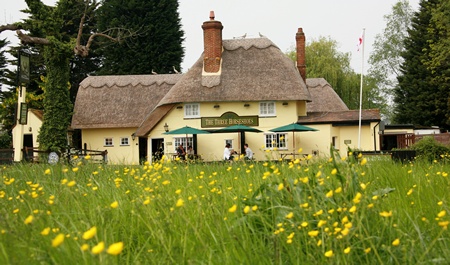
| The Three Horseshoes, Molehill Green, Essex: A recent and successful campaign against a second runway at Stansted Airport saved many historic buildings from either demolition or, like this pub, dismantling and rebuilding (Photo: John Lawrence) |
The concept of ‘conservative repair’ is central to good building conservation practice. It refers to an abstemious approach when carrying out work on old buildings – doing as little as possible but as much as is necessary.
This philosophy is often associated with William Morris and the manifesto he wrote with other founder members when the Society for the Protection of Ancient Buildings (SPAB) was formed in 1877. The idea of conservative repair has since shaped the approach to work on old buildings not only in the UK but in many parts of the world.
PRIMACY OF FABRIC
Old buildings are judged worthy of protection when they have a value to people beyond any purely utilitarian purpose. The value-judgements placed on a building will determine to a large extent how it is conserved.
To William Morris and the other founders of the SPAB, the value of an old building lay in its physical fabric. To them, an old building was more than simply the sum of its constituent parts. It had the ability to excite memory and anticipation, serving as a physical manifestation of the past and a potential source of influence on the future. The sheer antiquity of the building, the accumulated evidence of how it had changed over time and the patina of age and weathering of its surfaces were considered to be of the utmost importance. Surviving fabric was finite and, once destroyed, could never be retrieved.
Other, often less tangible, values may also be invested in a building. These might include a historical association with a particular person or event, or, in the case of a place of worship, spiritual value. A new idea of ‘significance’, contained in the Australian Burra Charter and later incorporated into English Heritage’s Conservation Principles, has now been officially adopted in England, following the introduction of Planning Policy Statement 5: Planning for the Historic Environment (PPS5). This treats building fabric as only one of a multitude of criteria that may contribute to the value, or significance, of a building. However, it is possible to reach a range of views about the significance of a building – in fact, every individual’s perspective is likely to differ and values will change over time. The concept provides no means of reconciling a direct conflict of values.
While, therefore, a whole variety of values needs to be taken into consideration, and some subjective judgements must be made when planning work to a building, it is the value of the fabric that should remain of primary significance. The retention of genuine historic fabric and the avoidance of misleading restoration will allow present and future generations to interpret the significance for themselves in their own way and on the basis of physical evidence.
FIGHTING RESTORATION
It is essential to think carefully about the direct and indirect consequences of every action when working on an old building because the value attached to it can be seriously harmed by inappropriate intervention. The SPAB was formed to counteract the over-enthusiastic Victorian restoration schemes of the Gothic Revival.
 |
||
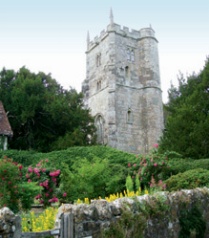
| The Church of St Mary the Virgin, East Knoyle, Wiltshire: the medieval tower was saved from restoration and repaired instead by SPAB luminaries in one of the society’s early cases (Photo: Douglas Kent) |
The word ‘restoration’ is often used loosely to cover all aspects of work on old buildings but in the strictest architectural sense means work intended to return a building or a component of the building to a perfect state. At its worst, it can mean the unnecessary renewal of features that are worn, damaged or non-original, and the hypothetical reconstruction of missing elements, or indeed of an entire building. Over 6,000 churches and cathedrals across the UK were restored during the 19th century. The aim of the architects, far from a desire to preserve material fabric, was to rebuild these structures to achieve stylistic purity in an attempt to stimulate greater piety.
‘Anti-scrape’, an early nickname of the SPAB, referred to the organisation’s running battle with those who were restoring or ‘scraping’ old buildings – removing plaster, cutting back the face of weathered masonry, and destroying other aging finishes – and attempting to return medieval buildings to an imagined original form. Restoration achieves tidy reproduction at the expense of genuine but imperfect work. The result is, in the words of Morris, ‘a feeble and lifeless forgery’. John Ruskin, the art critic and an early member of the SPAB, was equally as forthright: ‘Do not let us talk then of restoration. The thing is a lie from beginning to end.’
Because of its emphasis on the primacy of fabric, the SPAB is concerned that England’s new PPS5 may allow scope for restoration of the kind that has always been anathema to the society, particularly through references to ‘enhancing significance’. The society accepts that significance can be revealed or better understood but takes issue with the notion that it can be ‘enhanced’.
PROMOTING REPAIR – THE ALTERNATIVE
The considered alternative to restoration is conservative repair. This philosophical approach is intended to offer a flexible framework that allows consideration of a range of options to suit any given case rather than, as is sometimes thought, a set of dogmatic rules, which the diverse nature of old buildings precludes. It is based on the overarching ethics of authenticity and integrity underpinned by a number of key principles:
Authenticity (genuineness) In European culture it is held that the maximum retention of a building’s real historic fabric should be the over-riding objective. This contrasts with the view in some eastern cultures that buildings may be periodically rebuilt without detriment because it is considered that their authenticity resides in their place, design and spirituality rather than any physical relics.
 |
|
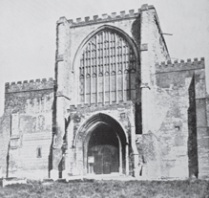
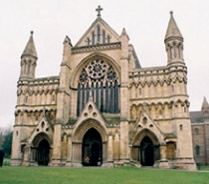
| Top: The west front of St Albans Cathedral before a highly unsympathetic Victorian ‘restoration’ project rendered it (below) as it is today. (Photo: SPAB) | |
 |
Integrity (completeness) Even where painstaking efforts are made to retain the authenticity of a building, it can be compromised by harm to aspects of its integrity. For example, the extensive sub-division of an old church during conversion to domestic use may damage the integrity of its design form by removing the large internal spaces that lend the building many of its ‘church-like’ qualities. Integrity could also be undermined by dismantling and re-erecting a building in another location, gutting it or reducing it to merely a facade in front of a new structure (‘facadism’).
The principles that support the twin ethics of authenticity and integrity can be grouped for convenience under the headings of ‘essential work’ and ‘methods and materials’. Each is addressed now in turn.
ESSENTIAL WORK
The only work that is unquestionably necessary is that which is essential to ensure the survival of a building’s fabric. Regular preventive maintenance is vital and represents the most practical and economical way of looking after a building. It not only restrains, or even obviates, the need for repairs later but will minimise the loss of original fabric. William Morris pleaded with those responsible for old buildings to ‘stave off decay by daily care, to prop a perilous wall or mend a leaky roof’.
Essential work also includes repair in a general sense, as well as renewal in instances where the fabric is without doubt beyond saving. Unfortunately, in too many cases more historic fabric is replaced than is strictly necessary. Each year countless timber windows that could be repaired or upgraded for good thermal insulation are needlessly replaced with double-glazed units. As a result many old buildings suffer a profound deterioration in their character and historic interest.
Essential work may entail additions to
a building too, where these add to its value
rather than subtract from it and extend its
usefulness. Exceptionally, essential work might
include an
element of restoration, where this
involves the reinstatement of missing fabric.
However, this should only be carried out as a
practical expedient on a small scale, as with,
for example the replacement of a weathered
moulding to ensure rainwater is shed clear
of a wall face or reapplication of a protective
render that has long since been removed.
METHODS AND MATERIALS
Anyone embarking on major work to an old building must understand it properly first. Appreciation of a building’s particular architectural qualities and a study of its construction, use and development are enlightening and may also help to illuminate the reasons why deterioration has occurred and how it might be halted. Misguided attempts to control damp in old walls by sealing them instead of allowing them to ‘breathe’, for example, frequently cause more harm than good.
 |
|
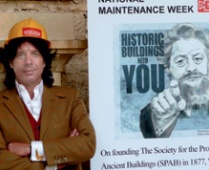
| SPAB runs a National Maintenance Week, culminating in a National Gutters Day. Endorsed by celebrities such as Laurence Llewelyn-Bowen, the aim is to show how jobs such as the clearing of gutters and downpipes, while mundane, can be carried out simply and inexpensively but, if neglected, may have devastating consequences. (Photo: SPAB) | |
 |
|
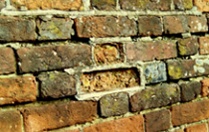
| Damage caused by localised cement pointing (Photo: Douglas Kent) |
In the course of repairs and additions, the new materials should always be adapted to the old, not vice versa. Responsible methods should be used so that a repair carried out today does not prevent treatment tomorrow.
Good repair will not eradicate or hide imperfections. Bulging, bowing, sagging, leaning and other signs of age should therefore be respected, providing the components continue to safely fulfil their practical function.
Careful, considered workmanship does justice to fine buildings, leaving the most durable and useful record of what has been done, and does not require concealing or artificially ageing. When the replacement of historic fabric is unavoidably extensive or otherwise significant, the work may be discreetly dated for future reference. A general premise of technically compatible repairs is endorsed so that new work does not exacerbate the deterioration of the old. For example, it is increasingly recognised that the use of dense cement mortar for repointing soft historic masonry originally built using lime mortar can cause substantial damage. Conversely, the reuse of architectural features salvaged from elsewhere confuses the understanding and appreciation of a building, potentially even causing original features to appear spurious, whereas demand for the new equivalent of the same materials helps sustain their production.
New work should complement the old, and not parody it, in order to avoid diluting a building’s authenticity. The work should express modern needs in a modern language to prevent confusion and add to, rather than detract from, the building as a historic document. Contrasting styles or materials can work well. There is, however, a difference between ‘honesty’ and ‘rudeness’, so skill is required.
Old buildings cannot be made to last forever but an approach based on the philosophy of conservative repair will ensure they survive as long as possible and suffer the least alteration. In the words of William Morris, it will see that we ‘hand them down instructive and venerable to those that come after us’.
Recommended Reading
- English Heritage, Conservation Principles: Policies and Guidance for the Sustainable Management of the Historic Environment, English Heritage, London, 2008
- C Miele (ed), From William Morris: Building Conservation and the Arts and Crafts Cult of Authenticity 1877-1939, Studies in British Art 14, Yale University Press, New Haven and London, 2005
- A Orbasli, Architectural Conservation: Principles and Practice, Blackwell, Oxford, 2008
- The SPAB Manifesto and the short text ‘SPAB’s Purpose’ can be viewed online at www.spab.org.uk/what-is-spab