
The Reconstruction of Coombe Cliffe Conservatory
Geoffrey Wallis
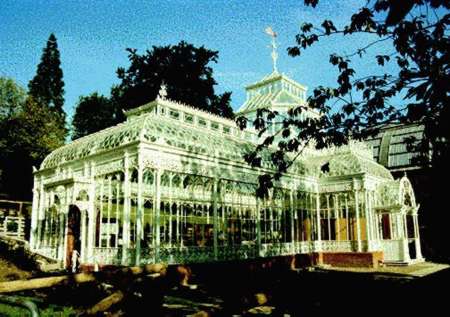
This fine example of Victorian modular construction using high quality decorative cast iron components was originally built as an attached extension to the Horniman family house at Coombe Cliffe, Croydon, in 1894. The castings in grey cast iron were from the then prolific output of Walter Macfarlane's Saracen foundry in Glasgow, incorporating the extensive detailed decoration which is typical of this 'Victorian wedding-cake' era. Features included columns over seven metres long, cast in one piece, numerous highly decorated ventilator panels, and curved 'fish-scale' glazing. These delicate iron frames held tiny panes of flat glass in tiers at slightly differing angles to give a wonderfully scintillating effect in the sunlight.
By the time the house at Coombe Cliffe was acquired by the GLC in 1982, the conservatory had fallen into disrepair. The structure was therefore totally dismantled and the loose components were deposited in two open compounds situated, by ironic coincidence, on the site of the old Crystal Palace, where they remained forlornly abandoned for several years.
The unique historical and architectural value of the structure however, had not been disregarded. Following the closure of the GLC, the project was taken up by the newly formed London Division of English Heritage and the Inner London Education Authority, who took the decision to re-erect the conservatory on a site adjacent to the Horniman Museum buildings at Forest Hill. No original drawings existed and no structural dimensions or component identifications had been recorded before dismantling, although some photographs were available. Painstaking detailed research and dimensioning of the components at the Crystal Palace was undertaken by English Heritage architects who also produced drawings for the re-erection of the structure.
As specialists in the field, the Bristolbased Southern division of Dorothea Restorations Limited was awarded the contract to restore the ironwork and re-erect the building. The project presented a significant problem in managing hundreds of random components which were lying in the Crystal Palace compounds, partly hidden by undergrowth. A system was devised using specially printed record sheets with a separate sheet for each component giving its description, its part identity number (derived from its position in the building), its condition as found and the repairs required. The sequence and nature of each repair operation was recorded, with details of grit-blasting and painting requirements, requirements for patterns and replication castings, and transportation details. These sheets were incorporated into volumes to provide a comprehensive schedule which was updated on a daily basis providing the repair status of every component and its whereabouts throughout the programme. Typical entries might include; 'at foundry Bristol as pattern for NA6', 'at Metalock for stitch repair', 'at DRL Whaleybridge for weld repair'. Only in this manner could it be ensured that no components were lost and a full complement of parts would be available for the recreation programme.
The specification required all components to be grit-blasted clean and immediately primed with two coats of 2 pack epoxy primers. Some major components such as main arches and columns weighed up to a ton and therefore required careful and cautious handling within the restricted confines of the Crystal Palace compounds, to gain all-round access for blasting and painting. No components were fractured or damaged during the preparation, repair, or re-erection programme.
Hundreds of individual repairs were required; many were minor fractures in dado panels, frieze panels or the fishscale frames of the curved roof windows which could be satisfactorily arcwelded on site. But there were also a large number of extended longitudinal fractures, usually in the hollowbore rainwater columns, which required metalstitching repairs over lengths up to 4 feet (1.2 metres).
Originally the conservatory was butted up against the wall of the main house at Coombe Cliffe, and did not include an east wall. It was therefore necessary to replicate a complete new outfit of castings for columns, beams, friezes, dado panels and window frames using the west wall components as the pattern and adapting as necessary to give the correct handing and dimensions. Two of the four columns supporting the central tower structure required lengthening by 30 inches to suit floor levels at the new site. These columns are of a four-start barley sugar twist cross-section which presented problems in the production of helically matched moulds, patterns and castings, as the extensions had to be both structurally sound and visually continuous with the original barley twist when they were fitted and stitched to the original columns. A multiplicity of smaller castings for window mullions, transoms and glazing bars were produced to replicate missing parts and those beyond economic repair, together with small elements of scrolls, finials, acroteria and miscellaneous decorative items which were necessary to give a visually complete detailed structure.
The re-erection process was complicated by the lack of original component identification and thus beams, columns and arches came together in the rebuild, although they had not been related, drilled and fastened together in the original structure. Particular attention was therefore necessary when adapting old fastening holes to achieve true structural levels, verticality, and alignment integrity in the resurrected building. Similar problems were inherited in the erection of the minor outfitting components such as dado panels, friezes and window frames, and the alignment of the in-built glazing landings had to be constantly borne in mind. This requirement was particularly pertinent to the fish-scale window panels of the curved roof which are an especially attractive visual feature of the conservatory. The whole structure was finally painted from top to bottom before glazing.