
Copper Sheet Roofing
Jonathan Goode
 |
|
| The copper dome of West Register House, Charlotte Square, Edinburgh (Photo: Charles Strang) |
With its natural tendency to form a protective green patina, copper roofing provides a prominent visual accent in our built environment. It is particularly distinctive against the occluded skies of our temperate climate. Copper is relatively expensive but it does have beneficial characteristics. This has meant that its use, historically, has typically been reserved for high profile buildings. During the 19th and 20th centuries the price of copper fluctuated dramatically, making it periodically available for use on a wider range of building types.
Large-scale use of copper roofing developed during the 19th century and examples or accounts of its use in England prior to this are rare. The use of copper as a roofing material became increasingly viable through increasing mechanisation and standardisation in the production of copper sheet. The use of copper in the first half of the 20th century fluctuated with its price, peaking around the 1920s and 1930s.
After the second world war many churches were in poor condition. Some had suffered bomb damage and many more had been deprived of general repairs and maintenance because of the enforced postponement of such work between 1939 and 1949. Even then, shortages in materials, labour and funds, coupled with the need to obtain a Ministry of Works licence, hampered repair works. One of the worst cases was Chichester Cathedral where nearly all the roofs were in need of re-covering (illustrated below).
THE BENEFITS OF COPPER SHEET
The use of sheet metal in general as a roofing material allows a near continuous water-resistant covering with a minimum of joints between sheets. It enables roof slopes to be covered at lower pitches than would be possible using other roof coverings and it can be used to provide a smooth surface over curved architectural forms. In this respect copper is not unique and a number of alternatives are available including lead, zinc, tin, aluminium and galvanised and stainless steel. However, certain properties of copper provide benefits over these other metals.
The density of copper is less than that of lead and it has much greater tensile strength. These characteristics combined mean that standard copper sheet is thinner and lighter than lead sheet, so it requires less structure to support it. The greater tensile strength reduces the likelihood of creep, making it better-suited to more steeply pitched roofs, such as domes and spires. Copper, with a much higher melting point than lead, also has greater fire resistance and was therefore considered suitable, historically, for use on important or valuable structures.
Corrosion of the outer surface of oxidised copper provides a protective coating over the metal beneath. This regulates the speed of corrosion through the metal so that copper sheet can last 100 years or more. The process of corrosion also produces a patina, which is predominantly green copper carbonate. It is this patination that gives most historic roof coverings their distinctive colour. Changing climatic conditions and air pollution affect the rate and colour of patination. The colder, dryer and less polluted the climate, the longer it takes for the patination layer to form.
INSTALLATION OF COPPER SHEET ROOFING
Until 1870 nearly all copper sheet roofing was laid in sheets, generally 2' by 6' in size, joined at the sides with vertical standing seams. Clips attached to the roof would be held between the sheets. The upstand would then be folded over either once or twice, to form the seam. Horizontal joints would be folded over flat to form welts. This is commonly known as the traditional method.
 |
|
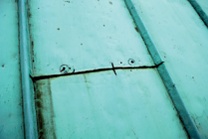
| Chichester Cathedral: the wide bays used between vertical seams allow the sheet to deflect under wind-lift, which can cause hardening and eventual cracking. |
With the development of thin sheets of consistent thickness, a system of vertical joints using wood-core rolls was developed. A conical wood roll was fixed to the roof, then sheets with their edges turned up were placed on either side and welted together over the roll. This method developed to use an almost square batten with a strip laid over the top and welted to the adjacent sheets. This later development made more allowance for thermal expansion of the bays, made it easier to form junctions and proved particularly preferable on shallow sloped pitches where footfall could damage standing seams.
Experimentation in methods of laying copper continued through the 1950s and 1960s, making use of the longer strips of copper then available for greater economy. The Broderick System was patented in 1953 and incorporated bay-width cleats held in place by dummy welts. Developments in Switzerland at the same time led to the Long Strip System, which was introduced in the UK in 1957 and is now used for most modern copper sheet roofing. This method uses long trays of copper sheet, 520mm wide and up to 8.5m long. It uses fewer clips and cross welts than the traditional method and the long standing seams are often machine-formed.
COMMON DEFECTS
Copper roofing can be affected by mechanical damage, corrosion and deterioration of the supporting structure. If the roof was laid in such a way that it cannot respond to the prevailing environmental conditions, then defects can arise through stresses applied to the sheets. Wind-lift can lead to drumming of the sheets. The copper hardens at the points of most stress and eventually tell-tale ‘star’ cracks form at the intersection of the lines along which the sheet has flexed. This is a particular problem at Chichester Cathedral where wider bays allow greater deflection of the sheets. Where thermal movement is restricted, fractures can occur. Accidental damage can produce punctures through the sheet or deformation of the seams, which prevent them from performing correctly.
 |
|
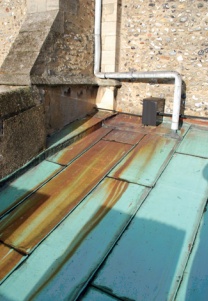
| Iron-staining caused by a steel overflow pipe to the heating system |
Acid corrosion of the copper sheet either by acidic run-off or concentrated flue gasses will lead to thinning of the sheet. The acid solution removes the protective patination and oxide layers accelerating corrosion of the metal. Excessive thinning can lead to perforations developing in the metal.
Deterioration of the structure or underlay to the roofing can be caused by condensation if ventilation of the understructure is inadequate. Deterioration may be due to earlier failure of the roofing as described above. In either case it is likely to lead to further mechanical failure. In this way defects in the under-structure or roof covering can lead to progressive failure of the roof if they are not dealt with when they become apparent. The use of roofing felt and wood-wool underlay, introduced in the 1960s, has led to the premature failure of some roof coverings.
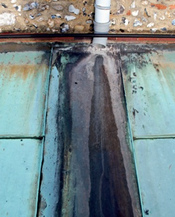
Staining is a common defect of copper roofs. It does not reduce the weathering capabilities of copper, but can significantly affect the visual appearance of the roof. Run-off from other metals, particularly those subject to oxidation, leaves metal oxide deposits in the patination layer, changing its colour. Run-off from steel or iron surfaces creates brown staining and run-off from lead surfaces creates grey staining. The only way to remove this discoloration is to dissolve the patination layer and then re-patinate it. The process for removing the oxide layer using a 5-10% solution of sulphuric acid is described in Ashurst and Ashurst’s Practical Building Conservation, Volume 4: Metals (see Recommended Reading). The solution must be handled and applied very carefully as even diluted run-off can badly stain adjacent wood or stonework.
REPAIR METHODS
Recommended repair methods for copper roofs are described by Ashurst and Ashurst and in the Defence Estates’ publication Roofs: Metal Sheet and Asphalt (see Recommended Reading).
In most roof coverings the sheets are held together through the use of welted joints. It is possible to re-open these joints and replace the defective sheets. Where necessary, the sheets can be replaced with sizes that are better suited to the mechanical forces which the roof covering is subject to.
Difficulties can arise from this method of repair because of the properties of copper. Hammering copper will harden the metal. Hardened copper sheets may fracture while the joints are being opened up or re-formed. Copper can be softened again with the application of heat, a process called annealing. Small areas of damage can be patched using soldering, brazing or welding, but all of these require the application of heat in some form. Consideration must be given to the potential hazards and the fire risk to the under-structure. The use of hot-work permits may be required. Where the risk is to a vulnerable or significant under-structure or building, the application of heat may be inappropriate.
 |
|
| Lead-staining caused by run-off from a higher lead-covered roof |
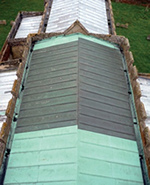
It may be possible to replace a smaller area of roof covering, particularly if it can easily be jointed to the existing sheet without the risk of excessive hardening and without the application of heat to anneal it. Cutting back the retained sheet and using a batten joint at the seam, so reducing the amount of work applied to the existing copper, can avoid splitting the hardened copper. This method is often appropriate where damage has been caused to part of the roof by extreme weather, as at the Church of St Mary the Virgin in Dalham, Suffolk, which suffered storm damage in 1987 (illustrated below). Due to the relationship between patination and impurities in the air, new copper sheet may take longer to patinate than historic copper sheet and may not match retained elements. However, copper can be pre-patinated to match an existing colour.
Patching small areas may be all that is needed where the roof covering is generally sound. The small area repairs described by Ashurst and Ashurst in Practical Building Conservation, Volume 4: Metals involve hot-works. Understandably, current practice does not favour hot-works when working on listed buildings. A recent study of church repairs found the techniques suggested by Ashurst and Ashurst were rarely used despite the likelihood that they would provide a more durable fix.
Most small repairs are carried out using some form of adhesive material: gluing copper sheet with black mastic, self-adhesive flashing tape, mastic tape and mastic beads. None of these methods can be recommended due to their short life span. Repairs of this type are often applied without thoroughly understanding the underlying fault. However, the most common reason why these repairs fail is that they have been applied over the patination layer. This layer is porous so the weathering process continues unchecked, leading to the bond between the roof surface and the repair patch breaking down.
At St Mary’s Church, Boxford, the architect has devised a successful cold repair method. The first stage is to remove the patination layer around the area of damage using a dilute acid solution in water. Then a triangular patch of copper sheet is adhered to the cleaned surface using acid-curing silicon. The triangular patch, pointing up the roof slope, allows water to be shed away. Although this method has not yet been extensively trialled, repairs are currently reported to have lasted more than ten years.
CONSIDERING REPLACEMENT
 |
|
| The roof of St Mary the Virgin, Dalham, Suffolk, which was partially re-covered following storm damage. The new copper may never match the original as the development of patina on copper depends on climatic conditions and these have changed over time. (Photo: The Whitworth Co-Partnership LLP) |
A number of post-war repairs now need significant attention after only 50 years. This is commonly due to shortcomings in the supporting structure, original specification or the workmanship. It should be borne in mind that these repairs were carried out at a time when resources were limited and during a period of rapid expansion in the amount of repair and construction being undertaken by contractors and professionals who were unfamiliar with the material. This was also a time of technical development and experimentation in the method of laying copper.
If the cause of a defect relates to the laying or specification of the copper sheet, or relates to some defect in the under-structure, the problem will worsen unless it is addressed and removal and re-laying may be the only viable option. In these circumstances, to conserve historic methods of installation and appearance, the replacement works should be laid in a manner which best matches the original detail but overcomes any shortcomings in the method or specification originally used, rather than specifying the now ubiquitous long-strip method.
Well-laid and supported copper should reasonably last 80 years or more. The sustainability of copper as a roofing material is improved by suitable repair rather than replacement. The relatively high cost of copper can mean that other roofing materials are used for replacement. This can result in a significant visual change to the building and the loss of copper as a historic roof covering.
~~~
Recommended Reading
J Ashurst and N Ashurst, Practical Building Conservation, Volume 4: Metals, English Heritage Technical Handbook, Gower Technical Press, Aldershot, 1988
The Guide to Copper in Architecture, Copper Development Association, Hemel Hempstead, 2006
Copper Roofing in Detail, Copper Development Association, Hemel Hempstead, 2002
Copper Through the Ages, Copper Development Association, Radlett, Herts, 1955
Historic Buildings Factsheet 3.02, Roofs: Metal Sheet and Asphalt, Defence Estates, HMSO, London
F Röbbert, TECU Copper Planning, Designing and Processing, KM Europa Metal AG, Osnabrück, Germany, 2000
This article is an abridged version of the author’s dissertation The Care and Conservation of Copper Roofing to Historic Buildings, 2009. A digital copy is available on request (Email jg@davidlelay.co.uk).