
The Limits of Lime
Repointing a damp church tower in the Hebrides
Paul Harding
 |
||
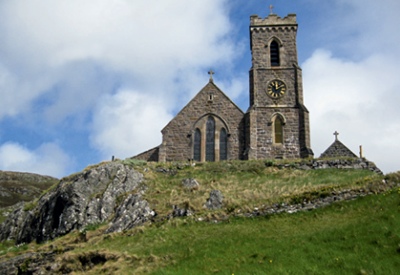
| Our Lady, Star of the Sea stands high above the sea at Castlebay on the Hebridean island of Barra, and its tower takes the brunt of the wind and rain |
It is generally held that if a solid stone wall is pointed with a permeable lime mortar, the high rate of evaporation from its surface will limit rain penetration to just a shallow surface layer. It would certainly never be expected to reach the inner face.
However, there have been a few recent cases on exposed sites which have shown that this assumption cannot be relied on. One of these is the category B listed Victorian church of Our Lady, Star of the Sea on the Hebridean island of Barra.
OUR LADY, STAR OF THE SEA
Barra is the most southerly inhabited island of the Western Isles, lying west of the Scottish mainland directly in the path of frequent Atlantic gales. It has some of the most extreme weather in the British Isles, with very high average wind speeds and an annual rainfall of about 1,100mm, almost twice as much as London. The fact that the Gulf Stream ensures that air temperature rarely drops below freezing is little consolation.
The church faces the prevailing southwesterly wind from an elevated site above the village. Designed by George Woulfe Brenan, an engineer and architect based in Oban, Our Lady, Star of the Sea was completed in 1888, and has squared walling of the local Lewissian gneiss with ashlar dressings of imported Elgin sandstone. Lewissian gneiss is a very hard metamorphic rock which is difficult to work but has an attractive range of colours from reddish-brown through grey to black. This stone appealed to the mainland Victorian architects and engineers who used it widely on the island for constructing new larger churches, schools and other buildings. The choice was influenced by the Gothic Revival and the tracts of Pugin and Ruskin. Very few of these designers followed the traditional Scots practice of coating walls with harling, the protective mortar harled or hurled onto the wall which is ideally suited to severe environmental conditions.
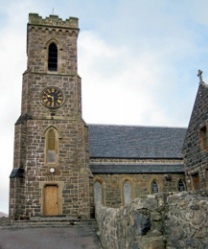
Damp problems have beset Our Lady, Star of the Sea since it was first constructed. The church consists of an arcaded aisled nave with a square clocktower over the entrance porch, where the heavy bell is supported off walls built in three stages, thicker at the porch than at belfry level, and buttressed at the external corners. Only the tower has this stepped section, and this is where most of its damp problems originate.
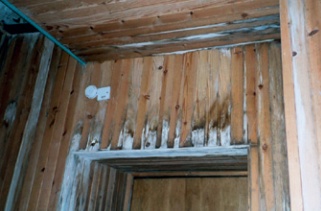
The building had undergone a series of earlier repairs. In the 1980s a major dry rot outbreak resulted in most of the original timber safe lintels (the innermost lintel over an opening) being replaced together with the boarded linings. The walls were then repointed with cement-based mortar, and coated with silane water repellent. How long this coating lasted can only be guessed, but it had no apparent effect. The tower walls continued to leak so much that a system of internal gutters and downpipes was installed to try to intercept water inside the building: these ran for several days after rain. Lime leaching from the tower core created stalactite-like deposits in sheltered areas inside and out. The porch walls were very wet, and its boarded linings were black with mould.
A programme of repairs was undertaken on behalf of the RC Diocese of Argyll and the Isles in 2004-2005. The approved project included re-slating, new leadwork and rainwater goods, as well as repointing the whole building using lime-based mortar. The scheme was grant-aided under the Listed Places of Worship (LPW) programme, which in Scotland is administered by the Heritage Lottery Fund and Historic Scotland. The new scheme provided the opportunity to remedy the long-standing penetrating dampness in the tower walls, but as the diocese was informed, there could be no guarantee that the penetrating damp would disappear completely. There was, however, an expectation that the problem would not be more acute afterwards.
ASSESSMENT AND SPECIFICATION
A thorough survey of the structure found the stonework to be in very good condition, and no indenting work was needed. Petrographic analysis by the British Geological Survey confirmed that the gneiss was extremely impervious, eliminating the possibility that moisture was getting in through the stone. The focus of the repair work to the tower walls was therefore on ensuring the integrity of the mortar joints, and that rainwater was properly shed from the roof.
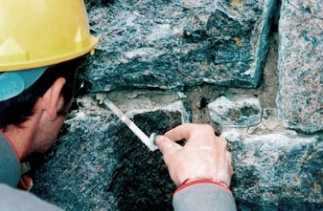
Most pointing on the building was found to be mechanically sound, and only at the west gable and on the tower walling was it cracked or not properly bonded. Because of this, and since removing well-bonded cement risked damaging the adjacent stonework, especially the fine sandstone, Historic Scotland agreed that sound areas should be left alone. Repointing was therefore largely confined to the tower and west gable. In the tower joints the residue of the original bedding mortar was found to consist mainly of wet sandy granular material, the result of lime leaching, under 20mm or so of cement mortar. Raking out this material and tamping new mortar into joints to an average depth of 150mm was a requirement.
 |
 |
| Before work commenced, the base of the tower was very wet and the timber linings in the porch were saturated and decaying |
A mason repoints the gneiss walling using a traditional, highly permeable hydraulic lime mortar to a depth of 150mm |
The particular problems of the tower, including the likelihood of water being retained in intramural voids, had been reviewed at an earlier stage. The structural engineer required that the tower wall was opened up so the core could be inspected. He looked into the possibility of grouting these voids but considered that the exercise was likely to be an expensive failure. He recommended repointing using the appropriate NHL lime mortar for the situation, also one of Historic Scotland’s requirements. The Scottish Lime Centre then undertook sampling and laboratory research, including determining the original mortar mix and composition. It set out recommendations for the new mortar to be used, which were then agreed with Historic Scotland.
The original mortar mix was found to contain locally burnt shell lime and beach sand which has a high proportion of rounded particles, and was considered unsuitable for pointing the masonry. Another conclusion was that the church had probably leaked since it was built, and photographs taken shortly after it opened showed much lime staining of the masonry.
The main reference documents for repointing work at the time the project was specified were Technical Advice Note (TAN) 1 ‘Preparation and Use of Lime Mortars’ published in 1995 by Historic Scotland (1) and an English Heritage study of remedial methods used to combat dampness in west country churches, published in 1989.(2) TAN 1 sets out the technical case and recommendations for the use of lime-based mortars, particularly in buildings constructed of dense impervious stone.(3) The English Heritage study compared alternative remedies for impervious stonework and concluded that repointing with an NHL (hydraulic lime)-based mortar was the best solution where walls could not be rendered.(4)
WORK ON SITE
Using a traditional lime mortar in this remote island site required good organisation. There was no local contractor with adequate knowledge of this type of work and therefore a suitably experienced off-island stonemasonry firm was employed as the masonry subcontractor. Although the lime itself was to be provided ready-prepared, the mason required the local main contractor’s men to help him undertake some of the basic preparatory work. The enthusiastic main contractor enrolled himself and his men on a specialist lime mortar training course on the mainland to familiarise themselves with this material, which is rarely used on Barra. They all received commendations for their work. It was hoped that the project would result in more local familiarity and acceptance of lime work, providing greater community benefit.
Lime work would require more frequent inspection than the architects could provide, so a very experienced retired surveyor was interviewed and appointed as a Clerk of Works by the diocese. It seemed that the stage was set as well as it could be to suit this island project.
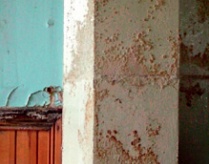
Some internal work began on site in late 2004 but hurricane-force winds in January 2005 caused long delays as the contractor was fully occupied with emergency repairs elsewhere. The scaffolding was finally erected in May 2005. As work progressed it became clear that the thicker tower walls would take a very long time to dry out, even if the repointed walls succeeded in reducing water ingress. But the wall at the south aisle arcade grew significantly damper: the gloss painted stone pilaster and arch blistered, and unsightly stains appeared on the framed plasterboard and timber lining. These areas are of course very visible to worshippers.
The porch contains the war memorial, a copper wall plaque fixed to the timber lining, so had to be kept as dry as possible. The priced proposal had been for an independent framed wall and ventilated cavity, reducing the porch’s already small area. On Barra external vents can let in wind-driven rain, so ventilation had to be to the interior, which inevitably would become more humid from the wet walls.
After the decision to reduce the extent of repointing, with Historic Scotland’s approval a proprietary drained tanking system was introduced. This kept the original porch floor area and allowed a new flagstone floor to be laid in place of slippery and unsightly 1980s tiles; the contractor completed the work without affecting contract period or overall cost. The fact that moisture cannot now evaporate from the porch walls is unlikely to have caused the increased dampness on the nave side, as the rubble wall core provides a multiplicity of routes for damp percolating eventually into the sandy sub-floor.
PERSISTENT DAMP IN THE FINISHED WORK
The specified remedial work using lime-based mortar followed established best practice, but without success: damp still affects the same walls. What went wrong? With hindsight it seems that the particular circumstances of the building have thwarted the best intentions of all involved. It has of course been a very frustrating experience for everyone.
 |
|
| The tower wall from the south aisle after completion: damp persists, damaging the new paintwork and timber linings |
Originally it was suspected that failures in the leadwork at the roof/tower junction and in the nearby roof drainage were making a decisive contribution to the damp problems below. Unfortunately, delays in remedying these defects delayed a clearer diagnosis.
Water seepage is now present in the middle and lower stages of the tower but not at the thinner top stage, where the renewed and realigned parapet gutter keeps the wallhead dry. This means that neither the roof nor the sandstone ashlar facings and projecting machicolations (the ornamental row of small corbelled arches) below the parapet level are likely to be the source of dampness in lower walls, and this conclusion is supported by the fact that sandstone elements elsewhere do not appear to conduct water into the interior except at the relatively thin window reveals.
There is of course more surface water running over the sandstone from adjacent walling than if the building was made entirely of sandstone, but (as in the cement-mortar pointed remainder) it does not appear to be a significant factor in the tower walls. The damp source is clearly the repointed gneiss tower walling.
The next question was whether the new mortar was exactly as specified, but after opening up it was found to be correct and well-carbonated. This confirmed that in this instance the established method of repair was itself at fault.
PRELIMINARY CONCLUSIONS
The tower walls’ construction can be summarised as follows: it is largely made of impervious stone; in the lower stages between the two masonry skins there is a relatively wide zone of backfilled random rubble where the original bedding mortar has degraded to sand, leaving occasional voids; there are impermeable bonding stones tying the two skins together, including those of the diagonal buttresses; and the outer walling is now pointed with a well tamped hydraulic lime mortar to almost the full depth of the joints.
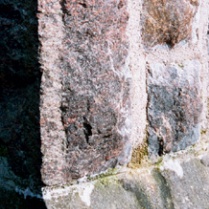
Since the walls continue to admit moisture despite the porosity and depth of the new mortar, the assumption made in authoritative technical papers is not correct: in extreme environments the rate of moisture evaporation from the surface of a lime mortar joint is not sufficient to keep the structure dry. This may be because there are significant air pressure differences between the exterior and interior over much of the year, and between different sides of the tower. Rainwater pushed through the porous joints by strong wind remains in the core, either in voids or in the degraded mortar, transforming it into a sponge, and which air pressure differences then pump into the interior. Rainwater is also able to percolate out along the repointed external joints much more than it could with the previous cement pointing, and it is leaching out lime, disfiguring the masonry.
 |
||
| The tower from the south showing the entrance to the porch at the base of the tower |
In an environment like this where a masonry wall is constructed of an impervious stone and is pointed with a lime mortar, one solution would be to introduce a lime-based overcoat (harling or render), as this would dramatically increase the area available for surface evaporation. But the church’s appearance could not be altered: its listing means that its character is protected by law.
Another option would have been to grout the core of the wall, and it may have been premature to dismiss this option. However, the engineer’s assumption of failure was based on his experience of similar masonry structures in similar environmental conditions, and there are other well known examples where grouting has been tried and failed, as in the case of some Norfolk flint towers. Furthermore, grouting is not reversible, and this alteration would not have been supported by Historic Scotland without further research.
For a project like this, where the scale of the work is very limited, it is not possible to undertake case-centred research prior to embarking on the scheme, and so the true nature of the problem may not be understood before work is irreversibly committed or complete.
With Historic Scotland’s approval a line has been drawn under the project. Nevertheless, with the evident failure of the pointing to keep wind-driven rain out of the interior, if more effective remedial action is to be taken, then more (possibly expensive) work will be needed. Finding a successful approach will require a careful review of realistic options, and a firm recommendation based on evidence. Any alteration to this listed building will need to be justified both to the client and to Historic Scotland, as will further financial outlay.
THE WAY FORWARD
Penetrating dampness in historic masonry structures of all kinds is not uncommon, and from the evidence of several other Scottish churches, it seems that chronic penetrating damp often persists even after repointing with lime mortar. Published guidance for professionals dealing with such situations does not adequately cover the problem and may need to be reviewed. Research is long overdue into the precise causes, the mechanisms involved, and the alternative specification options – particularly where it is not possible to introduce an external render or harling of lime mortar. Until then, the difficulties and disappointments are likely to continue. However, help may be at hand.
Over the past seven years English Heritage’s Damp Towers Project has undertaken the only significant research in this area, working with Oxford and Sheffield Hallam universities. The research takes forward the 1980s study into rain penetration in West Country church towers by examining a group of exposed church towers in Devon and Cornwall that suffer from penetrating damp, and by assessing the remedial methods adopted in similar grant-aided repair schemes. Research is nearing completion, lab work has finished and English Heritage is currently reviewing case studies and inspecting towers that were repaired many years ago. This work is expected to be completed by April 2011. When it is published it should go some way to provide the research data we need.
From preliminary information there seems to be evidence to support grouting in cases where render or harling is not an option, provided the wall construction is suitable.
 |
|
| A detail of one of the buttresses: Less than five years after repointing, lime is leaching out of the mortar once again |
A third option subsequently considered for Our Lady, Star of the Sea is to provide a continuous damp proof course through the tower walls using the same construction method as underpinning. This would ensure that water percolating down through the core of the tower wall could at least be collected and drained. However, this option presents considerable technical challenges, and since the masonry would remain saturated, it would not provide a suitable solution for buildings exposed to severe frosts.
Inevitably there are technical and cost issues to be resolved with all such proposals, and as no two buildings are the same, there is a strong case for some building-centred research to investigate the best option.
In the interim, until a definitive answer can be agreed, the diocese has specified minor work including a ventilated strapped lining for the aisle wall and removing the remaining built-in timber in the tower wall. This will help to alleviate or avoid more problems, but the damp walls will remain until an effective treatment can be found. Stripping the paint (which is non-original) from the affected stone to allow evaporation will also help, although there will be some minor implications for comfort and heating costs.
Repair projects such as this are inevitably of great local importance. The church building is the focus and symbolic heart of many rural communities which often have few resources except enthusiasm. The efforts made to organise the project and raise funds to allow it to proceed cannot easily be repeated, but somehow funds for further work will need to be found. Our Lady, Star of the Sea could provide an example of how to resolve a difficult problem affecting many similar buildings.
~~~
Note
The stonework repair project at the Church of our Lady, Star of the Sea, Castlebay was funded by the Listed Places of Worship programme, which is administered by the Heritage Lottery Fund and Historic Scotland.
References
(1) Preparation and Use of Lime Mortars: Technical Advice Note 1, Historic Scotland, 1995
(2) Rain Penetration in West Country Church Towers, English Heritage Research Technical and Advisory Services, 1989
(4) ibid, Part 4 Conclusions and Recommendations, para 4.7