
Damp below Ground
Geoff Maybank
 |
||
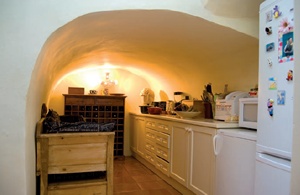
| A vaulted cellar of a Georgian terraced house in Bath: the cellar has been successfully adapted to provide a useful extension to the kitchen. |
Changing weather patterns in the UK have led not only to increased risk of low lying properties being flooded, but also to a periodic rise in the water table in many areas. In a modern cellar which has been mechanically tanked with a membrane to a high enough specification, a rise in the water table may not present a problem, but in older property, water can appear as if by magic and to a considerable depth. Finding the cause of damp below ground level is not an exact science and getting to the bottom of a problem, particularly on site, often requires some lateral thinking. The subject is as long as the proverbial ball of string, and for this reason the following article focuses on below ground rooms that are either habitable or have been habitable in the past.
Rooms below ground come in many forms. They can be simple cellars built below the footprint of the building and without windows or, on a sloping site, one or more walls may be exposed to provide natural light and an external entrance. In some cases the cellar lies outside the main footprint of the building, with at least three walls and the roof covered by the external ground, and there are many examples of Georgian, Victorian and Edwardian basement areas which extend under the pavement. Parts of ground floor rooms are often below ground level due to a sloping site, and there are also examples of basements that are almost entirely above ground, as at Victoria Baths in Manchester, although this may not be readily apparent.
DOMESTIC CELLARS
Historically, to build a house with a simple cellar it would have been necessary to find a well-drained piece of land. After digging out the ground to a depth of perhaps 1.5-2 metres, the cellar walls would have been constructed with a 300-500mm-thick lining of stone or brick and with a drain primarily for cleaning down and use of water within the cellar space. The floors would have been built up on crushed stone or sand to provide a level surface and paved, usually with flags. Brick paving, which was used in areas of the country where suitable stone was unavailable, became more common in later periods.
In small buildings the cellars were simply covered by the timber ground floor and ceilings of lath and plaster, but in larger houses arches and barrel vaults were often used to enable the floor above to be paved. If constructed for storage purposes, domestic cellars often have stone benches for salting meat and coal chutes, which are common across the country.
As residential buildings became more sophisticated in their internal layout, certainly by the 17th century, lower ground floors became popular. Many houses gained both elevation and a more imposing facade by having the main entrance at a half or full level above ground with steps leading up to the front door and with much of the lower space being below ground.
 |
|
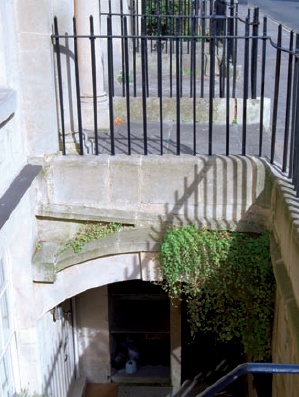
| A typical Georgian terrace in Bath: the area provides light and access to the kitchen on the lower ground floor, and cellars extend under the pavement on the right. |
The advent of the new order of internal space separated family from domestic staff. This produced a need for preparation and storage areas, as well as places for staff to live. As a consequence, large basements or lower ground accommodation, with windows, external doors and chimney breasts were introduced at this level, not only in stately homes, but also in terraced houses. Perhaps the high point, as it were, of lower ground floor space can be seen in Georgian and Victorian vernacular housing. A walk around a Georgian development like Edinburgh’s New Town shows a wide range of sub-floor accommodation with front and rear access and raised upper ground floors.
By the end of the 19th century, as domestic staff were lost and food refrigeration and canning became available in the early 20th century, the need for storage cellars disappeared. Nevertheless, lower ground floor accommodation is still being built, and in the larger towns and cities where planning restrictions and limited building space have created new pressures, many old cellars and lower floor kitchen and service areas are being converted into living accommodation.
Whatever the form, all structures below ground level are vulnerable to a range of problems, but damp and water penetration will always be high on the list. In most cellars, of which there are well over 550,000 in England alone, the walls and floors alone provide the barrier between the ground and the interior. However, many basements were more elaborately constructed with barriers and wall cavities to shield the interior from penetrating damp. Wall cavities provide a buffer, affected by condensation from the interior and damp from the exterior, which could then be drained. Running away from the outer edge of the walls might be land drains to divert water away from the house, especially from the up-hill side of the dwelling, and from surface water run-off from the building itself.
Such methods of keeping habitable, below ground spaces dry, certainly date from the Georgian period, although there may be earlier examples.
DEFECTS
Water which appears on retaining walls or floors today may come from the exterior, due to penetrating or rising damp and in some cases through leaking land drains or sewers, streams, and a fluctuating water table. But it may also be the result of condensation or leaks from internal services. All possibilities need to be considered.
When first built, most below ground structures were fit-for-purpose, with floors and ceilings that were fairly level and walls that were close to vertical. Otherwise they would not have survived, often for many hundreds of years. It must also be the case that when such lower level spaces were first built they would have been generally usable and relatively dry, if only by the standards of the day. (A cellar built without any damp-proofing will always be slightly damp when compared with a modern tanked alternative.) Thus any problems that we find on site today are likely to be the result of a change in circumstance from that position, and we need to ask the simple question: what might have changed? To answer this we need to look for evidence on site:
- How is the cellar or basement constructed? Is it built totally or partially underground? Is it porous, allowing damp to pass through as penetrating or rising damp? Was it originally designed with a drainage system? If we assume that the original format worked, then which part is failing? An understanding of how it was built starts to lead to a diagnosis.
- Has any change taken place to the subfloor space since it was built? Concreting floors, blocking up windows and doorways, and removing or bricking-up flues can reduce air circulation and so increase condensation and reduce evaporation. Replacing floors with a damp-proof membrane and concrete overlay will increase the amount of damp in the surrounding walls, as they offer the most immediate escape route for ground water trapped below a new floor. Wall linings can have an effect on condensation and damp levels by reducing air flow against the walls of the cellar, and they also introduce the added problem of rot if, as often happens, a timber framework has been used and is in contact with wet walls or floors.
- If the room is no longer used, has this caused a reduction in air circulation and heat and so altered the evaporation rate in the space? A return to full use might improve moisture levels in areas with minor damp or condensation problems.
- Has something changed close to the house that has altered the performance of the sub-floor areas? Often, land drains which once kept the amount of water in the subsoil to a reasonable level become blocked with roots or debris, ultimately causing water to seep through the retaining walls and into the building. Road or pavement works are notorious for causing this type of problem.
- Are there damp-proof materials which could have broken down with age? These include the gaskets of sewer pipes as well as damp-proof membranes (DPMs) and bituminous coatings. Structures with built in DPMs tend to be modern, constructed since World War I. In many cases the only way to fix this type of problem is to open up the membrane and undertake a physical repair.
- Has damp-proofing been carried out in the recent past? Injection damp proof remedies seldom work properly. The process involves pumping silicon into a wall under pressure, saturating the brick or stonework with a waterproof material. However, the mortar between stone or brick and any voids in the structure still allow moisture through, especially if this is under pressure from the ground behind. Rendering with a waterproof additive is then applied to seal off the moisture. However, even if very well undertaken, this type of repair tends to have a limited lifespan.
FIXING THE PROBLEM
Once you have established how the sub-floor space has been constructed and have tried to assess the cause of the fault (which may take several visits and even opening-up works), then a decision can be made on how to address the problem.
- A simple land drain problem or broken surface or foul water drain can be repaired or replaced with some expectation of a return to the status quo. However, great care must be exercised in laying new land drains as a radical drying of the subsoil leads to shrinkage, especially in clay areas, and often causes movement in the building.
- If the cellar suffers minor flooding and is to be used for storage only, then the creation of a sump drained by a pump with a water-sensor or float switch will often work reasonably well.
- Where it is possible to dig down externally, water ingress can be reduced by introducing a damp proof membrane, usually of polypropylene sheeting, against the external face of the retaining wall with a land drain at the bottom. Without the ability to connect this membrane to a horizontal damp membrane across the floor, the results will never be perfect, but good results can be achieved.
- Internal tanking can be used if the original internal surface of floors and walls can be lost from view. However, if the building is listed, listed building consent would be required, and this might not be possible with an important cellar or basement interior. If tanking is permissible, the laying of drains internally to take excess water out of the building and the tanking of the internal space with polypropylene or geotextile lining to the floors and walls can be very effective. Walls can then be lined with plaster, or with blockwork and plaster, and floors re-laid with new concrete and a screeded finish to create a solid and level working surface. The damp is not removed but its presence no longer affects the use of the space.
 |
|
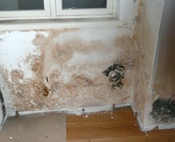
| Mildew and mould are perhaps the most common signs of a damp retaining wall. |
The real problem with tanking is that unless it is carried out to the exterior of the fabric, the damp remains in situ. Furthermore, a membrane applied to the inner face relies on its adhesion alone to resist water pressure. Excessive water pressure can damage or lead to leaking of the membrane material, and any timber such as window frames, lintels, floor joists, skirtings and architraves all need to be wrapped or isolated from the remaining damp source to prevent an outbreak of wet or dry rot. Behind skirtings and other joinery, dry rot can progress un-noticed causing extensive damage, and must be prevented.
To be effective, the membrane has to run continuously under floors and up walls which will often require floors to be reduced and re-laid if head room is limited. Internal walls and other structures rising from the floor will also have to be incorporated in the tanking strategy, either by isolating them from damp sources (usually the floor and the retaining walls) or by tanking them, too. It must be appreciated that the cost of this type of work can be expensive.
The use of membranes either in conjunction with drainage systems or as part of a full tanking system can be quite effective if properly thought through, allowing lower level accommodation to be successfully reused. This said, trying to achieve 21st-century standards of water-tightness in an 18th-century cellar perhaps misses the point. These areas were never designed to perform as well as today’s structures and sometimes we need to be prepared to live with what our ancestors provided rather than use expensive modern alternatives, which in some cases add little to the performance of the space while obviously altering its appearance.