
Ecclesiastical Exemption in England
Richard Morrice
 |
|
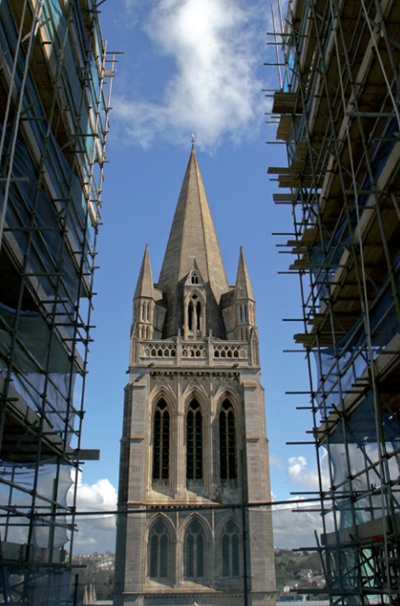
| Truro Cathedral, with the west towers under scaffolding and the central tower beyond. As a place of
worship owned by one of the exempt denominations, alterations which would usually require listed
building consent are dealt with under the exemption through an internal ecclesiastical system of control.
However, as the current works are supported financially under the Cathedrals Grants Scheme, in this
case English Heritage retains considerable control over the conservation work. (Photo: Mike Newman) |
Ecclesiastical exemption dates back almost to the beginnings of the development of legislation for the protection of historic buildings and sites, as a result of the failure of a push for Church of England cathedrals to be covered by the Ancient Monuments Consolidation and Amendment Act of 1913. Any protection of Church of England churches therefore had to rely on the Church of England’s procedures of faculty jurisdiction, a legal system for control of works to churches which dates back to medieval times. However, to answer the complaint about the lack of explicit controls over works to churches and cathedrals, the archbishops set up the Ancient Monuments (Churches) Committee in 1914, presided over by Sir Lewis Dibdin, the then Dean of the Arches (the head of the Court of Arches, the ecclesiastical court of the Church of England which covers the southern two-thirds of England) and a noted ecclesiastical lawyer and administrator. Apart from recommending improvements to the faculty jurisdiction process, the committee also proposed that advisory committees be established in each diocese ‘for the assistance of the court in architectural, archaeological, historical and artistic matters relating to churches as to which faculties are sought’.
By 1921 a number of dioceses had appointed diocesan advisory committees (Truro was the first DAC) and there was felt to be sufficient critical mass for the creation of a co-ordinating body, the Central Committee for the Protection of English Churches and their Treasures, with each DAC sending two representatives. Over time CCPECT metamorphosed into the Council for the Care of Churches, a subordinate body to the central church administration. In 2007 the CCC united with the Cathedrals Fabric Commission for England, which had been set up following the Care of Cathedrals Measure 1990, to become the Church Buildings Council. DACs themselves became statutory in 1938.
Diocesan advisory committees might look something like a local authority planning committee to the uninitiated, but they are not decision-making bodies; they are strictly advisory, having been grafted onto the faculty jurisdiction system of the Church of England. It is their job to give advice to the chancellor of each diocese, a legal officer who has a number of other diocesan roles but whose time is nowadays much taken up with decisions on petitions for faculty. Indeed the legal derivation of the system is underlined by the decisions being made by the chancellor sitting in a court; for this reason, any inquiry held by a chancellor into a contested faculty takes place in a ‘consistory’ court (actually, usually the church in question in terms of place; the court will always be a serious place but may not be as strictly formal as the name suggests). The administration of the court is undertaken by another legal figure, the diocesan registrar.
One result of the legal setting of the system is the underlining of the independence of dioceses, one from another, particularly because chancellors, as judges, cannot have their discretion fettered. This has meant that the central body has always had problems in co-ordinating the work of DACs, always aware of their autonomy.
Various refinements to the system have been made over the years, including the introduction in 1955 of the requirement for five-yearly (quinquennial) inspections of all churches by a suitably qualified architect. Cathedrals and their precincts, also considered generally exempt, have also received their own legislation, the Care of Cathedrals Measure 1990 and subsequent amendments. It set up fabric advisory committees which, unlike DACs, have decision-making powers, supported at national level by the Cathedrals Fabric Commission for England, which itself decides some classes of major applications.
The early history of the exemption relates to the Church of England, but that should in no way underplay the importance of the other denominations.(1) If the Church of England had a system for the control of works to churches, it was clear by the 1990s that other places of worship lacked control due to the absence of secondary legislation to define the limits of the exemption; at that time all churches and chapels were technically exempt. The Town and Country Planning Act 1971 had contained the power to vary or restrict the exemption but the power was only taken following the separation of conservation law from planning law with the Planning (Listed Buildings and Conservation Areas) Act 1990 and the drafting of secondary legislation. Various reports during the 1980s and early 1990s had pointed to the need for some tightening up, but it was the publication of the Ecclesiastical Exemption (Listed Buildings and Conservation Areas) Order 1994 which made it plain where the limits of the exemption sat. Henceforth only the following church buildings were exempt from the need for listed building consent and conservation area consent (the order covers both England and Wales):
- buildings within the faculty jurisdiction of the Church of England
- buildings subject to the Care of Cathedrals Measure 1990
- buildings of the Church in Wales
- buildings of the Roman Catholic Church (but not presbyteries)
- buildings of the Methodist Church
- buildings of the United Reform Church; and
- buildings of the Baptist Unions of England and Wales.
In England, the five denominations commonly referred to as ‘the exempt denominations’ are the Church of England, the Roman Catholic Church, the Methodist Church, the United Reform Church and the Baptist Church.
 |
|
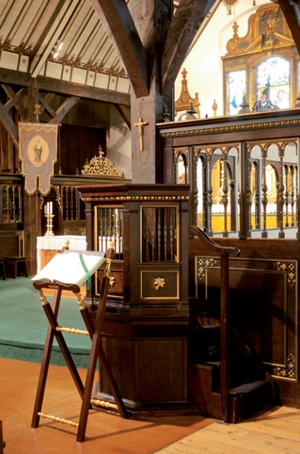
| The striking interior of the Church of the Annunciation, Brighton (Photo: Matthew Andrews, reproduced by kind permission of SAVE Britain’s Heritage from Brighton Churches: The Need for Action Now by Thomas Cocke) |
The exemption also applies to buildings within a ‘peculiar’ of the Church of England (these are churches which, for various reasons, are not under the control of a diocese) such as Westminster Abbey, St George’s Chapel, Windsor and Christ Church Cathedral, Oxford.
Beyond this, a number of places of worship which may be considered not to be subject to the control system of the exempt denominations, are also covered by the exemption. Into this category falls any building used for worship according to the rites, doctrinal standards, principles and usages of the Church of England, the Roman Catholic Church, the Methodist Church, the Baptist denomination or the United Reform Church on any premises forming part of:
- a university, college, school, hospital or inn of court, or
- a public or charitable institution, other than one referred to above, if the premises in question do not consist solely of that building or its curtilage
- buildings of religious communities of the Church of England
- buildings of a Roman Catholic religious institute or society of Apostolic life
- buildings of certain denominations subject to a sharing agreement, and
- buildings in use for worship according to the rites, doctrinal standards, principles and usages of the Church of Scotland, Free Church of Scotland and the Free Presbyterian Church (in England and Wales).
For all these denominations, except in the case of Church of England cathedrals, the exemption applies to church buildings, objects or structures within the buildings, similar things attached to the exterior of a church building, and any object or structure within the curtilage of such a building which, although not fixed to the building, forms part of the land.
However, objects or structures within the curtilage have not been considered exempt where they have been separately listed. This latter detail comes from the secondary legislation, or Order, which was published in 1994.
The Order was accompanied by a helpful guidance note, The Ecclesiastical Exemption: What it is and how it works, also published in 1994. For the first time government had pointed out to the denominations what was expected of them under the exemption – the guidance included details of the various denominational systems – and stated that religious buildings held by denominations without control systems were now no longer to be considered exempt, including the Society of Friends amongst others, and buildings held by other organisations of other religions.
CURRENT REFORM
As part of the tidying up of the exemption, government appointed John Newman in 1997 to report on the robustness of the denominational systems of control. His recommendations on improvements were in the process of being taken forward when the current round of Heritage Protection Reform superseded, for instance, a draft new Ecclesiastical Exemption Order (for England only) in 2001. Government then consulted on changes to the exemption in 2004, reported the results of that consultation in 2005, and then outlined changes to the exemption in 2007. These proposals were included in the Heritage Protection White Paper along with wide-ranging reforms to heritage protection. The consultation has led to the draft Heritage Protection Bill and a new draft Ecclesiastical Exemption Order and guidance, both currently available on the DCMS website.
The outcomes of the 2004 consultation can be found in the 2005 governmental response Ecclesiastical Exemption: the Way Forward. They are largely repeated in the Heritage Protection White Paper which summarised the government’s approach to Heritage Protection Reform. What is intended by reform, of which the draft Heritage Protection Bill is an important but by no means the only part, is a wide-ranging revision of processes and attitudes concerning heritage protection. The white paper proposed changes around three core principles: developing a unified approach to the historic environment; maximising opportunities for inclusion and involvement; and supporting sustainable communities by putting the historic environment at the heart of an effective planning system.
The Ecclesiastical Exemption is striking when looked at in terms of those principles. It tends towards the isolation of the control of works to places of worship away from the rest of the historic environment, not only by permitting separate control systems but by its lack of clarity to partners. It can also lead to a lack of involvement for those outside the denominations. On the other hand, a lot of the work is now going on within denominations towards the wider sustainability of places of worship within their communities. This has recently been reinforced with the publication of the joint government/Church of England report Churches and Faith Buildings: Realising the Potential (2009).
 |
|
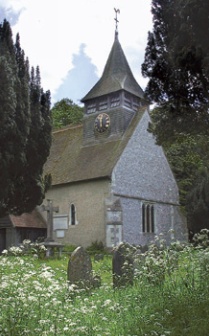
| St Andrew’s, the parish church of South Warnborough,
Hampshire, which was recently adapted with the
help of the Heritage Lottery fund to provide a centre
for local people in the south aisle. The
exemption from usual listed building consent controls
extends to include structures within the churchyard
also, unless listed in their own right. However,
extensions and other external alterations often
require planning permission. (Photo: The Heritage Lottery Fund) |
The proposed result of heritage protection reform is, through rationalisation and openness, a greater willingness of all parties to work together for mutual benefit. With this in mind, as part of the review of legislation, the secondary legislation relating to the ecclesiastical exemption was amended and published in draft alongside the draft bill, with new guidance for exempt denominations. Much of the guidance remains the same but it was brought up-to-date by underlining the importance of such matters as preapplication discussion, heritage partnership agreements (agreements designed to reduce the need to make applications for consent for certain routine types of alterations) and Historic Environment Records. Although the draft guidance emphasises the need for denominational control systems to take into account the significance of historic churches and chapels, and their archaeology, it emphasises that government recognises that churches have to adapt to meet changing preferences and to meet the needs of worshippers and users. As it points out, the exempt denominations need to be able to make the right decisions about changes to churches, accessing the best advice, while taking into account the special interest of listed churches as an ordinary matter of course. Heritage protection reform therefore offers all exempt denominations major opportunities precisely because it offers greater openness, replacing the disadvantages of a closed system.
In this way, a major change to the control regime proposed under the Heritage Protection White Paper is the clearing up of an anomaly in the current system whereby places of worship are exempt, as are any chest and table tombs, mausolea, headstones, churchyard crosses, charnel houses, churchyard walls and lychgates, etc, within their churchyard, but where such subsidiary items are listed in their own right they are under dual control, by both the denominational system and the secular listed building control system. This would remove a sizeable number of listed ‘buildings’ from local authority control, but it would place their management more closely under ecclesiastical charge. The gain in clarity of control by denominations is wholly within the spirit of heritage protection reform. It is difficult to be exact about the numbers of items concerned but it is thought that there are about 15,000 such list entries under dual control.
Heritage partnership agreements (HPAs) offer the denominations significant process savings, especially where repetitive works are the rule. English Heritage and the Church of England have been investigating the benefits of HPAs in such circumstances as cathedral precincts, where there are overlapping controls, and in groups of parish churches, where controls can be rationalised without being relaxed. There is a need for further work on this aspect of the control system but HPAs would appear attractive to the denominations especially as they could be developed internally without recourse to changes in secular legislation. They would offer the benefits of rationalisation and openness which are at the heart of heritage protection reform.
That is the position which has currently been reached. The exemption remains much as it has been since 1994, but there are proposals for widening the exemption to eradicate double-handling of some assets. Much work has been done by the Department for Culture, Media and Sport to clear up ambiguities over the exemption in the case of peculiars and related buildings, and draft guidance has been written following consultation with the denominations. We wait now to see what will happen with the Bill.
Notes
(1) The exemption also applies in Wales which is covered by both current legislation and guidance. This article considers the system as it applies to England.