Brussels and Beyond
The Conservators' Guide to European Institutions
Alexandra Coxen Warr
 |
||
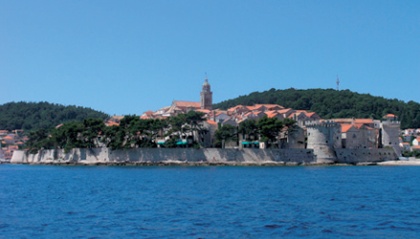
| The walled town of Korčula on Croatia’s Dalmatian coast |
The impact of pan-European organisations, legislation and funding systems on the conservation of the UK’s historic environment is rarely obvious. Professionals, contractors and craftspeople working in this field are generally shielded by the UK government from the might of Brussels, and might be forgiven for thinking that others are looking out for their interests.
However, as the UK’s lime producers recently discovered, an insular outlook can be disastrous. The introduction of the REACH (Registration, Evaluation and Authorisation of CHemicals) regulations in 2007 affects all industrial processes involving chemical reactions, including slaking quicklime for lime mortars. Small scale lime producers in the UK were caught off guard by the registration requirements and, as a result, many UK companies which had previously sold their own lime now only supply material slaked by others.
As the influence of pan-European decision making continues to grow, the conservation bodies and industries in member states need to be more aware of events on the European stage. This article maps the key bodies and organisations in Europe relevant to the conservation of the historic environment. It covers the European Union (EU), the Council of Europe and, finally, the principal European organisations devoted specifically to heritage and archaeology.
EUROPEAN UNION: EU Organs
European Commission The executive arm of the European Union is composed of commissioners and civil servants and it is organised into directorates working on specific policy areas. The commissioners are appointed every five years by national governments and subject to approval by the European Parliament. The commission has the right to propose legislation and is charged with upholding the treaties. It is also the manager and executor of EU policies and of international trade relationships. The commission appoints expert committees and groups of people or subcontracted organisations to manage funding applications and to manage advisory committees of experts which assist in developing policy. The UK’s commissioner is Baroness Catherine Ashton, who has been appointed as High Representative of the European Union for Foreign Affairs and Security Policy (2010-2014).
European Parliament Members of the European Parliament are directly elected every five years from all countries, and operate on the basis of political parties rather than national delegations. The last elections were in June 2009. There are currently 736 members who work in Brussels and Strasbourg, and sit on committees to scrutinise and amend draft legislation. The EP has equal decision-making powers with the Council of Ministers. MEPs approve the overall budget, but do not have input into granting of funds for projects.
UK MEPs are elected on a regional list by UK political party and, once elected, they join the equivalent political ‘family’ at the European level.
Council of Ministers A shifting body comprising prime ministers or presidents of member states which meets to give strategic direction to EU policy making. Councils dedicated to specific areas (such as agriculture) are made up of ministers responsible for that particular subject area and, alongside the European Parliament, agree and adopt the final texts of legislation. Most decisions are made by a system of qualified majority voting, but some are decided by unanimity. The presidency of the council rotates every six months.
EU Directives
There is no remit for the European Union to
legislate in the area of culture. The European
Treaty merely stipulates that the community
must support and supplement action by
the member states in order to conserve and
safeguard cultural heritage of European
significance.
Nevertheless, the European Union impacts on cultural heritage in a number of ways. Many of its policies and laws indirectly apply to this sector. Approximately 60 per cent of the UK’s legislation originates in Brussels, and for the environment this rises to 80 per cent, so it is worth understanding and influencing the relevant policy areas as they are being developed in the European Commission.
The policy areas which can have an effect on cultural heritage include transport, tourism, renewable energy, agriculture, the marine environment, education and spatial planning. Specific relevant measures have included the Environmental Impact Assessment Directive, the Strategic Environmental Impact Assessment Directive, the Habitats Directive, the Directive on Environmental Liability, the Landfill Directive, VAT regulations, employment law and recognition of qualifications, state aid rules, public procurement law, research policy, and many environment directives dealing with pollutants.
EU Funding
There is a small fund devoted to ‘culture’, but
the majority of funding for cultural heritage
work comes from other budget headings, such
as the structural funds, otherwise known as
the European Regional Development Fund
(ERDF) or from the substantial research
budget (generally from the environment or
ICT sections). Each year millions of euros are
available for work, subject to match funding,
involving the historic environment.
European funding programmes are
revised approximately every six years. The
current funding round, 2007–13 offers less
funding for the UK than previously because of
the enlargement of the EU to include countries
from Central and Eastern Europe.
THE COUNCIL OF EUROPE
This intergovernmental organisation (located in Strasbourg) comprises almost all European countries (47 as of 2010), from Iceland to Azerbaijan. It aims:
- to protect human rights, pluralist democracy and the rule of law
- to promote awareness and encourage the development of Europe’s cultural identity and diversity
- to find common solutions to the challenges facing European society such as discrimination against minorities, xenophobia, intolerance, bioethics and cloning, terrorism, trafficking in human beings, organised crime and corruption, cybercrime, violence against children
- to consolidate democratic stability in Europe by backing political, legislative and constitutional reform.
The Council of Europe is the only body acting at the European level which has a mandate for culture and cultural heritage. It has developed and agreed a number of relevant conventions including the European Convention on the Protection of the Archaeological Heritage (Valletta), the European Convention on the Protection of Architectural Heritage (Granada) and the European Landscape Convention (Florence).
OTHER EUROPEAN BODIES
The European Heritage Heads Forum
The EHHF was initiated by English Heritage
in 2006 with a view to creating an informal
meeting place for the decision makers (chief
executive level) in the heritage sector across
Europe where current pressures and possible
collaborative solutions can be discussed.
The European Heritage Legal Forum
The EHLF was founded in September 2008 at the
instigation of the EHHF (see above). This group
is an informal collection of interested legal
and policy persons working within heritage
agencies, whose principal aim is to vet draft EU
directives in the light of heritage needs.
Europa Nostra
Europa Nostra is a pan-European federation
of non-governmental and non-profit heritage
organisations. Its membership includes over
250 heritage NGOs operating in 45 countries
across Europe. It is supported by the EU,
the Council of Europe and UNESCO and was
founded by senior members of the Council of
Europe 40 years ago. It also runs the annual
cultural heritage prizes for the European
Commission.
 |
|
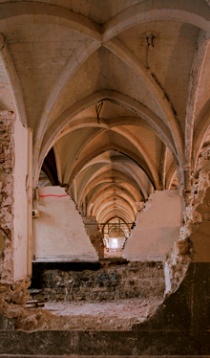
| Le Collège des Bernardins, Paris: a Europa Nostra Awards Grand Prix winner in the conservation category (2010). The college was built in the 13th century as a place of learning for the most gifted young Cistercian monks in Europe. The restoration project (2004--2008) has allowed its fine gothic colonnades, previously hidden by stabilising walls, to be revealed once more. (Photo: Europa Nostra) |
Europae Archaeologiae Consilium
(European Archaeological Council)
Founded in 1999, the Europae Archaeologiae
Consilium is a democratic network of
European heritage agencies. Membership is
open to all national bodies charged with the
management of the archaeological heritage
throughout Europe. Currently 21 nations and
92 separate agencies are members.
The objectives of the EAC are:
- to promote the exchange of information and co-operation between the bodies charged by law with the management of the archaeological heritage of the countries of Europe
- to provide archaeological heritage management agencies with a forum for discussion and exchange of information
- to assist working towards common goals and to act as a monitoring and advisory body on all issues relevant to the management of the archaeological heritage in Europe (particularly in relation to the European Union and the Council of Europe)
- to promote the management, protection, scientific interpretation, publication, presentation, and public enjoyment and understanding of the archaeological heritage in Europe
- to work together with other bodies which share its aims
- to watch over, and act for, the wellbeing of archaeology in Europe.
The EAC provides a single voice to speak out on specific issues that affect archaeological heritage management, and to influence the development of policies by European agencies. It has Official Observer status at the Council of Europe (CoE) and participates in all the latter’s activities relevant to the archaeological heritage. In particular it is currently working closely with the CoE to develop mechanisms to monitor the effectiveness of the CoE cultural heritage conventions and instruments.
European Association of Archaeologists
The EAA is a membership-based association
open to all archaeologists and other related
or interested individuals or bodies. The EAA
currently has over 1,100 members on its
database from 41 countries worldwide working
in prehistory, classical, medieval and later
archaeology. They include academics, aerial
archaeologists, environmental archaeologists,
field archaeologists, heritage managers,
historians, museum curators, researchers,
scientists, teachers, conservators, underwater
archaeologists and students of archaeology.
The EAA was created:
• to promote the development of archaeological research and the exchange of archaeological information
• to promote the management and interpretation of the European archaeological heritage
• to promote proper ethical and scientific standards for archaeological work
• to promote the interests of professional archaeologists in Europe
• to promote co-operation with other organisations with similar aims.
In promoting its aims, the EAA publishes the European Journal of Archaeology (EJA), organises conferences and seminars, and acts as an advisory body on all issues relating to the archaeology of Europe.
What the emergence of these various nongovernmental networks and associations over the last 50 years has demonstrated is that it is only through working together at a pan-European level that the interests of the historic environment can be protected. Greater awareness of events on the European stage is vital, but so too is our ability to influence them.