
Flint and the Conservation of Flint Buildings
John Ashurst and Gerry Williams
 |
||
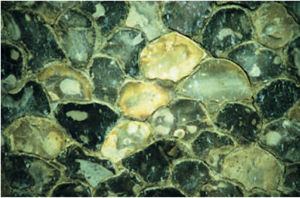
| This is a fine example of knapped flint work, with shaped flints forming a fish-scale pattern |
'The donor of the knapped flint from Kent writes that an operative capable of knapping is now difficult to find', reported John Watson in British and Foreign Building Stones (Cambridge University Press) in 1911.
After nearly 100 years, two world wars and a building industry changed almost beyond recognition since Watson completed his Sedgewick Museum catalogue of stones, it is not surprising that flint craftsmen are not the easiest of skilled tradesmen to find. Which is not to say that flint has been forgotten, nor that it has fallen out of use. On the contrary, in some parts of the country there is a revival of sorts, with flint being cast as a facing to concrete slabs, and flint veneers raised as decorative panels over blockwork in conservation areas.
There is nothing wrong and much to be said for new uses for traditional materials; but sadly, rather than a 'new use', flint is now emerging from these production lines in an awful parody of traditional flint masonry. Small faces of flint peer out from heavy frames of grey or yellow mortar, scarred with brush marks. When seen juxtaposed against the fabric of older buildings the experience is particularly dismal. This work cannot be more offensive to anyone than to the few surviving craftsmen, especially of Norfolk, Suffolk and Sussex.
FLINT, CHERT AND JASPER
 |
||
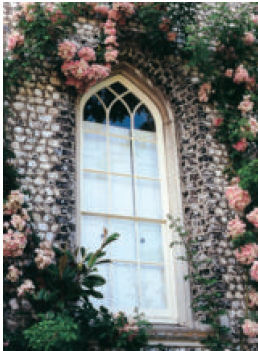
| An interesting example of polychromatic flintwork by Wyatt at West Dean is shown, with the window surround picked out in black using knapped flints | ||
 |
||
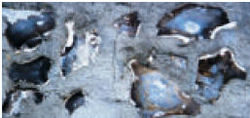
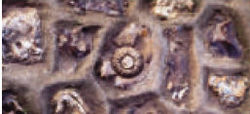
| Two examples of bad repair work: (above) an ignorant reconstruction with widely spaced flints set in a sea of hard cement mortar; and (below) original flintwork repointed with a thick ribbon of cement mortar in a parody of the snail creep detail. In the lower example a sea urchin can be seen forming the core of one of the flints. | ||
 |
Flint is one of three closely related forms of compact crystalline silica which have been used in building, and the most common. It is found in the top part of the middle and throughout the upper division of the Chalk geological formation. It is closely related to quartz, chalcedony, chert and jasper. The hardness of these materials is well known: they are resistant to scratching with a knife blade. In the context of building, flint, chert and jasper are the important rocks, with flint the most common and humble, and jasper, which St John tells us will be the stone of the new Jerusalem, the most illustrious.
Flint occurs as nodules or in bands within the Chalk, and can be seen primarily in the counties of Dorset, Wiltshire, Hampshire, Sussex, Kent, Surrey, Berkshire, Suffolk and Norfolk. Its origin is generally accepted as being the siliceous sponges once inhabiting the waters of Cretaceous seas. Flints which have been washed out of the chalk cliffs can also be found as rounded cobbles and pebbles and have been used extensively for building and paving.
Flint and chert are concretions, that is to say natural growths of mineral matter which form around a centre or core. Sometimes the core may be seen to be the sea urchin. The silica solutions from which flint was precipitated either displaced an equal volume of chalk, or flooded pre-existing cavities perhaps formed by marine borers. The colours of flint are black or dark blue-grey, and they are usually nodular in form, commonly coated in a white cortex of calcium carbonate, but tabular forms also occur.
The nodules break with a conchoidal (shell-like) fracture, forming sharp edges which have always been valued for their cutting potential. Elaborate and sometimes sophisticated tools such as axes, adzes, spear points and arrowheads were made from flint by early man by hammering and flaking 'green' or freshly mined flint, anticipating the later production of knapped flints and gun flints, which were produced with similar techniques.
Chert is not always easy to distinguish from flint. Also known as hornstone, it is generally the name used for silica beds, nodules and layers which occur in limestones other than the Chalk. The fracture is more 'hackly' than conchoidal. The use of chert in building tends to be very local and can be seen for instance in Chard, Somerset (sourced from the Upper Greensand) and Colyton, Devon, or in Richmond, West Yorkshire (sourced from the Carboniferous Limestone).
Jasper, an opaque form of chalcedony, is usually red, but can be yellow, brown or green. Gwynedd, North Wales, was once a well known source. In modern times it has occasionally been used for decorative purposes, a good example of which can be seen in stall risers in Piccadilly, London at its junction with St James Street.
BUILDING WITH FLINT
The first extensive exploitation of flint for building is Roman, predominantly but not exclusively in the core work of composite walls. Where flints were abundant, as along the south and east coasts, they were used in prodigious quantities, laced with levelling and bonding courses of square bricks.
Saxon and Norman churches also made extensive use of coarse but unsplit flint, a practice which continued in the flint regions throughout the Middle Ages. More sophisticated and architectural use of flints dates from around the beginning of the 14th century, when knapping and squaring of flints produced flat surfaces which could be framed in limestone, the practice known as 'flushwork'. Flushwork became highly fashionable and at times adventurous in the late 15th century and it continued to be popular for about 100 years. From the time of the first Elizabeth, flint was increasingly used in combination with other masonry materials such as limestone, sandstone or brick, in bands or chequer-work. Except for utility buildings it is generally the case that brick took the place of flint in its traditional regions during the 17th and 18th centuries.
A revival in the use of flint had to wait until an interest in the Romantic developed in the late 18th century. The flint garden grotto of the great houses is a symbol of the taste of the time. Flint cobbles were used extensively along the 'flint shores', often tarred or colour washed and in the Victorian period a whole range of flint buildings, coupled once again with limestone or brick, reappeared. This new fashion in flint extended from cottages and church restorations to fortifications and even great country houses.
 |
|
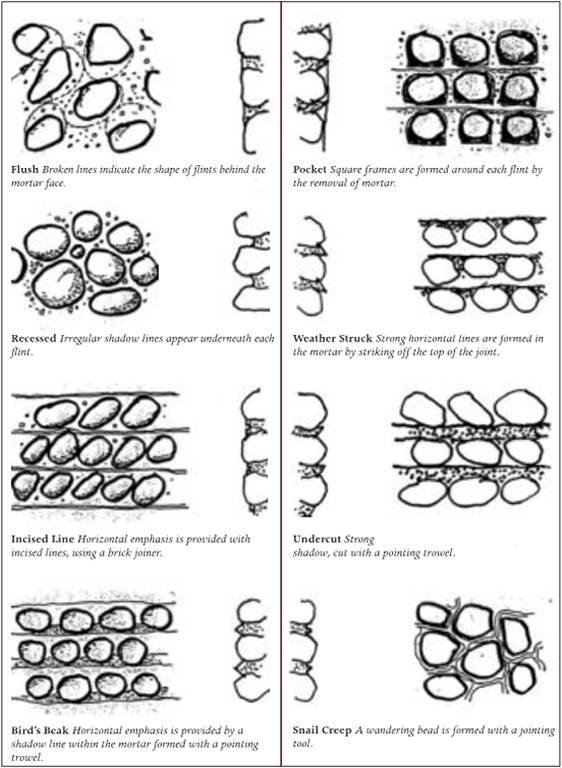
| Figure 1 Joints in Flint Masonry - mortar profiles | |
 |
|
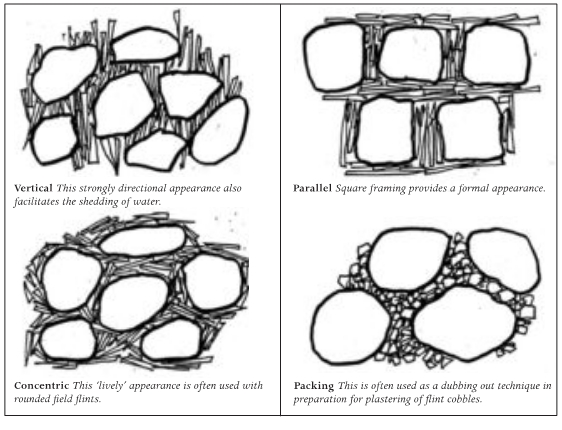
| Figure 2 Joints in Flint Masonry - use of gallets |
REPAIR AND CONSERVATION OF FLINT BUILDINGS
The important legacy of flint construction presents something of a challenge to modern owners and conservators. Too often, repairs seem to be carried out by the uninitiated (and are sometimes specified by them too). The tough, intractable, siliceous nature of flint is the source of its great durability; but this durability is confined to individual units and not necessarily to flint masonry. To a non-expert, flint is not only difficult to split and shape, it is also difficult to raise as a vertical wall even in its rough, nodular, field-flint form. This is why so much mortar is used in which the irregular flints are set like currants in a cake. True, more mortar is needed than for regular units such as brick, but somewhere in the wall the flints need to touch each other and lock together as much as possible within the mortar matrix.
Clearly, the importance of mortar is paramount. The Saxon Shore forts such as Pevensey or Portchester, built in the late third century by the Romans, survive in an aggressive environment because of the quality of their mortar. In these early years the mortars were lime, ash and (commonly) brick aggregate and brick or tile pozzolan. Where no reactive volcanic ash was available (true pozzolana) ceramic pozzolans were used extensively throughout the Roman world to impart a hydraulic set to their mortar. Tile or brick fired at low temperatures and crushed to a fine particle size reacted with some of the lime to form calcium aluminates and silicates, is almost always found during analysis of Roman mortars.
These mortars were ideal for masonry use; their permeability (their ability to allow water to evaporate through their pore structures), adhesion and flexural strength (which enables masonry to accommodate minor movements without cracking), ensured good, long-term performance. Later builders used lime mortars without ceramic powder but still containing significant quantities of kiln residues which could also impart a weak hydraulic set; or they used natural hydraulic limes such as those from Lewes in Sussex or Dorking in Surrey for their flint work. Analysis has shown that additions such as tallow or beeswax were also sometimes included, added when the lime was being slaked.
The use of similar mortars to the traditional types in repair and conservation is absolutely essential to good practice. Yet time and time again, partly misled by the strength characteristics of flint units and partly because the building industry is still locked into the use of cement, flint is raised in cement or masonry cement mortar. Not only is this, visually, a lifeless material, it develops shrinkage cracks around flints and forms continuous cracks through the mortar to accommodate movement inevitably caused by thermal and moisture changes. In addition to these problems, cement rich mortar inhibits the free evaporation of moisture which enters through cracks, and contributes to the overall dampness of the wall. In occupied buildings this is uncomfortable and unhealthy; in freestanding walls the masonry often falls victim to frost.
The most common occurrences of failure in flint walls are detachments of the flint faces, with or without the cracking associated with inappropriate mortars. Where detachment and major cracking occurs, the area affected must be taken down and rebuilt. All situations require that the character of the work is recorded and properly observed. Not all flint work, even of modest character, is as random as it might seem; there is usually coursing and the flints may be set in opposing diagonal lines as in the Roman 'opus spicatum' ('herring bone'). Without careful observation of the flint masonry as found, rebuilding and repair can change its character quite subtly and adversely. Sometimes there is fugitive evidence of jointing patterns and profiles (Figure 1), or the joints may be set with small shards of broken flint called gallets (Figure 2). All such detail needs to be put back.
The proper bonding of the flint face to its backing is a very important detail, even if there seem to be no bulging or loose flints present. Long tailed flints well anchored in hydraulic lime mortar provide the best method of bonding, but stainless steel wire ties or anchors can also be used. The backing or core may also need some consolidation as it varies from well built, well compacted brick and flint ('bungaroosh') to loose, rubbishy fill with little structural capacity ('ragtush'). Sometimes hand grouting of local voids with a proprietary grout or hydraulic lime may be necessary to supplement tamping and pointing. A suitable proprietary grout might contain a suspension of pulverised fly ash (a form of coal ash), hydraulic lime and bentonite.
Inappropriate mortar is cut out in much the same way from flint masonry as from other traditional masonry, although the depth of cutting out may need to be increased. Sharp tungsten tipped chisels should be used. If an aggressive mortar has been placed to some depth, which is unusual, it may help to carry out some 'stitch drilling' with a masonry drill first. The flints and backing need to be well wetted and if new flints are being used they need to be soaked in clean water before being placed. Mortar must be placed with great care, ensuring thorough compaction and filling of all irregular voids, and the final pointing needs to be cured slowly. During the curing process any shrinkage needs to be closed up with pointing keys as it occurs. Successful work cannot be carried out unless a suitable range of tamping tools and pointing irons is available. Typical mortars are as follows:
- sheltered exposure lime putty 1 : well graded sharp sand 1.5 : porous limestone 1.5 : brick pozzolan 1
- moderate exposure natural hydraulic lime (NHL2) 1 : well graded sharp sand 1.5 : porous limestone 1
- severe exposure natural hydraulic lime (NHL3.5) 1 : well graded sharp sand 2.
ASSESSING THE NEEDS, MEETING THE CHALLENGE
 |
||
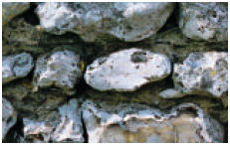
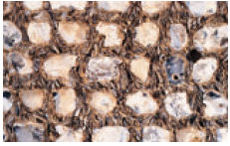
| Two examples which illustrate the versatility of flint: (above) the irregular shape of field flints which have been used as found; and (below) the neat, regular appearance of flush work, in which the flints are first split and knapped. | ||
 |
This is the subtitle for Traditional Building Craft Skills, a recently published report commissioned by English Heritage, the National Heritage Training Group, and CITB. The report identified on a region by region basis the percentage of contractors and sole traders having at least one employee with a specific craft skill, one of which was 'flint knapper'. Of the principal flint regions, East of England and the South East recorded five per cent (the highest) and three percent respectively for their flint knappers. The East Midlands recorded two per cent, the South West region, North West and West Midlands all registered one per cent. London had no source. Only the South East recorded a requirement for a significant regional inflow. Assuming flint knapping implies another ability, that of raising knapped and other flint work, and in spite of some nil returns on requirement forecasts, it is clear from the condition of our flint heritage that there is a critical shortage of skilled flint workers.
Happily there are centres where flint knapping and building are still carried out and where there is training potential. One of these is based at West Dean College in West Sussex where flint forms the subject of one of the English Heritage validated building conservation masterclasses. Great importance is placed on the quality of repair and the training expertise available in-house forms the basis of the flint masterclass.
West Dean House is one of the best examples of 19th century flint work in the country, the main facade being the work of James Wyatt, commissioned by Sir James Peachey in 1804 and completed by Wyatt's son Benjamin. Unlike its neighbour, Goodwood House, the flint for West Dean was brought from Norfolk for its supposedly superior quality. The full potential of flint and flint working skills is seen in the detailing of the house. Quoins are formed in square black flints; window reveals are knapped flint cavettos; the porte cochere is of limestone and flint flush work. Neat galleting of various kinds is obvious in all the work. Around the estate flint is used extensively but in far more modest ways.
As with all traditional building materials and building techniques, pressure for change in maintaining sources of materials and for development of continuity and training begins with an awareness of the significance of our flint heritage and the threats to its survival.