
Conservation and Design
Two historic garden case studies
Robert Grant
 |
||
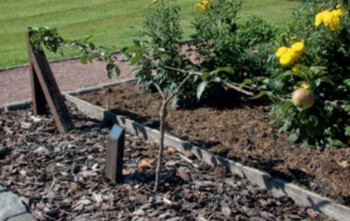
| ‘Step-over’ trained apple, ‘Tower of Glamis’ at Fyvie Castle (All photos: Robert Grant) |
Nearly 80 years after its establishment, the National Trust for Scotland (NTS) is responsible for many of the country’s most important historic buildings, collections, gardens and wild habitats. Seventy of the trust’s 128 properties include large or small gardens, 35 of which constitute major gardens and designed landscapes. They surround the great landed Scottish castles and country houses held in trust for the nation.
NTS first became involved in garden conservation a year after its founding in 1931. With the financial support of its first legacy, the trust purchased Culross Palace in the Royal Burgh of Culross (pronounced Cooross), Fife. Overlooking the Firth of Forth, it is not really a palace at all but earned its name because it was the grandest dwelling in the village at the time of its construction in the late 16th century. The trust’s engagement with this property was, however, short-lived. The trust was then unable to care for it and the property was passed into the guardianship of the Ministry of Works (now Historic Scotland), which managed the building and its adjacent garden for the next 60 years.
It wasn’t until 1945 that the trust looked at gardens again when the 5th Marquess of Ailsa and the Kennedy family gifted Culzean Castle (pronounced Cullain) to the trust. The castle stands on the Ayrshire coast and has 146ha (350 acres) of picturesque gardens and designed landscape. That same year the Hon Mrs Henrietta Leith-Hay gifted Leith Hall, Aberdeenshire to the trust, including its Arts and Crafts style garden, which she and her husband had created in the early years of the 20th century.
By the mid 1950s NTS had acquired 11 garden properties which, while managed on a day-to-day basis by garden staff, were overseen by a gardens adviser whose role it was to ensure holistic management across the developing portfolio and to agree on appropriate forms of garden conservation.
Bequeaths and acquisitions continued to grow, and with a collection of major gardens and designed landscapes now standing at 35, the trust has established a dedicated team of gardens advisers. The team is led by the head of gardens and designed landscapes whose responsibility it is to help research and understand the significance of the gardens in a local, regional and national context and to develop conservation management plans guided by detailed survey and analysis in line with the trust’s conservation principles. The process of evaluation has evolved since the 1950s in tandem with a developing national interest in garden history and a wider appreciation of the potential loss of horticultural heritage.
The trust made a sterling effort in the early 1950s to research, understand and evaluate contemporary schemes for the newly acquired Pitmedden Garden in Aberdeenshire, where the great double-walled garden with its ogee-roofed pavilions was recognised as being of national significance. While the estate records that might have shown the original 17th-century layout were lost in a fire of 1828, a new parterre garden was created by the trust based on contemporary designs of the gardens at the Palace of Holyrood House in Edinburgh dating from 1647. Today the iconic Scottish garden at Pitmedden is internationally respected and represents an outstanding example of a 1950s interpretation of a 17th-century garden design.
Despite relative successes in understanding and valuing garden heritage in its early days of garden management, the trust failed to recognise the significance and cultural value of other important landscape features that have since been lost. Acknowledging this as a significant factor in the organisation’s garden management process, a much more comprehensive system for garden study, evaluation and management planning now exists. This includes archaeological investigation, building survey, contour and tree mapping, together with a more rigorous evaluation leading to statements of significance.
CULROSS PALACE
 |
|
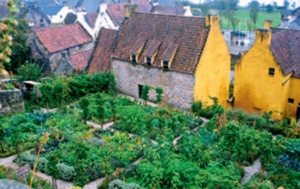
| The model 17th-century garden at Culross Palace |
Culross Palace and garden were re-acquired by the trust in 1991. A three-year garden restoration programme followed, which converted a simple amenity site into Scotland’s most authentic model 17th-century garden. The village of Culross dates back to the 6th century when it was an important religious centre. The monks were the first coal-miners in the area and over many centuries the mining industry thrived here. Ships carried coal and salt to Scandinavia and the Low Countries, often returning with ballasts of red pan-tiles, which are today a distinctive feature of the village. This exchange probably brought more than roof coverings: ideas about gardening and other cultural pursuits must have crossed the North Sea with them.
The early history of gardening is poorly documented: the first Scottish gardening book, The Scots Gard’ner, was not published until 1683. Gardening, as we know it today, was apparently rarely practised in Scotland except by royalty, the monasteries and the very wealthy prior to the accession of King James VI (later King James I of England) in 1587. The only vegetable known to have been widely grown in Scotland was colewort or kale, with onions, peas and beans being rarely grown by the general population until the end of the 17th century. Fruit was equally neglected, except in monastic establishments: Dene Matho Tachet of Culross Abbey is recorded as selling 15 ‘Plowm’ trees, probably bullaces (a type of wild plum), to the treasurer of James IV in 1503.
The height of Culross’s prosperity was reached during the life of George Bruce, a descendant of King Robert the Bruce, who took over Culross colliery in 1575. In 1597 Bruce built himself the fine new house that became known as ‘the Palace’. The building was further extended in 1611, the year in which Bruce was knighted by King James VI. It is uncertain whether Sir George Bruce ever had a garden of any ornamental merit at the rear of his house. It is more likely that it was a kitchen garden or kale-yard with a tethered pig and hens to support the needs of his household, but there is no archival evidence to support this.
 |
||
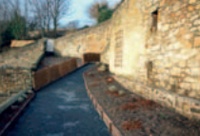
| The new raised beds at Culross Palace |
Over the years, Culross gradually declined with coal-mining and salt-panning dying out by the early 19th century. Changes to Culross Palace’s garden were not recorded again until 1887. In their book, Castellated and Domestic Architecture of Scotland, MacGibbon and Ross described the palace in great detail and recorded that the garden ‘forms a sort of hanging garden with several terraces commanding a fine view over the Firth of Forth and the country beyond’.
Between 1932 and 1991 the palace garden was developed by Historic Scotland with a simple layout containing conifers, herbaceous perennials, wall shrubs and fruit trees. Following the trust’s reacquisition of the property in 1991, a conservation plan was produced analysing known historical documentation including maps, drawings and photographs. A proposal was then developed for the future management and presentation of the garden. Despite the lack of archival material about Scottish gardens of the early 17th century in general and Culross Palace in particular, NTS felt that this was a sufficiently important site and as likely as any to represent the change from the horticulture of the regal or monastic institutions of the 16th century to the more ornamental horticulture being introduced by the developing middle class in the 17th century. To that end, a model 17th-century garden was created on the terraced slope behind the palace under the direction of the author.
During the course of 1993, the garden was transformed from an unremarkable 20th-century layout to a decorative yet productive garden reflecting the style of early 17th century gardens. A series of eight raised plots with interconnecting paths dressed in crushed mussel and cockle shells was created to support a wide range of period vegetables including onions, peas, beans, skirret, kale, scorzonera and salsify. However, most of the vegetables currently grown are the oldest varieties still commercially available, some of which are sourced through Garden Organic’s Heritage Seed Library. A covered walkway supporting Vitis vinifera ‘Ciotat’ (a variety of the common grape vine) and mulberries separates the main productive garden from a small orchard of old Scottish fruit varieties and a collection of rare Scots dumpy hens. To assist with the planting palette, reference was made to John Gerard’s The Herball or Generall Historie of Plantes (1597) and the detailed inventory of plants grown by Charles de l’Ecluse (Clusius) at the University of Leiden in 1593-1594.
Since its reincarnation in 1993-1994, the garden has continued to evolve based on a developing understanding of 17th-century horticulture and garden design, with an even greater emphasis on period features. These include trellis fencing, bowers, covered seats, basket planters and historic tools.
FYVIE CASTLE
The trust embarked on another significant garden makeover in 1997 to increase the horticultural interest of the empty two-acre walled garden close to the renaissance palace frontage of Fyvie Castle in Aberdeenshire.
 |
||
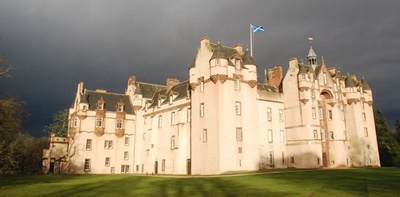
| Fyvie Castle from the south west |
Fyvie Castle was built on a hillside overlooking the waters of the River Ythan and dates back to 1395 when Sir Henry Preston built the first castle on the site of a royal hunting lodge. During the 16th century Fyvie was described ‘as a splendid palace’ and probably had an enclosed garden. Whatever grounds there may have been before 1644 they were almost certainly destroyed in the battle fought at Fyvie between the Duke of Montrose and the Covenanters. The Hon William Gordon inherited Fyvie estate in the early 18th century and in 1770 he began extensive improvements to the castle and grounds, which continued for the next 20 years. An estate plan of 1822 shows the improvements made by William Gordon and his son, which included the walled gardens (built in 1777), the large Fyvie Loch (designed by Robert Robinson and later improved by James Giles), the sinuous driveway, and extensive parkland, woodlands and formal gardens.
The walled kitchen gardens comprised three sections, all of which survive today although their uses have changed. In the 1822 plan, the area was divided into the Ball Green, containing the oldest fig house in Scotland; Rhymers How or Haugh Garden, growing mainly fruit – mulberries, peaches, nectarines and grapes; and the Garden, used as a shrubbery.
A magnificent glasshouse range was added to the kitchen garden layout in the late 19th century but little remained of the once spectacular structure at the time of the trust’s acquisition of the site in 1984. Vegetable and fruit growing continued until World War II when there were eight gardeners, three of whom worked in the glasshouses. In the latter years of the 20th century the garden’s fortunes declined and the areas were grassed over for easy maintenance.
Careful consideration was given to finding a sustainable use for the two-acre walled garden that would complement the property, improve the site’s horticultural focus and enhance the visitor experience. With its long tradition of fruit-growing it was felt that the garden at Fyvie should be developed in a way that would reflect its former glory. After many months of careful research and planning it was agreed that a garden of Scottish fruits should be developed to demonstrate both the conservation of rare, unusual and modern Scottish fruits and the craft skills involved in their cultivation and maintenance. Through the generous financial support of the Garfield Weston Foundation and the trust’s Great Gardens Appeal, the walled garden development began to take shape.
 |
||
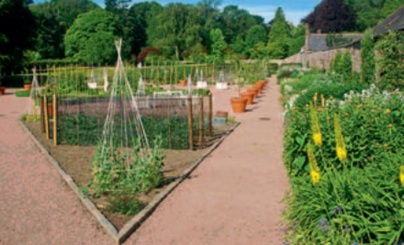
| The Garden of Scottish Fruits in summer 2009 | ||
 |
 |
|
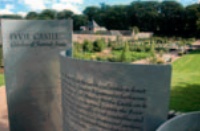
| Above left: The drawing room ceiling at Fyvie Castle was the inspiration for the design of the central parterre in the Garden of Scottish Fruits. Above right: Fyvie Castle Garden of Scottish Fruits site interpretation | ||
A design for the garden was developed that took into account the soils, the local microclimate, the physical limitations of the site and the agreed philosophy for the garden: to grow as wide a variety of traditional and modern Scottish soft and top fruits as possible displayed in a variety of styles and complemented by a selection of seasonally varied vegetables. The design for the new garden was not influenced by historical records, quite the contrary: the former layout of the northern section of the triple walled garden was unremarkable and untypical of other gardens of its period. Instead a new dynamic design was created, influenced by the design motifs of the plaster ceilings in the castle’s entrance hall and Lord Leith’s drawing room, which overlooks (at a distance) the walled garden. The geometric designs were created on the ground using 6,500 granite ‘cassies’, or cobbles, which form a series of beds. Interconnecting paths link the east and west sides of the garden with a central herb parterre.
The fruit plots accommodate a diverse selection of well-trained Scottish raspberries, blackcurrants, gooseberries, redcurrants and white-currants and various hybrid berries. These are complemented by the most complete collection of Scottish apple trees in Scotland including varieties such as ‘Bloody Ploughman’, ‘Cardross Green’, ‘East Lothian Pippin’, ‘Maggie Sinclair’ and ‘Threave Castle’, grown on a variety of rootstocks and pruned in a number of different ways. A small nutwood, fan- and espalier-trained plum trees and cordon- and espalier-trained Scottish pears, including ‘Chalk’ and ‘Green Pear of Yair’, are grown against the south and west facing walls.
In addition to maintaining the top-fruit collection, the garden also supports a varied selection of Scottish-developed vegetables and includes some of the dozens of varieties of potatoes that have been developed over the past 100 years. These include ‘Duke of York’, bred by William Sim of Fyvie in 1891, a popular early potato with superb flavour and texture, together with selections from the Arran, Pentland and Dunbar potato groups as well as some of the more modern varieties such as ‘Brodick’ and ‘Brodie’ that were developed during the 1990s. Other vegetables include ‘Balmoral’ and ‘Castlegrant’ cauliflowers, ‘Pentland Brig’ kale, ‘Musselburgh’ leeks, ‘Ailsa Craig’ onions and ‘Angus’ swede. Today, the significance of Fyvie Castle’s garden lies in its plant collection and in the conservation of the heritage skill-set required to maintain such an important fruit collection.
The systematic study and evaluation of historic gardens has evolved a great deal over the past 60 years. The approach taken by the trust during this time has included well-intentioned but sometimes misguided actions. These are offset by many examples of best conservation practice guided by NTS’s own conservation principles and those of international conservation charters. In this underlying philosophy the trust’s success is planted: it invigorates all of our efforts to understand, interpret and value the significance of Scotland’s garden heritage and our determination to ensure that it is accessible to all.
~~~
Recommended Reading
RW Billings, The Baronial and Ecclesiastical Antiquities of Scotland, Blackwood, Edinburgh, 1852
R Hurd, Scotland Under Trust, Adam and Charles Black, London, 1939
S Landsberg, The Medieval Garden, British Museum Press, London, 1995
D MacGibbon and T Ross, The Castellated and Domestic Architecture of Scotland, David Douglas, Edinburgh, 1887
AH Millar, Fife: Pictorial & Historical, A Westwood & Son, Cupar, Fife, 1895
J Morgan and A Richards, The Book of Apples, Ebury Press, London, 1993
HG Slade, ‘Fyvie Castle, Aberdeenshire, Scotland’, Château Gaillard: Études de Castellologie Médiévale, vol 12, 1985
AMW Stirling, Fyvie Castle: Its Lairds and Their Times, John Murray, London, 1928
Land Use Consultants, Inventory of Gardens and Designed Landscapes in Scotland, Countryside Commission for Scotland, Edinburgh, 1987