
The Garrison Chapel Windows
Michael Hinchliffe
 |
||
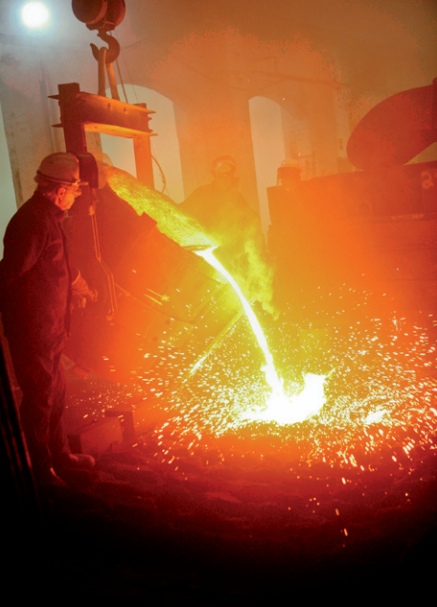
| The foundry pit at Hargreaves Foundry, Halifax |
The processes and precision required in cast iron production and patternmaking have changed very little over the last century. Nevertheless, the task of repairing and replacing historic 19th century cast iron windows often requires the skills of a master detective as much as those of a master craftsman.
Loss, erosion and damage over many years have transformed some historic cast iron windows into heavyweight jigsaw puzzles. When no original patterns and no record of the original dimensions survive, there is rarely a straightforward formula for 21st century replication of cast iron windows on important restoration projects.
The Garrison Chapel in Pembroke Dock is a case in point. Thought to be the last of its kind in South Wales, this Georgian classical chapel was built in around 1830. It was designed by the Royal Navy’s chief architect, George Ledwell Taylor, and forms the focal point of a busy dockyard ‘producing vessels that ranged from battleships to royal yachts’.(1)
After the military abandoned the dockyard, the chapel survived in a variety of uses before closing in 1975, a year after it was listed. It then fell into a steady decline and by the time it was sold to a private developer in 1986, the lead had been stripped from the dome, parapet gutter and roof.
In 2003, when the building became the subject of a compulsory purchase order by Pembrokeshire County Council, the roof had partially collapsed and the structure was shrouded with a roofed scaffolding frame. Sections of the dressed and rendered rubble stone walls were badly damaged and the five cast iron windows on the south side of the building had been replaced in steel.
Ironically, the original cast iron windows on the northern side were in much better condition than the steel replacements, which were badly rusted and in very poor condition. The replacements also lacked the unique hopper-style window openings of their surviving cast iron counterparts.
Funding for a major restoration programme came through the Heritage Lottery Fund’s Pembroke Dock Townscape Heritage Initiative, a project that was to win the Award for the Reuse of a Georgian Building in the 2008 Georgian Group Architectural Awards.
It was clear from the poor state of the building’s south side that all of the rusted steel windows would have to be replaced. Welsh Heritage Construction, the main contractor, repaired around half of the surviving cast iron windows in situ, along with some of the damaged stone masonry and glazing.
The remaining windows were removed by hand in sections and the broken fragments sent to Hargreaves Foundry in Halifax. Hargreaves were tasked with casting 11 new windows with a finished height of 4,240mm and a width of 1,677mm, featuring 80 individual window lights to be cast in grey iron Grade 250 BS EN 1561:1997.
To achieve this, Hargreaves’ pattern makers had first to piece together the original design from existing fragments and from photographs of the original hopper openings. Detailed measurements were taken and the dimensions of every detail of the windows were collated to the millimetre to produce a complex technical drawing. With the help of the pattern maker’s comprehensive training (apprenticeships often last five years), highly-developed skill and detailed understanding of the foundry process, a three dimensional pattern design is created.
 |
 |
|
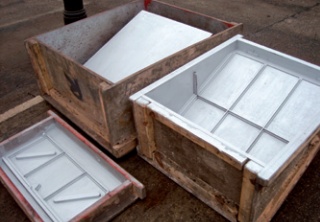
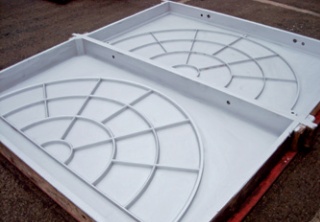
| Window patterns for the Garrison Chapel, Pembroke Dock | ||
PATTERN MAKING
Once the design has been approved, a manufacturing drawing is produced and the pattern is made by hand, usually in FSC-sourced yellow pine, birch plywood or mahogany, since these are among the least likely to warp or crack under the stresses imposed by the moulding process and storage.
Pattern making must also allow for shrinkage of the metal as it cools. In the case of grey cast iron, one per cent increments are applied to each dimension.
The main tools used to achieve this precision work are chisels and gauges, many of which are more than a century old and have been passed from one generation of pattern maker to the next. The process is so complex and detailed that a project on the scale of the Garrison Chapel can require two pattern makers working for up to six weeks.
Once complete, patterns can be reused to create hundreds or even thousands of moulds. But with zero tolerance of warping, it is imperative that patterns are stored in a dry environment before use.
MOULD MAKING
The completed pattern is placed inside a box in preparation for sand moulding. The interior of the box is coated with micronised talcum powder or micronised aluminium to aid mould release and the box is then packed with recyclable silica sand, which is then compacted, often by hand, in another process that requires expert knowledge.
 |
|
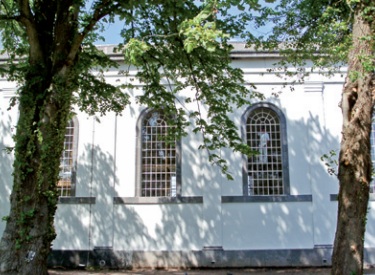
| The new cast iron windows of the Garrison Chapel |
Once the sand-resin mix has set, usually in half an hour, the pattern is removed from the box. Since the Garrison Chapel windows featured profiles to both the exterior and interior, two moulds had to be created which could be brought together to form two halves of a single casting.
The iron founder must create a runner system: a critical element of the process which ensures that the molten metal can be poured into the mould at just the right speed. The runner system has three elements, a down peg, a run bar and an in-gate, all created from the bonded sand and designed to exclude slag from the final casting. This stage demands great care and expertise. If the molten iron flows too slowly it will solidify before it reaches the casting shape, if it flows too quickly or too violently it could damage the mould, resulting in expensive scrap castings.
Since the size, weight and depth of decorative windows vary, the founder must also plan for the metal contracting at different rates. To compensate, the founder builds one or more ‘risers’, to hold a reservoir of molten metal which can then feed back into the mould as the cast iron contracts.
CASTING
Iron pouring is the most spectacular and dangerous part of the process, but also the least complex. The metal is a combination of carbon, silicone, sulphur, manganese and phosphorous, the proportions of which are crucial to determining the grade of cast iron produced. The windows were cast in flake graphite cast iron with a tensile strength of 250 newtons per square millimetre. The metal is heated in a furnace to a temperature of 1,500°c before the molten iron is poured into the mould.
FETTLING
Once cooled, the solid window castings must be removed from the mould. The sand is then recycled to make more moulds. A ‘fettler’ breaks the sand mould with a sledgehammer and chips off the runner and riser systems with power tools. The fettler also removes the flashes, the slivers of metal which seep into the spaces between the two mould sections. The casting, weighing up to 250kg, is then carefully removed by hand. The final stage in the production process involved shot blasting the window casting to base metal, creating a sound surface for painting before delivery back to Wales.
SERVICE AND SUSTAINABILITY
Now in situ and performing well in the restored church buildings, the cast iron windows can be expected to provide up to a century of service, after which the entire castings can be recycled.
~~~
Notes
(1) Jason Evans, ‘New Uses for Old Buildings’, Civic Trust for Wales conference paper, 2005 (available online at www.civictrustwales.org/conf_nov05/pdf/evans.pdf)