
Stained Glass and Its Decay
Drew Anderson
 |
|
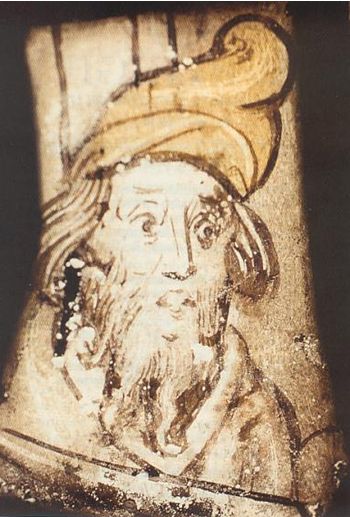
| Detail from the head of St Andrew, a panel at St Deny's, York (15th century) V&A Collection. This detail shows areas of paint loss, possibly caused by corrosion of the glass substructure, or as a result of poor firing or poor paint mix. | |
 |
|
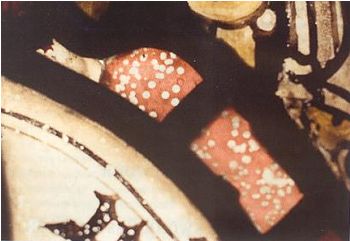
| Detail from the head of St Andrew, a panel at St Deny's, York (15th century) V&A Collection. This detail shows pitting aprox 2.0mm on flashed ruby glass and painted script. |
Glass is one of the most intriguing and complex materials found in historic buildings. Its use to produce dazzling displays of colourful light has amazed church-goers for centuries. It is extremely hard, durable and dense, yet it is transparent, and its molecular structure displays the random disorder of a frozen liquid, not the ordered structure of a crystal. Examples have survived since the Middle Ages, yet the material is also surprisingly vulnerable to decay.
With increasing recognition for the importance of Victorian stained glass as well as medieval examples, conservators must now, more than ever, be aware of the principles involved in the decay of this precious material and in the principles involved in its repair. To understand the particular problems encountered, one must first become familiar with the material.
The manufacture of painted and stained glass has seen a transformation from the early methods of production to the refined process it is today. The earliest glass was in essence merely sand fused with the aid of a flux such as plant ashes. In Britain production was probably first introduced by the Romans when they came here around 45BC. Small fragments of window glass have been excavated from, certain Roman settlement sites in England which suggest that the Romans produced an unrefined window glass, either by casting in a mould and polishing laboriously, or by blowing cylinders which were cut open and flattened to form a rectangular sheet of glass now known as cylinder glass.
Later, 'crown glass' began to be manufactured. In essence, this process involved blowing a 'gather' or blob of molten glass to form a spherical vessel which was transferred onto a pontil (a solid iron rod), leaving one end open. It was then reheated and carefully manipulated so that the glass opened out into a disk which was then spun rapidly in front of the fire. Under centrifugal force and its own weight, the disk enlarged gradually to produce a fine, circular sheet of window glass known as a 'crown', which could then be divided into useable shapes.
From medieval times until the mid 19th Century, cylinder glass and crown glass were the forms most widely used for glazing windows. The composition of the material varied according to the constituents of the sand and the type of flux used to reduce the temperature required to manipulate the glass. Both soda (essentially sodium carbonate) and potash (essentially potassium carbonate) were widely used as the flux for making glass in the early Middle Ages, but glass made with potash was discovered to be more prone to deterioration and was later abandoned. Where a lime-rich sand was used, calcium oxide was released as the material was heated, acting as a stabiliser, improving the durability of the material. Other oxides present also affected the properties and the resilience of the glass to varying degrees. Soda, lime and silica are the essential constituents for making most window glass from the Middle Ages on.
Coloured glass was made either by adding metallic oxides to the original material or by painting detail onto its surface using a mixture of ground glass and iron or copper oxides, which was then fused to the body of the glass by reheating it. In this way highly decorative window glass could be created. The use of silver stain from about the early 14th Century gave the craftsmen even greater decorative scope.
THE PHYSICAL STRUCTURE OF GLASS
To change from the disordered molecular arrangement of a liquid state to the regular configuration of a crystal, the individual atoms of a material must be able to migrate. However, as glass cools from its molten state to a solid the 'normal' liquid to solid crystallisation process is bypassed and the glass solidifies without crystallising. This is known as 'vitrification'. Vitreous silica has the same basic structure as nearly all of the crystalline phases of silica; the primary difference lies in the bond angle between the silicon and oxygen atoms which form the silica molecule. In its crystalline state the angle is 180 degrees, but in its vitreous state the bond angle can vary between 180 degrees down at least to 150 degrees and sometimes lower.
Vitreous silica then has a continuous network of interconnected silicon and oxygen atoms but lacks the parallel planes of similar atoms which characterise a crystal. When monovalent ions are added to the vitreous silica, such as a small amount (13-17 per cent) of sodium oxide, the balance between the oxygen and the silicon ions is upset so that not every oxygen can bond with two silicon atoms. However, every silicon still finds it possible to be tetrahedrally bonded to four oxygens. This results in a situation where some oxygen ions are bonded to only one silicon (which is said to be non-bridging). At an atomic level, large holes are then created in the network and the sodium ions can move into them. It is this particular lack of order rather than its common transparency and brittleness which is the defining feature of glass.
THE PROCESS OF DETERIORATION
The
proportion of silica in the glass and the additives used in its manufacture
affect the durability of the glass. Early medieval glass made with potash
and glass with a low silica ratio is more prone to decay than later 19th
and early 20th century glass but the causes of decay remain much the same.
Perhaps surprisingly, the principal agent of decay is water, whether as rain or condensation caused by variations in temperature and humidity. Atmospheric gasses such as carbon dioxide play a secondary role in the process. Where glass paint is applied well it will protect the glass, but conversely it can also accelerate the deterioration process, particularly if the paint is thinly matted, under-fired or badly ground. Similarly the application of silver stain will normally protect the glass.
The deterioration process which moisture initiates is complex but it usually involves the diffusion of hydrogen ions from water within the glass network. One hydrogen ion (H+) from the water molecule displaces the sodium (Na+) or potassium (K+) ions from the network, leaving an hydroxide ion (OH-). The by-product of this displacement is sodium or potassium hydroxide, both highly reactive alkalis which leach from the surface of the glass, depleting the body of the glass as a result. The accumulation of water on the glass surface will continue to produce a build-up of alkaline corrosion products which attack the silica network of the glass causing surface decay. Alkaline corrosion products react with atmospheric gasses to form sulphate and carbonate crystals. The paint can be lost when the glass substrate becomes sufficiently damaged. The net result is a gradual deterioration of the glass, usually accompanied by the simultaneous formation of a crust, normally composed of carbonates and sulphates and other opaque weathering products.
 |
|
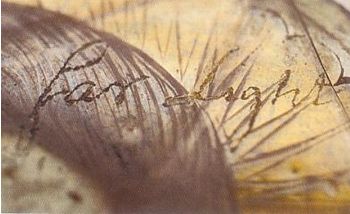
| Detail from the head of St Andrew, a panel at St Deny's, York (15th century) V&A Collection. This detail shows the glazier's instructions 'far right' have become deeply etched, caused by water caught in the scratched area. |
As the alkalis build up, so the corrosion will increase, taking the form of pitting or crusting. Pitted glass surfaces are often strikingly uniform in size across a corroded area. These pits, depending on a number of factors, may range from 0.1 mm in diameter to much larger, perhaps around 2.0-4.0mm. Pits can become linked together and crusts form within them so the difference between pits and crusts become slightly ambiguous. In the most severe cases, pitting and crusting can reduce the glass to a very fragile state often depleting the thickness of the glass, and in extreme cases, pitting may even produce holes.
Painted glass is less susceptible to the build up of alkalis as some alkali ions evaporate from the paint surface during the firing of the glass paint. In the case of silver stain, the silver ions replace the more weakly bonded alkali ions (such as sodium or potassium) during the firing process, thereby helping to protect that area of glass. However, the bulk of the unpainted glass remains most susceptible if water is left on the surface for long periods of time.
Considerable damage can also be caused by fungi. Although glass is not utilised by fungi as a nutrient source, they cause damage primarily by trapping moisture next to the glass by the fungal growth which lives off accumulations of dirt on the glass surface and in the crevices of the fixings. In addition, the glass surface can be etched by their acidic byproducts, further reducing the transparency of the glass.
It is evident that the solution to all these problems is to prevent water from remaining too long on the surface of the glass. In some cases isothermal glazing, a form of external protective secondary glazing, can achieve this successfully, but as with all conservation techniques its use needs to be carefully considered and further research may be necessary.
PRINCIPLES TO BE FOLLOWED IN DEVELOPING A PROGRAMME OF CONSERVATION
For
many years, the maintenance of stained glass was largely based on restoration
and reconstruction. Elements of a broken or damaged window may have been
treated in the same way as one might attempt to keep an old car running.
Damaged or broken pieces were often discarded and replaced. Today, those
concerned with the care of stained glass must work with a different set
of values. While there are certain basic principles which should be applied
before undertaking any work, it should also be borne in mind that any
two projects are rarely the same. When confronted with a degraded stained
and painted glass window the conservator must be open minded about problems
and possible solutions. Each situation should be considered on its own
merits to avoid failing into the trap of making generalisations.
Before beginning any work, a record should be made of the glass, including a complete site report, any historical information, photographs and notes on details of particular importance. Once in the studio, rubbings of the lead lines must be made on paper, so that further information can be recorded before, during and after the various stages of conservation work. It is most important that all aspects of record keeping are carried out methodically, especially with extremely fragmentary windows. The value of accurate records will be immediately apparent to any conservator faced with a project which has inadequate records of previous restorations and who has to spend precious time trying to establish what has been done before. Making detailed records of all the conservation processes can be time consuming, but it is absolutely vital for the future of the glass, should there be any recurring damage.
Minimum intervention is an important aspect of current practice, and the conservator must bear in mind that the stained glass may not need any treatment at all. This particularly applies to ancient glass. A large amount of important historic glass has already been destroyed by over enthusiasm and an eagerness to make the glass look as good as new. Minimal cleaning for example will still allow light through the window without risking damage to the paintwork or scratching the glass surface.
The level of intervention a particular job may require will be affected by a wide variety of factors, all of which will need to be considered. If after examining the window it is clear that further damage will take place, then some form of action would be justified. Preventative techniques to be considered might include forms of reframing, external glazing, or 'plating' small parts of the window with a new piece fixed to the leadwork or window frame on the inside. This piece can be painted to match the original where the coherency of the design is compromised, without requiring the alteration or replacement of original.
Another fundamental principle is that conservation techniques should be reversible. Reversibility allows for the possibility of future developments in conservation which may provide better protection or a less intrusive repair for example, and allows alterations and repairs to be removed or reversed should they subsequently prove to be damaging. Only techniques and materials which, to the best of current knowledge, will not harm the object or impede future treatments must be used.
Expertise in some aspects of glass conservation remains limited, and there is considerable need for a reversible treatment for loose or flaking paint for example. Fortunately there is continuous research and development by scientists and other specialists, and it is essential to keep abreast of current developments in the field. By sharing expertise, through full discussion at an early stage, and through the use of advanced analytical methods such as XRD (X-ray diffraction analysis) or electron microscopy, it may be possible to save time and money for all parties involved, not least by avoiding costly mistakes.
Finally it should be said that many treatments are influenced more by factors such as cost than by their appropriateness or necessity. Clients' wishes for restoration rather than conservation may also have to be taken into account. Here the conservator has a responsibility to promote awareness of the issues at stake, and to help clients understand the need to protect our stained glass.
Recommended Reading
- Comité Technique of Corpus Vitrearum: Guidelines for the Conservation of Ancient Monument Stained and Painted Glass, ICOMOS, 1989
- RC Evans, An Introduction to Crystal Chemistry, Cambridge University Press, 1966
- L Holland, The Properties of Glass Surfaces, Chapman and Hall, London, 1964
- RW Douglas and S Frank, A History of Glassmaking, Whitefriars Press, London, 1972