
Saving The Grange
Caroline Stanford
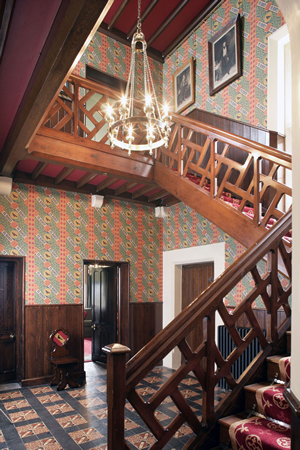 |
| The central hallway with its distinctive banisters |
The Landmark Trust is a building preservation charity which, for more than 40 years, has been rescuing and restoring historic buildings at risk and giving them a self-sustaining future by offering them for holiday lets. In June 2006, Augustus Pugin's home, The Grange in Ramsgate, was opened to visitors to general acclaim. It was a near-run thing: the building was facing demolition and redevelopment and would have been lost altogether without the trust's intervention.
The Grange (1843-4) in Ramsgate is important as the house AWN Pugin built for himself and his family. Listed Grade I, it was rescued from development by the Landmark Trust in 1997 with a grant from the Heritage Lottery Fund. The HLF provided further generous support for its repair and restoration (2004-6), as did English Heritage, Thanet District Council, charitable trusts and many private individuals.
Augustus Welby Northmore Pugin (1812-52) was one of the most influential and prolific architects and designers of the 19th century. Only 40 when he died, Pugin spent his life trying to revive medieval Gothic architecture and design as the only fit architecture for a Christian society. He looked back wistfully and sometimes whimsically to medieval society, which he thought morally superior to the increasingly mechanised and secular society he saw around him. A devout convert to English Catholicism, Pugin built many churches, schools, convents, monasteries and country houses. He also designed the interiors for the Houses of Parliament. In all his work, he was supported by a loyal team of craftsmen and builders who translated his countless designs into reality.
Pugin built few domestic houses and the site in Ramsgate is particularly important because here he was building for himself and his family. He wanted to bring Catholicism back to this part of Kent and so a church, monastery and other subsidiary buildings were also part of his plan for the site, to recreate the medieval social structure that he so admired.
Built of yellow stock brick and surrounded by walls of knapped flint, The Grange was not an inherently extravagant house despite the richness of its interiors. However, it was quietly revolutionary in the arrangement of rooms and their outward expression in architecture: a reaction against mainstream Classical architecture, which had been the most popular style for the past hundred years.
Pugin's starting point for The Grange was not outward symmetry but internal function. Windows, roofs and chimneys were placed to suit life inside rather than external appearance. This cheerful and uncontrived asymmetry became and remains such a familiar feature of English domestic architecture that it is easy to forget how radical it was after the formal terraces of the 18th century. The principle it reflects, that form should follow function, remains central to much of today's architecture.
PHILOSOPHY OF CONSERVATION AT THE GRANGE
When Landmark acquired The Grange in 1997, it was presented with a conundrum. The house had been adapted and changed, especially by Augustus Pugin's sons Edward (from 1861-75) and Cuthbert (after about 1880). Most of these changes were opportunistic and utilitarian, diluting the integrity and originality of Augustus Pugin's vision. But to remove them would be to challenge prevailing conservation wisdom that all the phases of a building are equally valid and should therefore be kept. The interiors were similarly compromised and provided further problems to the project team: how to untease layers that had never co-existed but happened to survive now, and to present a coherent picture of a seminal building that could be appreciated and understood. Meticulous archaeology, paint analysis and documentary research were brought together by the Paul Drury Partnership in a conservation plan that provided an invaluable framework for assessing these difficulties and managing decisions as work progressed.
 |
|
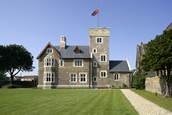
| The south elevation of The Grange, with St Augustine’s Church and Monastery to the right |
It became clear that a far more complete picture of the house existed, inside and out, for the 1840s than for any other period. Key pieces of information fell into place: the discovery of scraps of wallpaper all over the house of Augustus Pugin's personal design; a watercolour of his own sitting room; the original footprint of the house; the shadows of library bookshelves. It was clear, for example, that it would be meaningless to superimpose earlier wallpaper against later joinery and structure when they had never co-existed. When the body of objective evidence was added to the potentially more subjective view that the core historical and architectural significance of the house lay in the period of the mind which originally conceived its radical design, it became impossible to resist the conclusion that the case should be made to return the house to its appearance in the 1840s: a house that Augustus Pugin himself would recognise.
Quite rightly for a Grade I building, the consultation process preceding the permission for such a course of action was protracted and demanding. Eventually, however, Landmark was able to convince English Heritage, Thanet District Council and others that in this case such an approach was appropriate.
Only two areas do not fall within this approach. The north courtyard, with covered walkway, enlarged entrance and gateposts and altered Cartoon Room, overlooked by Edward Pugin's studio in St Edward's Presbytery, exists as remodelled by Edward Pugin and has been left much as it would have been in Edward's day. A south-facing bedroom known as Jane's room, also presented an unusually complete survival of Edward Pugin joinery and chimneypiece. This room too has therefore been left to evoke an Edward Pugin interior.
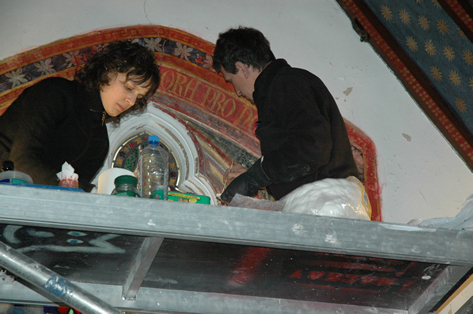 |
| The Wall Paintings Workshop recovering the original paint scheme around the chapel window |
Before any work began, the whole building was recorded through exhaustive photography and a video record made by students on Bristol University's MSc course in Archaeology and Media Studies. Building analysis continued as the building was gradually opened up, and all materials taken out were labelled for future identification and reuse wherever possible. The house was then swathed in scaffolding for a year and a half, complete with temporary roof.
EXTERNAL WORKS
Under the direction first of architects Donald Insall Associates of Canterbury, and subsequently of Thomas Ford & Partners of Sydenham, the initial task for contractors, Barwick Construction Limited of Dover, was carefully to take down the later extensions: a cloakroom block beside the covered porch that masked the large hall window, a two-storey extension above the kitchen, a sitting room extension with modern steps leading up to its roof, and two later bathrooms.
The roof was returned to its original, double-ridged profile, lost after a fire in 1904. This was a major undertaking for the joiners, roofers and lead-workers involved, and included reproducing, where necessary, Pugin's massive and characteristic 'tusk tenons' that fix the wall plates and barge boards. Stonework on the chimney stacks was also found to be in a parlous state with several stacks requiring complete rebuilding. The tower roof and parapet were severely weakened. The Pugins' penchant for flagpoles had put considerable strain on the tower over the years and so in rebuilding its upper level, structural engineers at The Morton Partnership were consulted to ensure that a flag could be flown in future without such problems arising.
Much of the brickwork needed repointing, a challenge for today's team to match the original and fine penny-struck pointing. The stonework was often badly decayed, especially on the seaward-facing windows, owing to crude patching with cement, which had trapped moisture behind and caused further damage to the stone as it froze and thawed. Wherever possible, so-called plastic repairs were carried out by PAYE Stonework of London, using lime mortar. The next degree of decay involved patching in new pieces of stone, but in some cases the whole window had to be sacrificed and an entirely new one put in.
Pugin himself had used Caen stone, the preferred Kentish material since the time of the medieval masons at Canterbury (the only local stone is Kentish ragstone, of very variable durability and appearance). It was fortunate that a new and better supply of Caen stone became available during the project for the first time in decades in time for it to be used on all replacements below eaves level.
INTERNAL WORKS
Inside, work may be broadly considered under five headings: wallpaper, paint finishes, metalwork, stained glass and joinery.
Wallpaper
Augustus Pugin's
personal wallpaper design (which he called 'En Avant') was known
to exist from his letters to his decorator J G Crace, and from
drawings held at the V&A. No blocks for it had survived and none
was known to survive in the house itself. However, once careful
exploration of its fabric had begun, several survivals of the 'En
Avant' design in four colourways were found in reception rooms
and bedrooms alike, ranging from large and pristine survivals
beneath panelling to tiny vestigial strips beneath beading.
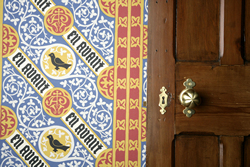 |
| The reproduced 'En Avant' wallpaper |
In service areas, a second design of a green and cream paper was found, later christened 'Strapwork'. It is not known or thought to be a Pugin design, although similar Regency papers are known. It seems to have been an off-the- peg paper used by Pugin for the service or backstairs areas of the house.
The entire papering scheme for the house in the 1840s was thus known, but presented another conundrum. Handblocked paper (as this would have been originally) is notoriously expensive and wallpaper generally does not sit comfortably in a building used for holiday lets. Yet it would have been deeply unsatisfactory not to have reproduced papers so personal to the architect and his house.
The solution was reached with wallpaper manufacturers Cole & Son, who also hold the largest archive of original Augustus Pugin blocks (sadly these two designs were not among them). In order to paper as many rooms as possible in their original design and colours at a justifiable cost, it was decided to reproduce the paper using rollerprinting, a technique first introduced in 1839. The design had to be adjusted only marginally to comply with modern roller sizes and, although modern inks were used, different thicknesses of ink created a slight impasto effect that replicates the liveliness of handblocking to all but the most expert eye.
In Jane's room, an Edward Pugin interior, it was possible to use a later paper, 'Gothic Trellis'. This was a design found to be used by Edward Pugin, much as his father had used 'Strapwork', in the less public spaces. The paper is still in production today, by the other wellknown purveyors of Pugin wallpaper, Watts of Westminster. A special colourway was commissioned to replicate the very faded samples found.
Paint analysis and restoration
 |
|
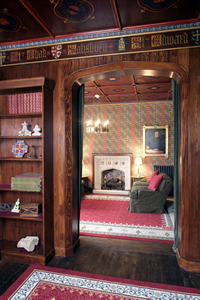
| View from the library to the sitting room at The Grange, showing wallpaper, fireplace, new joinery and original decorative paint finishes |
Catherine Hassall's paint analysis was an essential tool in the battery of approaches used to understand the fabric of The Grange. Not only applied to recover the colour of paint finishes used on walls and joinery and to test the primacy of surviving finishes, paint analysis also enabled the understanding of the fine, but misleading, chimney-pieces in the house.
These presented themselves initially in gaudy polychrome, carved inner faces embellished by elaborate, pseudo-Classical marble columns and mantel-shelves that were most unlike anything else by Augustus Pugin (and indeed counter to his principles of design in including Classical elements). Paint analysis would prove that the columns and shelves were added by Edward Pugin and that all the colour also post-dated Augustus's death in 1852. Augustus Pugin's own treatment was a simple stone-coloured wash, embellished with enamelled brass shields, the exact designs of which were recovered from early photographs and original drawings. The fireplaces have been returned to their original appearance. The later additions are carefully stored in an archive of material removed during the restoration, kept on site in the Cartoon Room.
Paint analysis also allowed the recovery of Augustus Pugin's original
paint scheme
around the east window in his private chapel, which
had been covered by later, cruder work. This reinstatement was
carried out by The Wallpaintings Workshop of Faversham, who also
cleaned and restored the fine painted ceiling and frieze in the
library and the large central beam in the dining room, as well
as reinstating lost ceiling finishes in the living room and dining
room. Biblical texts running around the library shelves, known
from a letter, were reproduced by Trish Murray of Tomfoolery,
who also painted the Pugin martlet onto reproduction hall chairs
made by Landmark's furnishing team.
Metalwork
Augustus Pugin's
original metalwork was supplied by his good friend, John Hardman
of Birmingham, whose studios were later also renowned for stained
glass. The John Hardman Studio Ltd survives to this day, and was
the natural choice in seeking to reproduce the single set of brass
door furniture that survived in the house. Hardmans also reproduced
the enamelled brass shields for the fireplaces and some wall lights
based on 1840s designs by Pugin.
Pugin was also ahead of his time in choosing practical, cast-iron window frames with opening lights and plate glass. These were replicated from a couple of surviving originals by Barr & Grosvenor of Wolverhampton.
Stained
glass
Pugin used
stained glass, both ancient and of his own design, for the upper
lights of the windows in the most important rooms and in his private
chapel. The glass had survived the vicissitudes of later uses
of the house (as a school, and for troops during the war) remarkably
well, but was still in need of expert cleaning and restoration.
It was removed for these purposes and for safekeeping during the
main works by Keith Hill of The Stained Glass Workshop of Rochester.
Joinery
Augustus
Pugin's approach to internal joinery was simple and practical.
Most of the house was originally panelled to dado height in simple
matchboarded panelling. The original doors were of modest, six-panel
proportions with simple bull-nosed architraves, but Edward had
enlarged most of these, adding nine-panel doors with much heavier
surrounds. It was part of the decision to return the house to
its appearance in the 1840s that the original joinery regimen
should also be reinstated.
The original woodwork in the house was mistaken by contemporaries for mahogany but was in fact pine, cleverly stained to a warm reddish golden colour by the application of a thin wash of red oxide between layers of varnish. The melding in of old and new joinery proved one of the greatest challenges of the restoration process, undertaken by Mackays of Perth, who carried out all the decorating and also hung the wallpapers.
Landmark's own furnishings team carried out the conservation and restoration of certain bespoke joinery elements, including the library shelves with their secret door, reproduced using the shadows left on the panelled walls; the living-room arch, which was restored to its original dimensions; and the massive rising shutters, found intact beneath the floors, which were restored to working order. The team spent several months living on site to co-ordinate and complete the rich and unique interiors and external landscaping.
The research and restoration of The Grange took some five years and was perhaps the most complex of some 180 buildings restored by the Landmark Trust over the past 42 years. It could only ever have been achieved through the dedication of the highly skilled multidisciplinary team detailed above.
Today, The Grange has found a new lease of life as a place for holidays and as an exposition of the life and works of Augustus Pugin. The main rooms are also open to the public on Wednesday afternoons (strictly by appointment) and there are regular full open days through the year.
For more information, visit www.landmarktrust.org.uk or call the Landmark Bookings Office on 01628 825925.
~~~
Recommended Reading
- Paul Atterbury and Clive Wainwright (eds), Pugin: A Gothic Passion, Yale University Press in association with the Victoria & Albert Museum, London, 1994
- The Grange, Ramsgate, Landmark Trust, 2006
- AWN Pugin, Contrasts and The True Principles of Pointed or Christian Architecture, 1841, facsimile edition published by Spire Books, Reading, 2003
- Alexandra Wedgwood (ed), Pugin in his Home, The Pugin Society, 2006
- Caroline Stanford (ed), 'Dearest Augustus & I': The Journal of Jane Pugin, Spire Books, Reading, 2004
See also: The Pugin Society website: www.pugin-society.1to1.org