
Windows and Heat-loss
How to increase thermal efficiency non-destructively
Bruce Clark
 |
||
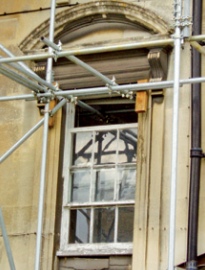
| A typical Georgian sash window awaiting full repair and restoration. Care is needed to preserve the original glass where it exists, particularly if joiner repairs are required to the astragal mullions. | ||
 |
||
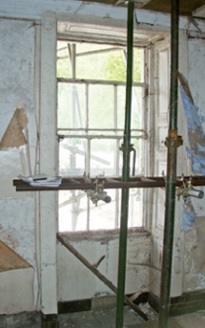
| A typical Georgian shutter assembly with timber decayed at the joints; painting it has only accelerated the damage. |
It is often taken for granted that buildings with double glazing are automatically more sustainable, and therefore more ecologically sound, than those without. Questions remain, however, regarding the balance between the energy saved by fitting double glazing and that expended in producing it. Although rising fuel costs are likely to keep demand for double glazing buoyant, the fuel cost saving is typically not very large: approximately £40 per annum for the average home. Furthermore, cost savings do not necessarily equate to an overall carbon saving.
In England, 81.6 per cent of homes are fitted with double glazing. Research carried out for Historic Scotland shows that pre-1919 homes have the lowest proportion of double glazing, with only 63 per cent having been retro-fitted. The current Part L1B requirement for double glazed units is a U-value of 2.2 W/m2K in England and Wales and 1.8 W/m2K in Scotland. (U-value is a measure of energy transfer through a component separating spaces of different temperature, so the lower the value the better.) The requirements approximately halve the heat loss from the equivalent single glazed window, suggesting a significant saving in the overall carbon footprint. However, this apparent energy saving ignores other elements in the energy equation: the cost of raw material extraction, unit production, transport, use of new materials, and the disposal of the old window. (Approximately 24 per cent of all waste in England is generated by the construction industry.)
Traditional windows have a bad reputation with the public: it is often assumed that they lose heat rapidly, generate draughts and condensation, and require complex and expensive maintenance. This view is supported by an industry dedicated to retro-fitting double glazing.
In reality, the energy equation is far more complex than that presented by the replacement industry. Well-maintained older windows can last for centuries, far outlasting the majority of modern replacement windows. Importantly, areas of damaged or rotten wood in a timber window frame can usually be repaired without the need to replace the entire window. Furthermore, timber itself can be recycled and reused without the need for industrial manufacturing processes. Conversely, modern replacement frames, where they can be recycled as opposed to reclaimed, require further energy expenditure during the complex re-manufacturing processes.
Single glazing is a homogenous sheet with an almost limitless durability. Double glazing, although more thermally efficient, has a far shorter expected lifespan because it relies on other components than the glass for its efficiency: the seals and the gasses. The seals break down leading to the formation of condensation within the unit, or ‘fogging’. Removal of the condensation requires replacement of the unit. The most commonly used argument in favour of double glazing is that it saves more energy than it takes to produce. The shorter the lifespan, however, the less achievable this claim becomes.
PUTTING HISTORIC WINDOWS TO THE TEST
Understandably, double glazing is usually rejected as an option for upgrading historic properties on the grounds that it unacceptably alters the appearance of the building and displaces historic fabric. The proportions and setting out of original glazing sections play an important part in the overall visual appearance of a building. However, there are ways of retaining original windows while improving their thermal performance.
Secondary glazing is usually seen as a cheap fix but, correctly fitted, it can cut heat loss by 63 per cent. Maximising the thermal efficiency is dependent on achieving a close fit to the opening, with draught proof seals to the surrounds. Systems fitted close up against the rear face of the original windows are still discernible externally, and are often very visually intrusive on the interior side, as well as making the operation of the windows awkward. To their advantage, secondary glazing systems are usually reversible, with no loss of historic fabric.
Laboratory testing carried out by Glasgow Caledonian University for Historic Scotland has shown how effective the alternatives to double glazing can be when correctly installed and used. Unfortunately, however, modern curtains and blinds are generally fitted primarily to preserve privacy and for solar shading, with little thought given to potential thermal gains.
CURTAINS
Modern curtains are typically manufactured using lightweight man-made fibres with little insulation value. Fitted with minimal laps to the window surrounds, they have little impact in terms of preventing heat loss. However, traditional brocade curtains using insulating natural fibres can cut heat loss by 14 per cent. Curtains must be properly lined, and overlap all sides of the opening so that they hang against the wall surfaces. The head detail is also important: if windows are deeply recessed, curtain heads can sit against the soffit, otherwise a pelmet housing should be considered. The performance of curtains can be further improved by fitting multi-foil or blanket insulation between the curtain and its lining.
BLINDS
Another traditional approach is to use Victorian blinds, which can reduce the heat loss further to 28 per cent. In other words, blinds are twice as effective as curtains. Roller blinds are an easily-sourced modern equivalent. These are easily fitted close up against the window frame, and when retracted do not show to the exterior. Most modern blinds have a small cross section of less than 35mm. Domestic installations usually leave the blind exposed below the window soffit internally.
 |
|
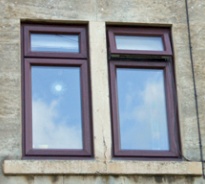
| This replacement uPVC window is visually intrusive in a historic setting, particularly when set against original windows. The bulk of the sections, opening pattern and mullion setting out are all different from those of the original Victorian sash. | |
 |
|
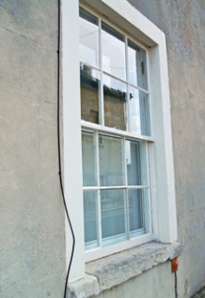
| Secondary glazing set inside the original sash is less visually intrusive externally although it is more visually intrusive internally, and does affect the use of the original window. Some installations are fully reversible. | |
 |
|
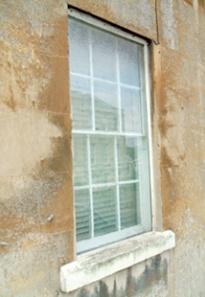
| This secondary external glazing prevents the use of the original window. |
Blind housings hidden above the soffit require disturbance and modification of the linings, and they necessitate some loss of historic fabric. The advantage is that they are visually very discreet and operate well with shutters because the housings are above the top shutter rail. This may not be an issue where the original shutters and linings have been lost, or have already been heavily modified.
When fitted with a low emissivity film on the window-facing side of the blind, the heat retention of roller blinds alone can improve to 45 per cent. Unfortunately, this does increase the bulk of the blind, making it less discreet or resulting in greater disturbance to the historic fabric. The film also alters the appearance of the building when the blind is drawn as its reflective surface is very apparent externally.
The honeycomb blind is a more recent double-layer system which can improve the base figure to 36 per cent. While neither of these modern solutions have a traditional appearance internally, fitting is reversible and can minimise alteration to the window surrounds.
Convenient automated blind or shutter systems are becoming increasingly popular. They can be linked to daylight sensors and central switching so that they minimise heat loss when the building is unoccupied and at night. However, even small motors can be visually intrusive, and hiding them usually entails some disturbance and loss of historic fabric.
SHUTTERS
Traditional shutters on their own can reduce heat loss by 51 per cent when in use. Yet in many buildings where they are fitted they have fallen into disuse despite their thermal retention and security benefits. Their heat loss reduction approaches the energy savings achieved by standard double glazing units with no modifications required.
Modifying the shutters by adding insulation can increase their performance to the equivalent of low emissivity double glazing. Results from a Lister Housing Co-operative property show an improvement in the U-value from 5.5 to 2.2 W/m2K. However, the thickness of the insulation if retrofitted to historic shutters would usually affect its operation, requiring modifications to its hinges and housing. If the original shutters are replaced with modern insulated shutters, an important (and increasingly rare) part of the historic fabric would be lost, but where the original shutters are missing, the introduction of modern insulated designs may well be more appropriate, as it is arguably more ‘honest’ to fit a new design than a facsimile of a traditional one.
COMBINATIONS
Where shutters exist and blinds can be fitted, the U-value can actually be improved beyond the levels achieved by double glazing, although issues can arise in locating the blind housing so as to avoid fouling the shutters. The combination of shutters with blinds and curtains can achieve the same U-value as modern insulated shutters with minimal impact on historic fabric.
ENERGY MANAGEMENT
Alternatives to double glazing systems that have minimal impact on the appearance of historic buildings do exist. Shutters and blinds are simple and robust, easily repaired and, if used correctly, their efficiency is comparable with that of double glazing. Shutters also have the added benefit of improving home security. All systems, both historic and modern, need to be correctly managed to ensure they are used to maximum efficiency, but they can reduce heat loss more effectively than double glazing alone.
Arguably the best starting point for all energy efficiency measures is to go back to the source and review the heating installation and maximise its efficiency. In the case of historic buildings, the occupants also need to develop an understanding of how their buildings work.
Old buildings with a high thermal mass behave differently to modern lightweight buildings: applying heating at maximum output over a short period is inefficient. Old buildings which were built and used historically in ways that were highly sustainable, are often forced to adapt to modern lifestyles and levels of comfort which are inherently unsustainable. Clearly, adapting old buildings to 21st century requirements is often vital to their survival. As English Heritage has acknowledged, the vast majority of historic buildings need a beneficial use to justify their continued maintenance costs. But perhaps those who use historic buildings need to adapt too, understanding and working with their buildings to reduce energy consumption and improve efficiency.
~~~