
Holy Trinity
Cathedral of the Arts & Crafts
Daniel Martin and Stephen Clare
 |
||
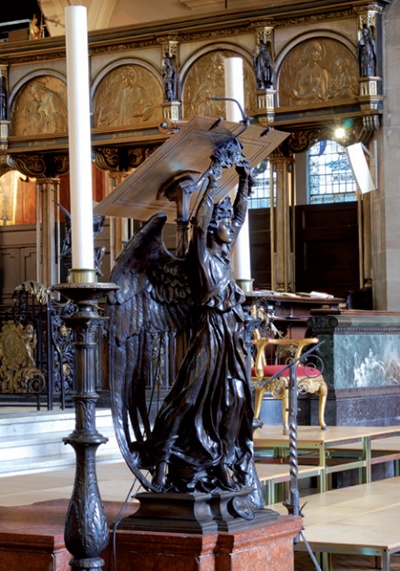
| HH Armstead’s bronze lectern of 1890 with choir stalls beyond by FW Pomeroy |
Holy Trinity, Sloane Square, London is one of the most artistically significant churches in the UK. Designed by the architect John Dando Sedding, it was consecrated on 13 May 1890 and is a Grade I listed building. It is a classic example of a late 19th century gothic style church, drawing on an eclectic range of styles including early medieval, Byzantine, pre-renaissance Italian and English Decorated Gothic. Poet laureate Sir John Betjeman, with his passion for architecture and churches, dubbed it ‘the cathedral of the Arts & Crafts Movement’, a phrase that stuck.
Sedding was a founding member of the Arts & Crafts Movement and one of the most distinguished designers and architects of his time. He was an accomplished designer of wallpaper, embroidery, metalwork and sculpture. As a founder and second master of the Art Workers’ Guild, Sedding’s aim was to revive the medieval system of cooperation between architect and craftsman.
Holy Trinity is home to a wealth of treasures from the Arts & Crafts period including works by Henry Wilson, a student of Sedding who completed the building of Holy Trinity following Sedding’s death. The angel lectern and spandrels of the nave and chancel arches were designed by Henry Hugh Armstead, the angels on the pillars of the Baroque chancel screen and panels in the choir stalls were designed by Frederick Pomeroy, the altar frontal of the entombment was carved by Harry Bates of the New Sculpture movement and the reredos is the work of John Tweed.
Occupying a prominent position in the heart of Chelsea in London, the church was badly hit by German air raids during the Second World War. In September 1940 a bomb fell on the church causing a fire that put its organ out of action for six years. Another bomb hit the church in May 1941 destroying the roof. Miraculously, the Great Eastern Window remained undamaged, but it took ten years to complete a new permanent roof.
In recent decades, in line with the growing prosperity of the neighbourhood, the church has been rejuvenated as a focal point of the local community. The building is open to the public throughout the day, holding daily morning and evening prayer sessions.
In light of the many treasures in the church, it was decided in April 2007 to commission a condition survey to establish the extent of repairs that would be necessary to maintain the building. The detailed condition survey found that, given its age and history, the church was generally in a good state of repair although some urgent repairs were necessary to avoid progressive decay.
WINDOW CONSERVATION
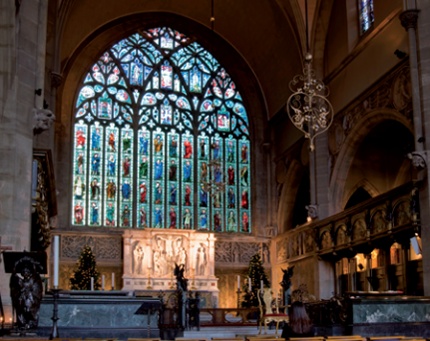
Even among this extraordinary confluence of art and architecture, Holy Trinity’s stained glass is often considered the finest of its treasures. The most notable example is the Great East Window, designed by the pre-Raphaelite painter Edward Burne-Jones. It is a classic example of a 12 light window and depicts 48 figures including prophets, apostles and saints beneath scenes from the Nativity, the Garden of Eden, the Crucifixion and the Annunciation. The window is the largest ever manufactured by Morris & Co.
The south aisle windows and clerestory windows were designed by Christopher Whall, arguably the most important stained glass artist of the 20th century. The initial design concepts for Holy Trinity survive in a sketchbook held by the William Morris Gallery in Walthamstow.
The stained glass in the church, although dirty, was in reasonably good condition. All the glass was cleaned but only the two Christopher Whall windows in the south aisle were releaded. Minor repairs were undertaken to other windows. While the resources were available and the Whall glass was in the workshop the opportunity was taken to commission Peter Cormack of the William Morris Museum to draft a report on the history of the glass in the church. It was discovered that descriptions exist in Whall’s notebooks for every window at clerestory level but that only part of the scheme was ever cartooned and realised. The legibility of these windows in particular has been greatly improved by the in situ cleaning.
 |
 |
|
 |
||
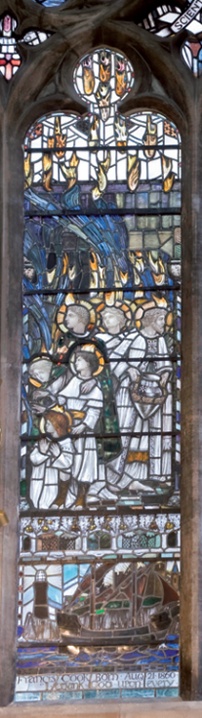
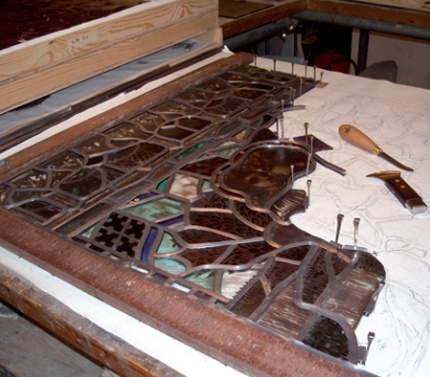
| Top left: The Great East Window, designed by Edward Burne-Jones. Above right: A detail from Christopher Whall’s Pentecostal window in the south aisle which was releaded, showing Simon the Cyrenian wearing a coat of richly mottled glass. Above left: the releading of South Window III in progress. | ||
South windows III and IV were produced by Whall in collaboration with JD Sedding. It is clear that Sedding had great faith in Whall’s abilities and included him in the design process for the elaborate scheme of decoration which he had planned for Holy Trinity as early as March 1889.
Window III is a four light window depicting The Holy Spirit and the Pentecost, and dates from 1907. It was designed by Whall and made with the collaboration of his pupils and assistants at his newly established studio-workshop at 1 Ravenscourt Park, Hammersmith. The window was donated to the church by Frederica Cook in memory of her husband, Wyndham Francis Cook, who died in 1905.
Window IV is a three light window that depicts The Adoration of the Magi and the Shepherds, and dates from 1900. It was designed by Whall and made by him in collaboration with his pupils and assistants, using the workshops of Messrs Lowndes & Drury of 35 Park Walk, Chelsea. The window was donated by Mrs E Harvey in memory of her husband, Edmund Harvey, who died in 1898. These great windows by Christopher Whall are rightly considered to be major works of the Arts and Crafts period.
The reasons behind the intervention were straightforward; the extremely heavy leaded panels were severely bowed and this was causing the glass to crack and allowing water ingress. In common with many Whall windows these are constructed using his beloved ‘Norman Slab’ glass and heavy lead ‘cames’ with a very deep heart section (the part of the H section which separates the glass panes). The decision was taken to remove both windows for cleaning and repair following the recommendations of the original report of March 2007.
 |
|
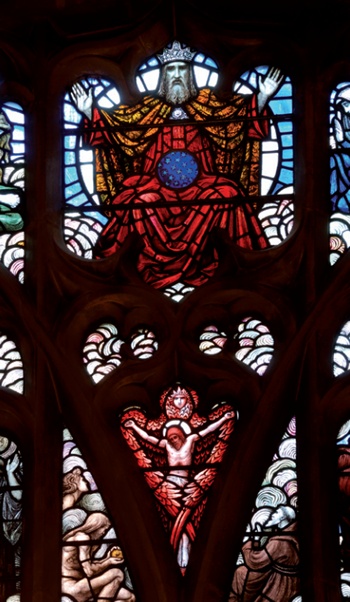
| A detail of Christ the King from one of Sir William Blake Richmond’s windows in the north aisle which was cleaned. |
The windows were removed by carefully chipping away the perimeter mortar and the panels were then transported to the workshop. In the workshop a number of steps were carried out in the conservation of the stained glass. These were as follows:
1 The conservators closely examined the panels individually, taking careful note of the glass types, condition of painted detail and methods employed in the original leading of the panes.
2 Detailed photographs were taken of the lead matrix to allow conservators to consult full scale computer images of the original panels during the reconstruction. A photographic record was taken of each panel on the light box in reflected light and transmitted light, clearly scale marked.
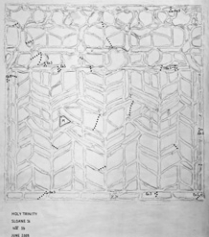
3 Three rubbings were carefully taken from the leadwork of each panel. One of these was used to lay out the glass following dismantling from the lead. The second was used as a guide during re-leading and the third was marked up as a conservation diagram using CBC (Church Buildings Council) annotation.
4 The glass was then carefully cleaned using a 50/50 solution of acetone and de-ionised water. Cracks to the glass were repaired employing the copper foil method, which is reversible but, like a thin lead came, obscures the edges of the glass on either side. In isolated places pieces which had multiple cracks were edge bonded with epoxy resin (Araldite 2020) to reduce the visual impact of the repairs. Protective backing glasses were not provided as the great thickness of the original glass allowed the resin to form a very strong bond.
5 Lead was commissioned with the same sections as the original with heart depths of 6, 8 and 10mm. This allowed the original lead forms to be accurately replicated. However, for the thickest pieces of Prior’s Norman Slab it was necessary to open out the lead further to accommodate the glass. In these areas the heart of the lead was soldered to ensure rigidity.
6 The panels were cemented in the traditional manner; photographs of the completed panels were taken as before. Numerous ‘in progress’ photographic details were also taken.
7 The panels were then re-fixed on site into a hydraulic lime mortar using one part St Astier NHL3.5 to three parts sharp sand and horse hair.
BUILDING CONSERVATION
The building itself was found to be structurally sound, although there were several areas where rainwater had penetrated creating a need to repair roof coverings and overhaul and improve the rainwater drainage system. Equally important was the installation of a new access harness system that will allow routine maintenance of the drains to be performed more regularly.
 |
|
| Stained glass conservation diagram marked up using Church Buildings Council annotation |
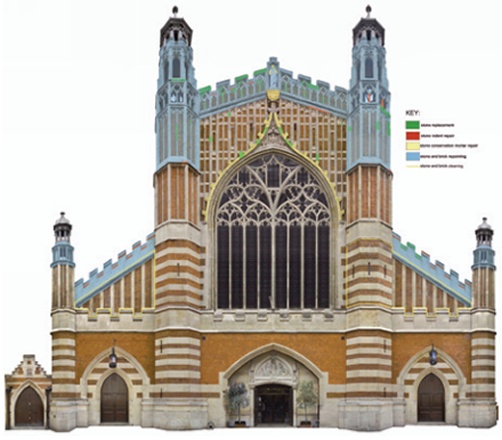
At the front of the building the stonework at the top of the facade, particularly that of the parapet, was showing signs of considerable erosion. Early photographs show that the parapet was originally constructed as a pierced open screen. The infilling brick panels are a later addition. Such slender detailing in this exposed location was always going to be problematic. Consideration was given to removing the brick infill but this approach was rejected since it would have resulted in far greater replacement of the stonework if the structural stability of the parapet was to be guaranteed.
The repair approach adopted generally was to indent with new sections of stone as mortar repairs were not considered appropriate for such exposed locations. Priority was given to repairing hood mouldings and other elements that protect the surfaces beneath, and some of these had to be replaced, including those above the clerestory windows in particular. In the parapet a few complete blocks of stone also had to be replaced.
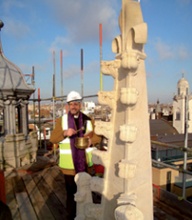
The stone finial at the apex of the west front was renewed. It was unclear when this had been lost but it may have been a victim of the bombing. The design was developed using record photographs and design elements found elsewhere in the building. The finial sits above an alcove accommodating a statue of Christ. Minor consolidation work was carried out to the face and robes on the statue but the temptation to reinstate the eroded face of the statue was resisted.
Gentle cleaning of the brick and stonework on the flank and rear elevations helped to identify defects during the repairs contract but also revealed the yellow and red banding on the face of the church that had previously been concealed by dirt. The interior of the church was originally finished in the same way but has since been covered with painted plaster.
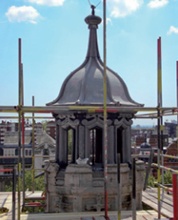
The quality of the lead detailing to the west elevation cupolas is exceptional but previous repairs to the lead-lined gutters at the base of the two large cupolas had been poorly executed and had resulted in saturation of the timber wall plates beneath. The bases of both cupolas had to be almost totally rebuilt. Sourcing timbers of the required size proved difficult and the structural engineers had to develop a design that minimised the extent of replacement while ensuring stability throughout the process of rebuilding.
Due to the position of the building and the size of this project it was essential to keep the entire church covered in scaffolding for nine months. With the scaffolding now removed and almost all of the essential work to the exterior of the building complete, it is unlikely that a programme of this scale will be needed for at least another 40 years.
 |
 |
 |
|
| Above left: colour-coded repair guide showing the stone conservation work carried out to the front facade. Top right: The west elevation cupola prior to gutter repair. Above right: Rev’d Rob Gillian blessing the new front finial on completion of the works. | |
~~~