
Innovations in Limewash
Roz Artis-Young
 |
|
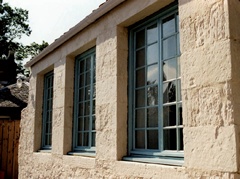
| Charlestown hydraulic limewash over masonry at Charlestown Workshops, Fife (training centre for the Scottish Lime Centre) |
The aesthetic properties of limewash and lime paint finishes are unrivalled by modern materials. Limewash is the chameleon of traditional building materials, giving protection and a coloured vibrancy while blending harmoniously with the surrounding geology and landscape.
Unfortunately, industrialisation and bulk material production have seen regional textures and colours lose ground to products that are widely available from builders merchants and DIY stores. In the past, the texture and colour of masonry finishes have tended to reflect local acquisition or production of materials and consequently reflected their surroundings.
While modern materials may not be able to emulate the aesthetics or indeed the technical properties of traditional limewashes, we should not ignore innovations in the production and formula of these materials, we should embrace them. A number of new formula limewashes and paints have been brought onto the market in the last few years that demonstrate technical advances in preparation techniques and also the blending techniques of lime and pigments.
Limewash is a traditional interior and exterior finish for many stone and brick buildings, applied either directly to the masonry surface or, more commonly, to a coating of lime plaster, render or harling. It is also the normal finishing material for daub and, with or without a lime plaster coating, for clay and earth buildings. As a vapour permeable material, limewash is the most effective and appropriate finish available for traditional buildings: it is also the most beautiful.
As with other lime-based materials, limewash is a relatively environmentally friendly material that cannot burn or ignite and does not give off VOCs or other toxic gases. Limewash is UV-proof (ultra-violet light is the main agent of decay in modern exterior paint systems). There is no risk of adverse reactions between coats and, in fact, each addition binds and improves what is already there. Limewash is still used all over the world and in many countries limewashing houses is an annual event. Traditionally, limewash is tinted with cheap, local earth or mineral pigments, all of which are compatible with lime. In Northern Europe, warmer limewash colours have traditionally been favoured under the greyer skies.
A key characteristic of any limewash is the size of the lime (calcium hydroxide) particles in suspension. All limewashes are suspensions of calcium hydroxide particles along with small amounts of calcium carbonate, silica particles, and other minerals. The typical size of particles in a limewash made from hydrated lime is likely to be around 200-300 microns or more (the actual particles of calcium hydroxide are smaller than this but they agglomerate when mixed with water and even intense mixing cannot fully break up the agglomerations).
 |
|
 |
|
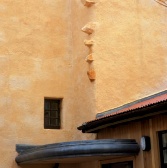
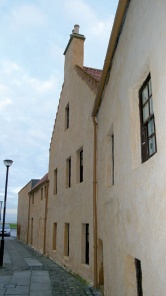
| Above and top: Whitepeak limewash onto new lime finishes at Dymock’s Buildings, Bo’ness, West Lothian |
A limewash made from slaking quicklime will have smaller particle size, perhaps 100-200 microns, which is why this material is considered better than hydrated lime. Smaller particle size gives a number of benefits:
- The suspension is much more stable and does not settle as fast, making application and handling much easier and more consistent.
- The particles are able to penetrate into the substrate more easily as they can exploit more (and smaller) pores and capillaries in the surface, giving a more bonded and durable finish.
- The greater surface area within the suspension allows the limewash to hold more pigment enabling richer colours to be achieved.
- The greater surface area also means that the carbonation reaction is rapid and consistent.
- Finally, there is some evidence that vapour permeability of the limewashed surface is increased with a decrease in the particle size in the limewash.
In short, the smaller the particle size the better. One of the finest examples, White Peak limewash has an average particle size of just one micron. Made at Buxton Lime’s Tunstead Works in Derbyshire using techniques developed for industrial water treatments, its particles do not form agglomerations. A superfine suspension of calcium hydroxide such as this results in easy handling and application, excellent finish and durability, and the ability to hold rich colours and to handle a wider range of substrates than previously possible.
HYDRAULIC LIMEWASHES
Another very interesting form of fine particle suspension limewash is achieved using hydraulic lime, the form of lime which sets on addition of water. This may be made by either slaking hydraulic quicklime in an excess of water or mixing hydrated hydraulic lime in an excess of water and maintaining a saturated slurry.
Current wisdom suggests that the hydraulic set should affect the performance of the lime slurry through settling and hardening. This in fact is not the case: if the materials are well stirred on a regular basis, once a day for the first week or so and then every two to three days thereafter, the particles continue to get finer and smaller with age.
The particle sizes can, with time, be as little as 1-3 microns. In the case of a moderately hydraulic lime (NHL 3.5), this generally takes place in about two months. The settled putty that forms at the bottom of the storage vessel is beautifully silky smooth to the touch.
The set is only marginally diminished (bear in mind that a hydraulic lime only realises 10 per cent of its total final strength in the first month and then only in ideal curing conditions) as limewash is not strength dependent. Even two to three months of storage and (theoretical) reduction of strength is not an issue that should cause concern. At our workshops in Charlestown, we regularly make limewash by slaking our local hydraulic quicklime in an excess of water and store it for up to a year before remixing and applying as limewash. The results are quite beautiful and extremely durable.
There is a great deal of information available about the use of hydraulic lime but much of it is derived from the chemical composition and is often related to the performance of cement. The testing regimes in the European standard EN459 were originally formulated for cement testing, while the main test criteria relative to performance is compressive strength, gauged by testing cubes, which is also a cement based criteria. The actual performance of these materials is markedly different and we should be prepared to experiment with them without the standards and constraints of the cement and concrete industry as our guiding principles.