
Intumescent Products
Andrew Forecast
 |
||
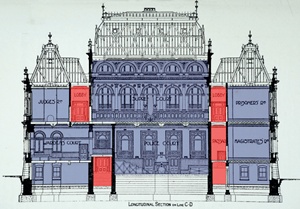
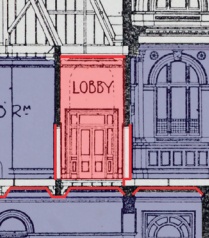
| Compartmentation: the diagram and the detail below left illustrate the complexity of ensuring that fire cannot spread rapidly from one part or 'compartment' of a building to another. All openings must be taken into consideration, including those like underfloor spaces which can be permanently protected, and those like doorways, ducts and pipework which must be sealed in an emergency. |
Fire protection within our built environment has always been of vital importance, not only for life safety but also for property and heritage protection, including business continuity. Fire protection, used for whatever reason, typically falls into two categories, active and passive.
Active fire protection generally means those installations that will actively respond to a fire event, including detection, sprinklers and smoke venting for example.
Passive fire protection refers to those products that remain robust enough to resist the passage of hot gases and fire for a given duration, and includes architectural elements such as doors, floors and walls as well as proprietary sealing systems such as collars, wraps and dampers.
Although the term passive might not be expected to apply to products which react to the application of heat, it is also used to describe elements which include intumescing materials. Such materials react to heat, usually by expanding, to enhance the resistance of a component to the passage of heat, smoke and flame.
Active and passive methods of fire protection will typically be used in conjunction with one another to ensure that escape routes remain tenable for a duration suitable for firstly effective evacuation (to comply with life safety requirements in The Building Regulations) and secondly for property protection (including salvage). The determination of where escape routes are needed and for what period they need to be protected, stems from the The Building Regulations 2010. Recommendations on how to achieve those minimum expectations are given in the Communities and Local Government (CLG) guidance, Approved Document B (ADB).
COMPARTMENTATION
Compartmentation is the vertical and horizontal division of the building into spaces and suites of spaces that can be isolated from each other in the event of a fire. In historic buildings, ensuring that fire cannot spread rapidly from one part or ‘compartment’ of the building to another can be complex since the integrity of walls and floors cannot always be relied on. Furthermore, during the life of the building its use may vary considerably, and even minor changes to the structure and fabric may impact on the integrity of its compartmentation. Additional measures may be deemed necessary, particularly when a new use is proposed, or where its heritage value has been re-evaluated and better understood, or indeed simply to make the building function better.
 |
Focusing on the need to maintain the compartmentation of a wall, doors are common passive fire elements that typically need to be maintained or upgraded. A door is seemingly a straightforward piece of joinery – it’s a bit of wood that fills a hole! However, things are never quite that simple.
Although any closed door will have some delaying effect on the development and spread of a fire, for a door to be considered a fire door (whether it is original, old, upgraded or new), it must be proven to be capable of resisting the effects of a standard fire test (BS 476: Part22 or BSEN 1634-1) for stipulated periods, usually 20, 30 or 60 minutes.
The requirements for fire doors are complex. While representative examples of intended fire door designs are required to be tested, this is generally not an option where existing door-sets are to be upgraded in situ. In most cases, regulatory authorities are willing to accept an assessment of likely performance in lieu of a direct test result, which will take account of performance evidence for upgrade materials when applied to the specific door-sets in question.
All building elements will of course have an inherent degree of fire resistance but without specific knowledge of products, construction and fire resistance testing procedures, the determination of such periods will be impossible. For example; will a door measuring 44mm thick provide 30 minutes fire resistance? The answer is possibly, but considering its thickness alone would not be enough to assess whether its performance will be adequate. It will also be necessary to consider other issues such as:
- What (if any) is the amount of bow and twist?
- Is there any leaf damage?
- Are there perimeter intumescent seals in place?
- Are there any intumescent gaskets to protect the ironmongery locations?
- If panelled, what are the panels made from and how are they retained?
Even if the above sample questions are suitably answered, it does not determine the materials/methods required to enhance performance.
If it is found that upgrading the door may make it suitable for use as a fire door, the next step is to determine appropriate upgrade materials. For timber door-sets there are many, ranging from paints and varnishes to board materials and intumescent papers. The type to select depends very much on the end appearance and the door construction itself. Not all upgrading products are all encompassing. Consideration of ‘reversibility’ is also needed, particularly on historic door-sets in listed buildings.
PERIMETER SEALS
Intumescent perimeter seals are almost always needed on timber based fire-resisting door-sets. They sit, usually centrally, within suitable grooves in either the frame reveal or leaf edge and are typically encased in a PVC sleeve. Retro-fit seals are also available which adhere directly to the frame reveal. These seals tend to be wider, but as they are not encased they may only be 2mm thick.
The purpose of intumescent perimeter seals is to expand on heating not only to seal the opening gap and to provide a barrier to restrict charring of the local timber elements, but also to provide sufficient pressure between the frame and the edge of the door-leaf to help control leaf distortion, caused through dehydration and char. Performance is directly linked to the size of the edge gaps. Evidence suggests that once gaps exceed 4mm, the performance of the perimeter seals dramatically reduce; lowering the pressures produced to control distortion, decreasing the erosion resistance capabilities and limiting their efficiency at gap filling. The physical amount of intumescent seal used is also not set as the larger the door leaf (height and width), the larger is its propensity to distort and so the greater is the need for a larger perimeter seal. A perimeter seal alone is not sufficient to demonstrate suitable protection.
PANEL UPGRADES
Assuming that the edge conditions have been bottomed out, what of the panels? Depending on their thickness and their method of installation, panels can be one of the weakest part of a door construction. Upgrades are available in the guise of boards, papers and varnishes.
BOARDS
 |
||
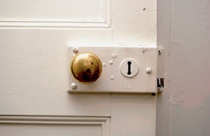
| A typical Victorian panelled door: upgrading to provide half-hour fire protection could be achieved by the use of intumescent perimeter seals and intumescent paper to the recesses of the panels with minimal impact on its character. |
Over-sailing a thin timber panel with a board material of known fire resistance (gypsum or calcium silicate based) may well be considered appropriate by some people. However, screw-fixing the board over the panel on the room side (fire risk side) would not necessarily work if tested under the current fire resistance test standard. Many thin (6mm) fire-rated boards will not offer insulation and so, if used on the fire side, radiant heat has the potential to burn the thin panel behind and cause it to spontaneously combust, thereby allowing fire to spread to the non-protected side.
In this case, such boards may be best fixed to the non-risk side so that the panel burns away, but the fire cannot then penetrate the applied board (subject to suitable fixings of course). Additional questions arise from such upgrades, where there is the use of large boards on a single door. The door becomes unbalanced and so distortion characteristics may not be able to be controlled by the perimeter edge seals, causing the edge of the door to become exploited by the hot gases and flames.
Boards can be, and are, successfully used to upgrade doors, but it is essential that the board’s inherent performance is known, and that it has specific data to demonstrate its use as an upgrading medium on a comparable door construction.
The primary advantage of using board products is that, although the end appearance is not original, the upgrade is easily reversible subject to the minor infilling of screw fixings.
INTUMESCENT PAPERS
An alternative would be to upgrade panels using intumescent papers. These are thin (1-2mm) sheets of intumescent material, often coated on one side with a timber veneer to match the existing timber and grain pattern of the base door. Such sheets are typically applied to both sides of the panel. Their exact installation would be dictated by the manufacturer’s test data but generally will require the removal of the perimeter beads in order for the intumescent to be inserted to the edge of the panel before re-applying either new or the existing beads. Some manufacturers have data which demonstrates that this is not required, but it would be advisable to check the evidence before installing. In this case, the intumescent material will expand many times its original thickness, to create a deep protective layer, which keeps the timber panel cool. The intumescent layer also tends to flow, helping to fill fissures within the burning timbers to prevent the entire mass (intumesced product and timber panel) from falling out prematurely.
If it is feasible to remove the existing panel, a replica could be inserted, which will provide enhanced fire performance. Replica panels would typically have an intumescent sheet (1-2mm thick) sandwiched between two thin timber faces of between 4-6mm each. The panel would then be replaced within the door structure using timber beads and pins. Specific evidence of performance of such a system would be needed.
With each of the above options for panel demonstrate performance but only for what was tested, which would include the specimen size. If a tested panel measured 350mm x 350mm, it would not necessarily work on a panel where one of the dimensions exceeded 350mm. In some instances, the self-weight of the large expanse of reacted intumescent is enough to pull it off the door it is protecting. Therefore, care should be taken to ensure that the test data supports the size (and thickness) of panel that is to be upgraded.
As with the board fixing option, panel upgrades that use intumescent papers are relatively easy to reverse, albeit requiring the potential remake of beads.
PAINTED COATINGS
 |
||
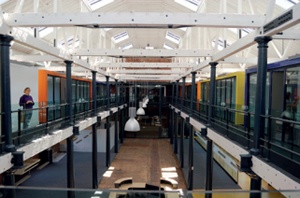
| Intumescent paints are often used to enable the retention of structural elements such as these cast iron columns where industrial buildings are converted. The coating must ensure that structural integrity is maintained for long enough to evacuate the building. |
Paints and varnishes are available which offer improvements to the fire performance of existing doors and panels. Their performance is based on a reactive coating that protects the underlying door/panel construction. The paints would require several coats, in thicknesses stipulated by the manufacturer, which would be applied to both sides of the door/panel. Their end appearance varies depending on application and is reversible if they are water-based.
However, their performance is again linked to dimension and door/ panel construction. Small tested specimens would not necessarily support the product's use on a large expanse of panel due to increased heat experienced by the centre of large panels, which do not benefit from the shadowing of the perimeter beads and stiles and rails. Similarly the existing substrate would need to be identical to that tested in order to ensure good adhesion of the reactive coatings. This would certainly require the removal of any existing paint or varnish finish to the underlying door-set/panel.
WHOLE DOOR UPGRADES
If a door leaf is solid with no panels, but its thickness is not consistent with that expected for suitable integrity duration, can it be upgraded? The answer is ‘possibly’.
Boards Boards (plasterboards, calcium based boards etc) could be applied if they have correct test data to support their use as an upgrade to thin doors. But this is again dependent on the size of the door to be upgraded. Typically test data will support fairly standard sized door-sets (1,982mm x 762mm) with an existing thickness of 35mm or more if used in single leaf configurations. In most instances, the full boards would be located on both sides of the door, either notched to go over the door stop or, the leaf re-hung and the door stop moved to accommodate the increased thickness. This is a robust and reversible method of upgrade but again, has size limitations.
Intumescent papers Intumescent sheets are not really appropriate for such full size upgrades, and paints and varnishes have limitations in terms of base material (removing existing paints and ensuring similar timber base to test data) and of leaf size.
With all intumescent and board upgrades, it is essential to understand the test data and how it can ultimately limit the end application. A product seen to work in one instance on a pre-prepared specimen of limited dimensions will not necessarily work on a much larger scale. Care should be taken when reviewing test data. Always remember, test evidence is valid for exactly what was tested on the day of test. Its extrapolation to other uses (including size and material) can only be given by carrying out either many tests to cover the range, or by having an assessment produced by a reputable fire engineer.
IRONMONGERY PROTECTION
Intumescent materials are also used underneath items of ironmongery, more often for the higher integrity door-sets (60 minutes and above) but also for lower integrity door-sets when items are large and/or invasive to a door construction. Unusually large hinges blades, for example, which cross the frame reveal, act as a path for heat to be transferred past the perimeter intumescent seals (usually bisected at half-hour performance). This has the potential to char timber deep into the frame reveal and ignite the framing on the non-fire side.
Bedding hinge blades on an intumescent gasket helps in two ways, firstly the material will cool the blade by taking heat in order to react and secondly, to fill local fissures within the timber to help slow down the passage of hot gases. Bedding hinges on ‘old’ timber where grain patterns are prominent is also useful as a matter of course.
ALTERNATIVE APPROACH
The provisions above are driven by recommendations in ADB. However, ADB is a functional document which also enables fire engineering to be developed to demonstrate comparable conditions. Taking the geometry of the existing building into consideration, it may be possible for a qualified fire engineer to demonstrate that the instant flashover conditions of a BS476 (BSEN 1634) fire test would either not be reached or would be significantly delayed. If this is considered in conjunction with the speed for a fire to be detected and grow, it could be possible to demonstrate that a full 30 or 60 minutes fire resistance to the British Standard, is not needed. This provides the opportunity to reduce the extent of upgrades needed, with obvious benefits not only in terms of costs and timescales, but also by limiting the need for potentially damaging alterations to historic fabric.
SURFACE SPREAD OF FLAME
Notwithstanding fire resistance, escape routes, defined by either ADB or a prepared fire strategy, would be expected to have a certain level of performance to the wall linings. This does not relate to fire resistance (although most escape routes would also need fire resisting properties) but to the surface spread of flame. This relates to the speed at which fire will propagate and spread across the surface of a product. Typically escape routes would need to be classified to a National Class 1(European Class C-s3, d2). Timber has a general surface spread of flame rating of National Class 3 (European Class D-s3, d2). The exposed surfaces may be treated to change the inherent classification, enhanced to meet the Class 1 needed. This may be achieved by the use of suitable paints and varnishes. There are many available and unlike the intumescent paints/varnishes, will not have a size restriction. It only becomes necessary to ensure that the base timber is suitable to receive the applied paint finish.
IN RETROSPECT
As with all fire rated products, be it for integrity or for surface spread of flame, test evidence is key, as is making sure that the product itself is sufficiently suitable and robust for the application in question. In historic buildings, demonstrating fire resistance retrospectively (that is to say, for pre-existing fabric) is therefore quite a complex issue, and should only really be confirmed by those with suitable experience who are able to take account of evidence from the product manufacturer and apply suitable determination.