
Iron Railings
A Conservation Case Study
Eleni Makri
 |
||
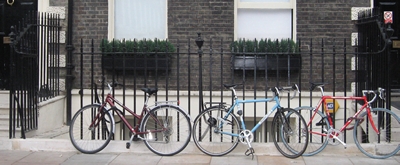
| The repaired railings in Bedford Square, London |
Bedford Square dates from the second half of the 18th century and is acknowledged as one of the most significant and best preserved Georgian squares in London. Important attributes include the nearly symmetrical, palatial composition of the terraces on all four sides, all of which are Grade I listed. The private, landscaped gardens in the middle are included in the English Heritage Register of Historic Parks and Gardens, and listed Grade II*.
Severe damage was caused to some of the square’s original railings in 2010: following heavy snowfall in London in January, a car spun out of control and hit the railings of No 37 Bedford Square, part of the terrace which forms the square’s western side. Fortunately, the car came to a halt before it could fall into the lightwell, which the railings enclosed. This article describes the conservative repair and reinstatement of the damaged Georgian railings.
ASSEMBLY AND CONDITION
The railings of No 37 are typical of the square and of the period in both their materials and their ornamental detailing: square wrought iron balusters are fixed at regular intervals into a Portland stone plinth and secured with molten lead in the plinth sockets. At the top, the balusters are held by a horizontal cast iron coping rail. The railings were constructed in two panels, defined by wrought iron standards decorated with cast iron urn finials. The badly damaged panel included a pivoted gate. The whole structure is braced to the front wall of the building. The return section to the entrance door has the cast iron horizontal coping fixed into the brickwork, also using lead.
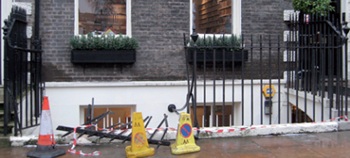
The impact of the car, as well as severely damaging one of the panels, had caused movement to the whole enclosure, including the gate standard and pivot. The wrought iron balusters in the damaged panel were buckled and dislodged, and the stone plinth sockets had been broken as a result. The cast iron coping remained attached to the collapsed balusters as the coping itself broke into two pieces, consistent with the brittleness of cast iron.
 |
|
| The damaged railings following the impact of a car in snowy conditions |
Assessment of the damaged railings revealed two key maintenance problems, both relatively common.
Firstly, the metalwork had only a thin protective covering of paint. It was clear that the railings had been stripped and repainted in the past few years and that repainting had not provided adequate protection as there were several areas of underlying corrosion.
Secondly, the Portland stone plinth had been painted white. The impact from the accident had caused the paint to flake and the stone underneath to delaminate but this also revealed areas where the stone had turned to powder. This was probably the result of frost damage, as water seeping in through capillary action could not evaporate but remained trapped behind the impervious paint. The painting of the Portland stone plinth was problematic both in terms of its appearance, which was not faithful to the original 18th-century design, and its long term compromising effect on the integrity and strength of the plinth and its capacity to support the main fixings of the railings.
REPAIRS
Remedial works were carried out in the following sequence of like-for-like repairs:
1 Railings stage 1: the damaged cast iron coping rail and wrought iron square balusters were dismantled by the metalwork contractor and taken to the contractor’s specialist blacksmiths’ workshop. There, the balusters were stripped of paint, straightened and repaired using traditional forge techniques and the cast iron coping was stripped of paint using light bead blasting. The restored metalwork was then primed ready for delivery to site.
2 Portland stone stage 1: according to the assessment it was not feasible to carry out mortar repairs to the Portland stone plinth section which had supported the collapsed metalwork because the original sockets in the plinth were too badly damaged. It was therefore decided that this part of the plinth would be replaced with new matching Portland stone and a workshop drawing was accordingly produced by the mason and checked on site. Once the railings had been taken away, the paint on the retained Portland stone section was removed using a chemical gel application and the DOFF system. This uncovered past repairs in grey cement, which were carefully chiselled out. Finally, a sample mortar repair was carried out using hydraulic lime and Portland stone dust as the main aggregate and sponged off to produce a smooth finish. This approach was designed to achieve an appropriate strength and to match the colour and texture of the surviving stone.
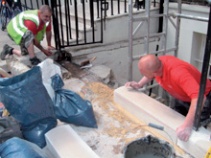
3 Portland stone stage 2: the relevant stone plinth sections were removed and the new stone was bedded in on a sand and non-hydraulic lime mix with the minimum amount of water. Mortar repairs were carried out to wetted stone to ensure that water was not drawn too rapidly from the repair mortar, which would have caused shrinkage. The repairs were built up in layers no more than 12mm deep, as required. Mechanical keys were formed on the undercoats to achieve better adherence of the overlay by combing or scratching to produce evenly spaced lines. The top coat was wiped with a sponge after the mortar had set but before it became too hard, to produce a seamless joint with the stone proper. Finally, all stone joints, both new and old, were re-pointed.
 |
||
| Partial replacement of the Portland stone plinth |
4 Portland stone stage 3: round sockets were diamond drilled in the new Portland stone plinth by the metalwork contractor and squared off by the stonemason.
5 Railings stage 2: the primed and repaired railings were returned to site, refitted in the new plinth sockets and fixed in place with molten lead. The molten lead fixings attaching the wrought iron balusters to the cast iron coping were also reinstated. The reconnection of the coping to the cast iron section that had remained in situ was carried out using a combination of a discreet mechanical fixing in the form of a connection plate to its underside and brazing of the broken joint. This is standard practice: because cast iron does not lend itself to welding, repairs to broken sections make use of mechanical connections and patent methods such as cold stitching. In contrast, wrought iron can be forged, allowing weak sections to be cut out and new pieces of matching profile and material (such as recycled wrought iron) to be welded to the original.
6 Railings stage 3: once the damaged section was reassembled, the rest of the railings were rubbed down to recover healthy metal behind rust patches, primed and prepared for re-painting. It is important that all rust is removed from any piece of ironwork and a rust inhibitor is applied straight away to avoid re-oxidisation of the cleaned surface. If the rust is not removed completely it will continue to develop through electrolytic action beneath the paint until all the metal returns to its original state (iron oxide, the raw material from which iron is obtained). Left unprotected, all ferrous metal corrodes rapidly. When lead fixings to stone fail, water collects in the sockets causing the ferrous metal to corrode and expand. This may explain the cracks in the retained original stone plinth sockets and associated earlier cement repairs in the Bedford Square railings.
7 Railings stage 4: all railings were painted using a two-pack zinc phosphate primer followed by a micaceous iron oxide intermediate coat finished with a high build, high gloss polyurethane top coat.
8 Portland stone stage 4 (pending): the lead in the new Portland stone sockets will be concealed with caulking to match the colour of the stone.
COLOUR SCHEME
In the 18th century, railings were rarely painted black, a practice introduced by the Victorians. English Heritage is currently encouraging a return to authentic colour schemes and it is hoped that a future agreement can be reached with Bedford Estates to adopt a Georgian colour for the ornamental ironwork and other elevational elements of the listed buildings in Bedford Square.