
Heritage Ironwork Training
A call for specialist training and accreditation
Chris Topp
 |
|||
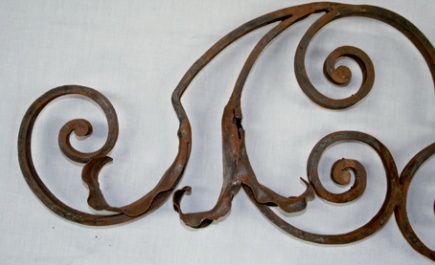
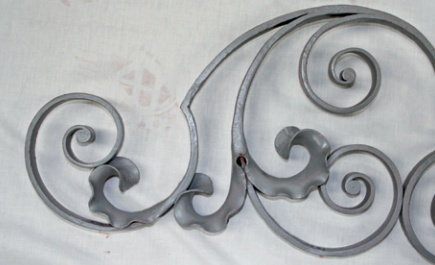
| Above: a set of Grade II* listed gates poorly restored in 2001 and, below, after faithful restoration in 2009 | |||
 |
There is a wealth of historic ironwork in the UK. Many examples exhibit such a mastery of design and craftsmanship that they are recognised as works of national importance. It is all the more remarkable then, that when historic ironwork needs to be repaired or conserved, there is no mechanism to ensure that the people who carry out the work are, as with other work to historic fabric, suitably qualified.
Most working smiths have been offered restoration work on historic ironwork at some time, and many have seen what damage unskilled hands can do. In 1980, elements of Chatsworth’s Golden Gates needed to be restored. The gates were then nearly 300 years old and extremely precious, yet it was found that every joint had been electric welded in recent years. As a result, the vast majority of the restoration work required was dedicated to putting this right rather than repairing the weathering of three centuries.
The illustrations to the left demonstrate a more recent case in which a set of Grade II* listed gates that had been badly restored in 2001 had to be restored again, faithfully, in 2009. The use of electric welding and the lack of care in the shaping of components is clearly apparent and the poorly formed leaves had rusted through.
The cause of this situation is two-fold. Firstly, skill-shortages are particularly acute in this field. Although there are many blacksmiths, few have the skills required to conserve and restore historic wrought iron, which is in part the result of the shortage of suitable courses and training opportunities. Secondly, it is a question of demand: too few specifiers and owners of historic ironwork have sufficient understanding of what constitutes an appropriate method of repair, and there is currently no accreditation system in place to circumvent this.
Contracts for restoration work are generally awarded to the lowest bidder. In the absence of any restriction concerning those who tender for the work, and as high quality work is inevitably dearer in the short term than poor work, smiths who have taken the trouble to achieve a high standard may find themselves at a commercial disadvantage. As a result, at a national level, we are missing the chance to acquire a group of skilled and dedicated individuals who can be entrusted with the future maintenance of our great but sadly neglected heritage of wrought ironwork.
 |
||
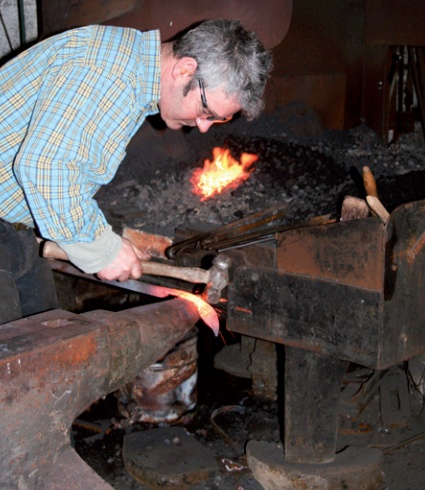
| Blacksmith Matthew Dwyer forging a leaf in puddled wrought iron at Chris Topp & Co’s Carlton workshop |
There is a pressing need to guarantee that a practitioner is a master of the craft before being recruited to work on listed ironwork. In other conservation disciplines people are expected to prove themselves by achieving some form of accreditation. The field of heritage ironwork deserves no less.
To work within the discipline of conservation, smiths should know something about the materials used to create the objects under consideration, in this case wrought iron. They should be able to identify the different irons and be familiar with the materials in terms of manufacture and properties, and have a good understanding of the techniques used to create the piece. They should possess sufficient practical skill to be able to reproduce missing components using the original materials and techniques, as well as mastery of any new materials and techniques which may be called for. Ideally, they should be able to assess the object in terms of the history of the craft, perhaps even to identify in the piece the work of any of the more prominent historical smiths.
A system of accreditation is required which should be based on the achievement of a pre-determined set of standards, or the passing of certain tests to demonstrate knowledge and ability such as the production of a satisfactory test piece.
The question remains as to which institution would act as the awarding body for the qualification, but perhaps, as there will be a need for dedicated training courses in the field, an obvious candidate would be one of the existing training providers. The resulting qualification must be respected by the clients, of course, whose incentive will be a raising of standards across the industry and the provision of work which will last longer and be better value for money in the long term.
At present, there are various courses available to blacksmiths, and while some of the courses deal with aspects of heritage work, none at present is dedicated to it.
There is a need for advanced courses that build on the basic training and which specialise in heritage ironwork. Equally, the specifiers of the work must be better informed in order to specify the appropriate techniques and materials, and to put their weight behind our efforts to procure better value in terms of quality and long term cost savings. To this end we wish to secure training for owners and specifiers, provided as CPD.
Bodies such as the National Heritage Training Group have been entrusted with filling the huge skills gap within the heritage building trades. Such bodies have funds at their disposal to establish craft training where it is needed. A new body, the National Heritage Ironwork Group (NHIG) has been established by Chris Topp and Company and set the task of securing such funding to provide the skills base. However, no such initiative can survive without the support of the employer, the owner of the historic piece, and we recognise the need to secure the endorsement of the national heritage establishment. To this end the NHIG has published a set of preferred standards, a suggested curriculum for an advanced training course and is vigorously promoting the debate within the heritage industry.
NHIG would be happy to receive constructive comments from interested parties and can be contacted through the author at the following e-mail address: christopp@christopp.co.uk.
SKILLS REQUIREMENTS NATIONALLY A brief summary from the Heritage Lottery Fund |
The demand for training places for HLF’s Training Bursary Programme has outstripped the opportunities available by as much as 60 to one.
|
For further information on craft training bursaries see the Heritage Lottery Fund website |