
Recent Developments in Laser Cleaning
Martin Cooper
 |
 |
||
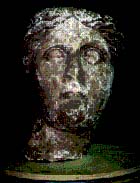
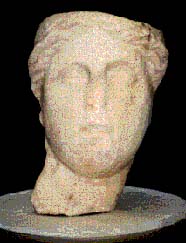
| A Greco-Roman marble head excavated in Shropshire - left, after laser cleaning with an Nd:YAG laser - and far left, covered in soil and whitewash. The treatment removed all traces of soil and whitewash without damaging the marble surface. | |||
Cleaning is a critical part of the conservation process. It serves not only to improve the aesthetic appeal of an object or building but also to reveal its true condition so that appropriate action can be taken to ensure that it survives for many future generations to enjoy.
During recent years there has been increasing concern over some of the more conventional methods of cleaning used on sculpture and sculptural decoration on historic buildings. Careless and inappropriate use of techniques, such as air-abrasive and steam cleaning, can lead to severe damage of the underlying stone surface. The loss of surface detail by overthorough cleaning can reduce the visual appeal of a surface and in extreme cases can even lead to its accelerated decay. Even if cleaning is carried out very carefully, techniques such as air-abrasive cleaning will result in some loss of material from a surface, particularly from a decayed crumbling surface, simply because abrasive particles cannot discriminate between the soiling and the stone surface. The removal of black encrustations from limestone sculpture is usually accompanied by removal of the patina which develops on the surface over a period of time and within which the original surface relief is preserved. Chemical-based cleaning techniques also have associated problems: chemicals often leave residues within the stone which can cause problems later on and once they have been applied their reaction cannot be suitably controlled. In Glasgow some sandstone buildings which were chemically-cleaned a few years ago are turning green at an alarming rate since ideal conditions for algae growth have been created on the surface. The development of laser-based techniques during the past few years has been a significant advance in making conservation methods less intrusive and more controllable. The fundamental difference between cleaning with laser radiation and conventional methods is that particles of light, or photons, can discriminate between the soiling and substrate. This allows the conservator to control the level to which the surface is cleaned.
The laser is a unique source of light, providing energy in the form of a very intense, monochromatic (a single colour or wavelength), well-collimated beam (a typical laser beam spreads out only a few millimetres after travelling several metres). When a laser beam interacts with a surface, part of the energy is reflected and the remainder is absorbed (assuming no transmission). The fraction of energy absorbed depends on the wavelength of the laser radiation and on the physical and chemical properties of the surface. A laser beam can have no effect on a surface unless it is at least partially absorbed.
The most common laser used in conservation at the moment is the Q-switched Nd:YAG laser which provides short pulses (typically 5-10 ns long) of near infrared radiation at a wavelength of 1.064 mm (or 1.064 x 10⁻⁶ m). These are effectively very short pulses of heat. The short pulse length is important since it prevents heat from being conducted beneath the soiling into the stone surface. This type of laser is commonly used since most soiling layers are much more strongly absorbing than the underlying substrate at 1.064 mm. This means that, provided cleaning is carried out within safe parameters, once the dirt has been removed, further pulses will have no effect on the surface as insufficient energy is absorbed to cause any damage - in other words the process is self-limiting. The Nd:YAG laser is also extremely reliable, easy to maintain, relatively compact and robust.
Commercial laser cleaning systems have become available during the last three years and are now being used by conservation studios across Europe. In a typical system the laser head, power and cooling supplies are housed in a single portable unit which weighs about 125 kg and runs off a 13A/240V mains supply. In this case the laser beam is directed by means of a 7-jointed articulated arm with the beam emerging through a pen-like handpiece within which a lens is used to produce a diverging beam. The conservator controls the cleaning effect through adjustments to the energy in each pulse, the number of pulses fired per second (repetition rate) and the distance between the tool and the surface (which controls the intensity or spread of the beam). The maximum pulse energy and repetition rate varies between systems and a few systems use an optical fibre rather than an articulated arm to deliver the beam. Most commercial systems are suitable for work either in a studio or out onsite.
The most important cleaning parameter is the energy density, or fluence, of the laser beam which is defined as the energy per unit area incident on the surface (energy per pulse/beam size at the surface) and is usually measured in joules per square centimetre (J/cm2). When working the fluence should be high enough to remove the dirt layers but low enough to ensure that the substrate surface is not damaged. At the Nd:YAG wavelength there is a safe 'working window' within which this can be achieved for a wide range of materials. This is the 'self-limiting' regime of laser cleaning. If the fluence must be raised above the damage threshold of the substrate in order to remove the soiling then the process will not be self-limiting and, as is the way with conventional cleaning methods, the conservator must attempt to stop the process as soon as the soiling has been removed to prevent any damage.
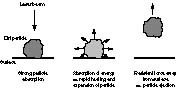
Laser cleaning occurs by a combination of mechanisms, the relative importance of each depending on the fluence used and the properties of the soiling. Since most types of soiling absorb strongly at 1.064 mm, cleaning can usually be carried out at relatively low fluence (<1 J/cm2) to minimise any risk of damage to the substrate. Strong absorption of energy leads to rapid heating and subsequent expansion of a dirt particle (see figure). Since the pulse length is so short the expansion happens so quickly that the resultant forces generated are sufficient to eject the particle from the surface. This is a very selective process. If the fluence is increased slightly then some material will be heated to a sufficiently high temperature to cause vaporisation. At higher fluences still (above approximately 1.5 J/cm2; values depend on the properties of the soiling) the removal mechanisms become more complex and involve the formation of a plasma just above the surface and generation of a shock wave. This mechanism is less selective and can result in damage to the underlying substrate. Cleaning should therefore be carried out at the lowest practical fluence so that the more selective mechanisms operate.
|
|
|
|---|---|
|
Schematic
representation of dirt removal by 'rapid thermal expansion'. This selective mechanism appears to dominate the cleaning process at low fluence. |
Water can sometimes be used to enhance the cleaning effect. By brushing or spraying a thin coating of water onto the dirt surface immediately prior to irradiation, stubborn deposits of dirt can be removed without having to increase the fluence to unacceptably high levels. Dirt particles become coated with a thin film of water which is also able to penetrate into cracks and pores within the dirt layer. Absorption of the laser beam by the dirt layer occurs as normal and rapid heating at the dirt/water interface leads to explosive vaporisation of the water molecules, which exerts forces on and within the dirt layer sufficient to eject further material from the surface. The addition of water usually increases the cleaning rate significantly.
The main advantages of laser cleaning are:
Selectivity
Provided cleaning is carried out within suitable parameters it is possible to remove layers of dirt without removing any original material from the surface of the object. Such control allows the conservator to select exactly what is removed from a surface and also allows him or her to go back over an area which has already been cleaned to remove remnants of dirt without over-cleaning. The technique is sensitive enough to preserve the surface relief; original tool markings can be uncovered and delicate patinas left intact.
Non-contact
Since energy is delivered in the form of light there is no mechanical contact with the surface. This allows extremely fragile surfaces to be worked on.
Localised action
The laser cleans only where directed. A single laser can supply a beam with a diameter variable between a fraction of a millimetre and one centimetre, allowing the same tool to be used for both extremely precise and relatively large-scale work.
Immediate control and feedback
The cleaning action is instantly halted once the laser is switched off so the conservator can stop the process whenever he or she decides. The condition of the surface can be continuously monitored by the conservator during cleaning, allowing decisions to be made at the earliest possible stage.
Environmental
Laser cleaning generates very small quantities of waste material (of the order 100 g/m2 for a uniform black soiling approximately 0.1 mm thick on outdoor limestone). The only waste generated is the dirt ejected from the surface which is straightforward to collect and dispose of using efficient extraction systems. There is no use of hazardous chemicals or solvents and the only protective clothing necessary is safety spectacles and a face mask. Laser cleaning is a clean and quiet technique which causes minimum disruption.
Versatility and reliability
Laser radiation at 1.06 µm has successfully been used to remove dirt and other coatings from a wide range of materials including: marble, limestones, sandstones, terracotta, alabaster, plaster, aluminium, bone, ivory and vellum. In some cases the availability of radiation at other wavelengths can increase the flexibility of the tool, for example in the removal of some types of organic growth. As lasers have very few moving parts, they are also extremely reliable.
The laser described in this article has been designed specifically for work on sculpture and sculptural detail on buildings. More powerful laser systems capable of cleaning approximately ten times faster are available and would be more suitable for larger scale cleaning.
Laser cleaning does not work on everything. The cleaning of polychrome sculpture poses problems since different pigments absorb different amounts of radiation, certain types being very sensitive. For example, a single low-energy pulse will be sufficient to turn vermilion from red to black. In cases where there is evidence of pigment on a stone surface cleaning is usually carried out in such a way that the area is not exposed to laser radiation, unless it is known to be stable at the fluence being used.
Although laser cleaning of sculpture is usually much quicker than cleaning by the more sensitive conventional techniques, the large scale laser-cleaning of buildings cannot, at the moment, compete in terms of speed with techniques such as grit-blasting. It does however leave the stone surface intact. The development of laser systems is so rapid that it might not be too long before large-scale laser cleaning systems become available.
The relatively high initial cost of purchasing a laser system is seen by some as a disadvantage. This should be set against the low cost of maintenance and the savings that are made on time taken to complete a job. Purchasing a laser cleaning system is a long term investment. In the short term it might make more sense to hire an appropriate system for a particular job. Training courses are available which will teach the conservator when and how to use a laser.
During the past three years interest in lasers for cleaning has increased rapidly culminating in LACONA I, the first international conference on Lasers for the Conservation of Artworks which was held in Crete in October 1995. The conference brought together scientists, engineers and conservators to discuss current work (which includes the use of many different types of laser) and future developments in this rapidly expanding field. LACONA II will be held in Liverpool in April 1997.
Recommended Reading
- JF Asmus et al, 'Surface morphology of laser-cleaned stone', Lithoclastia, vol 1, 1976
- V Verges-Belmin et al, 'Elimination des croutes noires sur marbre et craie: a quel niveau arreter le nettoyage?', Conservation of Stone and other Materials, MJ Thiel (ed), Proceedings of the International RILEM/UNESCO Congress, Paris 29 June - 1 July 1993
- MI Cooper et al, 'Characterisation of laser cleaning of limestone', Optics and Laser Technology, vol 27, no 1, 1995
- MI Cooper and JH Larson, 'The use of laser cleaning to preserve patina on marble sculpture', The Conservator, vol 20, 1996
- J Wilson and JFB Hawkes, Optoelectronics: An Introduction, Prentice-Hall, London, 1983
- AC Tam et al, 'Laser-cleaning techniques for removal of surface particulates', Journal of Applied Physics, vol 71, no 7, 1992