
Underside Condensation and Corrosion of Lead Sheet Roofs
Fred C Coote
 |
||
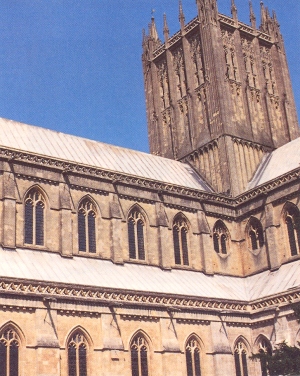
| Lead covered roofs, typical of many churches and cathedrals |
Lead sheet, one of the oldest and most durable roofing materials, has been known to last for over 200 years. However, even with the best of materials, poor design often leads to failure. One particular problem which has been the subject of increasing concern, speculation and debate, is the tendency for condensation on the underside of metal roofs to cause corrosion. As a result, the Lead Sheet Association (LSA), English Heritage, and the Historic Royal Palaces Agency have jointly sponsored an independent research programme to investigate its cause and its effect on lead sheet roofs.
WHY AND HOW DOES CORROSION AFFECT LEAD SHEET?
While lead sheet can resist the external elements better than any other roofing material, like many of its competitors it is vulnerable to distilled water (condensation).
In principle, falling rainwater contains an appreciable amount of dissolved carbon dioxide which attacks the lead resulting in the formation of a layer of lead carbonate. The layer adheres to the surface of the metal and gradually thickens to form a stable, protective patina, preventing further attack.
However, conditions on the underside of the lead are entirely different, as carbon dioxide in rainwater and the air may be prevented from reaching the surface of the material in sufficient quantities to promote the development of a natural, protective patina. Where a film of moisture forms across the underside of the metal, the lower availability of carbon dioxide allows soluble lead ions to migrate from the surface through the formation of lead hydroxide, which is the first compound to form in the carbonation process. Any subsequent development of a carbonate layer will occur away from the surface of the metal, leaving moisture in contact with the lead. Further development of a protective carbonate layer is therefore prevented. In the absence of passivating conditions, and in the presence of condensation, the expected life of lead may be severely reduced.
Unfortunately, there is no ‘rule of thumb’ for estimating the rate of deterioration, as conditions that contribute to the amount of condensation and corrosion are variable. In the presence of certain wood-borne acids, such as those found in oak or western red cedar, the deterioration caused by condensation may become more aggressive.
Condensation problems are not specific to lead and bad detailing will also cause problems on roofs covered with other sheet materials. The type of deterioration differs, but if condensation is allowed to form under any type of fully supported roof finish, it will cause a problem. If improper fixing or detailing inhibits the natural thermal movement of lead sheet it may buckle and split, causing leakage that will not only damage the interior of the building but will introduce moisture into the roof structure, creating ideal conditions for condensation. It is therefore essential that lead sheet work is detailed and installed correctly if the normal 100 years or more service life and performance of the lead sheet is to be achieved.
However, there have been instances where neither the material nor the application have been at fault and yet corrosion has occurred. What is the cause and how can it be prevented? These questions must be addressed and clearly understood by the contractor or consultant before commencing a programme of refurbishment of any building that includes leadwork.
WHAT ARE THE SIGNS OF CORROSION?
 |
|
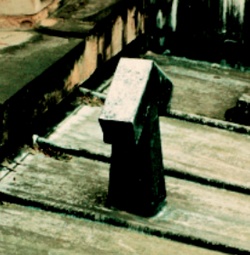
| An example of a lead ventilator found on some old churches |
The most obvious signs are white stains or powder falling out at laps and rolls and severe ripples in the surface of the lead sheet where it has thinned. Corrosion is not always obvious and lifting the lead sheet to inspect the condition of its underside is the only way to be certain. An inspection of the top surface of the lead may show that numerous holes have appeared. Lifting of the lead will show that these holes are above areas of severe corrosion. Water penetration through the holes that have developed will exacerbate the corrosion problem because entrapped rainwater will vaporise in summer conditions to create more condensation. If the lead sheet is found to be badly corroded, it would be prudent to investigate and eliminate the main cause of corrosion and, if necessary, alter the roof design to prevent condensation before undertaking repair or renewal.
White powder found under lead sheet is not always a sign of severe deterioration. It could be attributed to the drying out process after lead sheet has been laid on a wet substrate when new. Providing that there is adequate ventilation of the roof void, no further corrosion is likely to occur and the white powder present will harden into a patina. In these cases, it is advisable to make regular inspections to monitor the condition of the lead sheet to ensure that a stable patina is developing.
When renewing leadwork on existing buildings the condition of the underside of the lead sheet gives an indication of whether or not there has been a condensation problem. If corrosion is minimal, the advice usually given is to leave the roof structure as it is, providing that there is to be no change in the use or heating level of the building. In most cases, however, heating levels have already been increased, or are likely to be, following the refurbishment of the building and therefore where possible, better ventilation is recommended.
HOW DOES MOISTURE ENTER THE ROOF STRUCTURE?
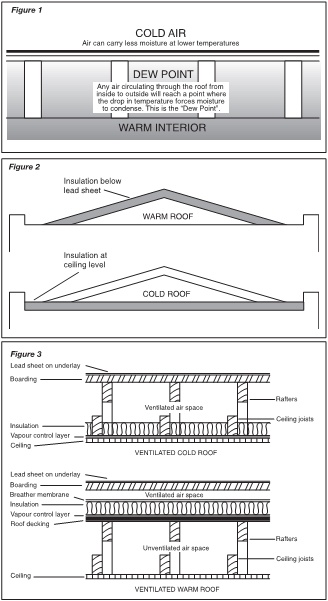
Improved standards of heating efficiency and energy conservation have created higher vapour pressures within the roof sandwich, thereby moving the dew point position (the point in the fabric at which condensation occurs) to the coldest surfaces of building components such as metal roofs or the supporting timber (Fig 1, below left). Many old churches have high levels of humidity even when the church is unoccupied. Moisture can also be introduced into the roof structure when lead has been laid in damp conditions or leakage has occurred as a result of failure of the lead roof or the abutment flashings.
It is often less disruptive when upgrading the existing roof structure of old buildings to lay a vapour barrier, insulation and timber decking over the existing decking creating a warm roof. The warm roof eliminates the ‘cold bridge’ and has been favoured by designers for many years, particularly on new buildings because it is seen as both practical and economical. However, it has been discovered that leakage in the vapour barrier or roofing material, and residual moisture have led to moisture becoming trapped between two impervious layers. Traditional lead roof coverings are normally weathertight but not watertight.
Investigative work carried out on warm roofs covered in lead has shown that in rare instances moisture can also be introduced by the development of ‘sub-atmospheric pressure’ in the roof space; when a hot roof surface is suddenly cooled by rain, the pressure in the area between the vapour barrier and roof covering can fall below atmospheric pressure. A situation is created where water held by capillary attraction under laps and splash laps can be sucked into the insulation area. Once the rainwater is in the roof structure, moisture may migrate to other areas and condense on the underside of the metal sheet when the temperature falls. A warm roof decking should therefore not be used, as the dew point usually occurs under the lead sheet making the risk of condensation very high.
Although there have been cases of condensation where lead is laid on boards with 4mm gaps and directly exposed to the church interior, condensation normally dries out if there is adequate ventilation in the church. There may be some initial reaction when the lead sheet is new, but in a large, well-ventilated church the surface of the lead sheet is pacified after a few years and no significant corrosion occurs. However, it has been found that condensation sometimes occurs where there is inadequate ventilation or where there are stagnant air pockets, such as might be found in the apex of a pitched roof. High levels of humidity, created by damp walls and floors, large numbers of visitors and low levels of ventilation may also increase the risk of condensation on the underside of this type of roof.
HOW CAN CONDENSATION BE PREVENTED?
Corrosion on the underside of lead sheet is caused by trapped moisture: therefore remove the cause of moisture and you remove the problem. Many different coatings and treatments to inhibit corrosion have been tried under a variety of conditions during the current research programme, but none as yet has proved successful. However, preliminary reports confirm that if the leadwork is correctly detailed and basic precautions are taken against conditions which encourage condensation, underside corrosion can be avoided.
 |
|
Due to the improved standards of insulation now required by current Building Regulations, it has become necessary to reconsider methods of providing efficient ventilation to control condensation. Where a warm roof is used, a ventilation void should be provided between the insulation and the timber decking supporting the lead if there is sufficient height available. For guidance on the amount of ventilation required, reference should be made to British Standards 5250 and 6229. If it is not possible to provide ventilation to a warm roof then a ventilated cold roof will need to be considered. It is often possible to introduce the ventilated cold roof construction during renovation of older buildings particularly if the decking is to be replaced, in which case it is essential to provide an efficient vapour barrier under any insulation.
Whether a warm roof or a cold roof is specified, there should be adequate provision for ventilation as shown in Figure 3 (left). It is essential that there are no stagnant air pockets and that there is proper circulation of air to all parts of the decking which support the lead covering.
WHERE VENTILATION CANNOT BE INTRODUCED
During the recent research programme English Heritage has been concerned with looking at possible methods of controlling condensation without severe disruption of the roof structure.
It is not always possible to raise the roof decking high enough to accommodate ventilation and it is usually difficult to introduce a vapour barrier and insulation at ceiling level. Conditions within the building should be considered as a whole and not in isolation. Levels of humidity, ventilation, moisture content of stone walls and floors and methods of heating should all be taken into account when considering what precautions to take. There is no one simple answer and each case must be treated on its own merits, but generally the recommendation is to reduce humidity and increase ventilation.
Some advocate the use of lead sheet on slatted ‘penny gap’ boards with no underlay so that the underside of the lead sheet has access to fresh air from within the building. This is acceptable practice but it must be appreciated that the edges of the boards may, in time, read through the top surface of the lead sheet, particularly on Code 6 thickness or less.
Another suggested method of preventing moisture on the underside of lead sheet is to provide a vapour impermeable underlay. This is often recommended for oak boards to prevent any acid vapour reaching the lead.
UNDERLAYS AND SUBSTRATES
The type of underlay and substrate on which the lead is laid should also be carefully considered. In general, it should be smooth to allow for thermal movement to take place freely. Underfelts cushion the lead against any imperfections in the surface of the substrate and may allow air to gain access to the underside of the lead sheet where gap boards are used. A building paper to BS1521 Class A is normally adequate for laying lead sheet on plywood and as a separating membrane where there is a serious risk of corrosive attack from certain substrates. Most timbers currently available are suitable for lead sheet, but care should be taken not to use hardwoods such as oak, western red cedar, Douglas fir and elm which are likely to have a corrosive effect on lead. Plywood is still suitable for use under lead sheet but it is sometimes considered inappropriate for use on historic buildings. Whatever type of decking is used, it must be at least 18mm thick and any timber treatments or residual dampness must be allowed to dry out before the lead is laid. Most stone and concrete substrates do not cause corrosion providing that a suitable underlay is used. The moisture content of the substrate should be not more than 18 per cent.
Correct installation and adequate precautions against condensation will ensure that lead sheet will continue to provide a long lasting, maintenance free covering to historical buildings. Lead sheet is a great building material with a noble ancestry. Used properly, it will continue to live up to its fine reputation.