
Lime Plaster and Render Reinforcement
Bob Bennett
 |
||
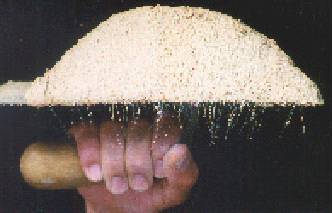
| A well haired plaster should have hairs evenly distributed through the mix with spaces between the hairs of no more than a few millimetres. |
The earliest structures to which plasters were applied took the form of panels of woven hazel or willow spars supported by timber. When first applied, some of the plaster would protrude through the spars, creating interlocking 'nibs' in the void behind. The nibs help to secure the plaster to the lattice, reinforcing the key or bond between plaster and wood. For centuries hair and other fibres have been added to lime and gypsum plasters to give greater strength to these nibs and stop them breaking off.
For the reinforcement of lime plasters and renders, hair should be strong, long and free from grease or other impurities. Ox hair is the preferred choice, but horse, goat, donkey, and a variety of other hair, including reindeer, are suitable. Human hair, being relatively fine and of poor strength, should not be used.
Traditional alternatives to hair include chopped straw, reed, manilla hemp, jute, sisal, and even sawdust. Modern synthetic fibres such as glass and polypropylene which have been designed for use with Portland cement mortars have also been used successfully in pure lime mortars, despite their smooth and almost shiny appearance when viewed under a microscope. Natural animal hairs, by comparison, have a much rougher texture, and are generally more appropriate for historic buildings.
While woven hazel or willow spars work well and are often found in surviving wattle and daub, the practice of splitting oak and chestnut lath to produce riven laths became popular early in the 15th century. Oak and chestnut make particularly good riven lath as they both contain natural oils, thus ensuring long life.
By the 19th century sawn lath started to be used, although there is no doubt that riven lath is stronger, and its textured surface and exposed grain affords a far better key.
Laths should be spaced about one centimetre (3/8") apart, which is the distance between the top of your little finger nail and the underlying pad. (Spacing can be gauged simply by resting your little finger on top of the last lath to get a sufficiently accurate gap - you seldom see a true craftsman with a modern rule, measuring as he goes!) If the laths are fixed any closer, the first coat (or 'scratch coat') of plaster (often prepared from mature slaked lime putty and well graded, sharp aggregate ranging from up to 3mm through to fines) will not be able to pass through to form good nibs. Larger gaps will allow heavier nibs to form which are liable to break off, filling the void behind the laths.
In the 1999 edition of The Building Conservation Directory, the view was expressed that it was a mistake to think of a 1:3 lime/aggregate mortar mix as 'standard', as the proportions depend on the choice of aggregate and in particular its surface area and void. Suitable mixes can vary from beyond 1:3 down to 2:1, but if the proportions are not relevant to the aggregate the mix could well be totally unworkable. The same problem can also occur with haired mortar specifications as the weight to volume ratio of animal hair varies considerably from species to species. There is no point in specifying a particular weight of hair for a given quantity of lime mortar if the source and type of hair is not identified.
The importance of ensuring that sufficient hair is evenly distributed throughout the mix cannot be over-emphasised. In the past, apprentice plasterers often started their training by spending several weeks at a bench, beating bundles of hair with lengths of riven lath to break up any lumps and separate the fibres. Allowing lumps of hair into a plaster mix is almost worse than not putting any hair in at all, as the lumps have no binding power and create weak spots in the plaster, causing it to fail.
Where haired lime plaster is to be applied to a masonry background, the plaster relies largely upon suction for its bond, so it does not need as much hair as a plaster which is to be applied to lath, which relies almost entirely for its key on the nibs that protrude between the laths. Insufficient hair reinforcement in a plaster mix on lath will result in weak nibs and the risk of early failure.
Hair should be added to plaster just before spreading as the alkalinity of the lime attacks the protein in the hair. Millar, in his 19th century masterpiece Plastering Plain and Decorative (see Recommended Reading), writes of an experiment where haired lime plaster was stored in wet conditions for nine months: at the end of this period he found that the hair had 'been consumed by the action of the lime'. Recent analysis of a failed ceiling plaster from an important civic building showed that, while the mortar mix proportions were adequate and the appropriate quantity of hair was almost certainly used, it had been introduced into the mix and 'wet stored' for several weeks prior to application. The weakened fibres were unable to maintain the integrity of the nibs which could then not support the weight of plaster, resulting in a failure that could have been catastrophic had the hall been occupied at the time.
For many thousands of years, lime plaster has been applied to masonry substrates and various forms of wooden lath. An increasing number of specifications now call for lime plaster to be applied to inappropriate backgrounds such as plywood, and a variety of alternative lathing materials have been introduced, including expanded metal and patent forms of lath product such as Riblath. Even chicken wire has been used. As there will be little or no bond with a parent background such as plywood, the integrity of the render is dependent on the choice of lath and the quality of fixing. All these attempts to bypass the proven traditional methods will fail unless the fixings are capable of taking the load and the mesh, or lath, is fixed in such a way that mortar can encompass the structure that is to support it. If expanded metal is specified, a system of spacers, such as simple timber batten, should be fixed behind the mesh to ensure that the plaster can surround the support.
When working on historic and, in particular, listed structures, repairs should ideally be carried out using similar materials to the original. Not only are they more appropriate to the historic character of the architecture, but they usually work better than modern alternatives, especially when used in conjunction with other traditional materials and construction techniques.
Recommended Reading
- William Millar, Plastering: Plain and Decorative, (1897), Donhead, Shaftesbury, 1998
- Ashurst, John and Nicola, Practical Building Conservation Volume 3, Mortars, Plasters and Renders. English Heritage, Gower Technical Press, Aldershot, 1988
Training
For information on training, please refer to our course pages.