
Thatching with 'Long Straw'
Keith Quantrill and John Letts
 |
|
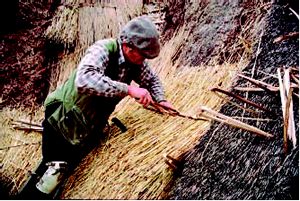
| Figure 1 Securing 'yealms' to a weathered coat using hazel sways and spars |
Thatching is one of the oldest surviving building crafts, although its history has only recently become a focus for research. Thatch was the most common roof covering in almost every part of Britain in the medieval period, and remained a popular roofing material in rural areas until the late 19th century when mass production and the expansion of the railway network gradually reduced the price of other roofing materials such as clay tiles, slates and corrugated iron. At the same time, changes in agriculture led to a reduction in the number of thatched houses in the countryside and a shortage of skilled thatchers – a situation that has been reversed only in recent decades.
Over the past five centuries a wide range of materials has been used to form ‘weathering’ coats of thatch on cottages and grander buildings, depending on local availability and traditions. Cereal straw, marsh grasses, rushes, heather, broom, flax and even wood shavings and potato stems have been discovered buried beneath later recoats.
 |
|
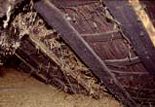
| Figure 2 A smoke blackened base coat dating to c1450 (Devon) | |
 |
|
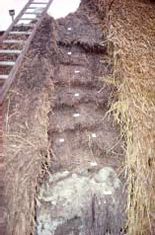
| Figure 3 Archaeological excavation of a multi-layered straw roof (Northamptonshire) |
Traditionally, a new weathering coat was simply fixed over the worn out surface (see Figure 1), which was itself pegged onto a ‘base’ coat that was tied to the rafters and battens. Base coats were never replaced, and approximately 250 examples of original base coats survive from the late medieval period (1350-1600). Most of this ancient thatch is heavily blackened by the smoke of the open fire that burned in the centre of the medieval hall (see Figure 2). Smoke-blackened thatch contains almost perfectly preserved examples of ancient cereals and crop weeds, many of which are now extinct, and has allowed archaeobotanists and agricultural historians to examine ancient crops and farming practices in unprecedented detail.
On many older buildings
rethatching and patching over many centuries has generated build-ups of
thatch up to two metres thick. The 12-15 distinct layers of thatch that
survive on such roofs can be excavated and sampled using archaeological
methods in order to unravel the individual thatching history of a property
as well as chart the changes that have occurred in the materials and methods
used in a locality or region (see Figure 3).
STRAW THATCHING: COMBED WHEAT REED
Until
the 1960s most of England’s thatched buildings were covered with straw.
The evidence surviving within historic roofs indicates that the vast majority
of roofs in England were thatched with wheat straw, which was abundant
and available cheaply as a by-product of grain production. Rye straw was
once widely used in the West Country and in other areas less suitable
for growing wheat, but was largely abandoned as a crop in the early 19th
century.
Most
of the straw used over the past two centuries could be described as either
‘combed wheat reed’ or ‘long straw’, although there were many local variations.
In the West Country, wheat was carefully grown, harvested, threshed and
‘combed’ to remove grain, leaves, weeds and short or broken straw without
crushing the stem, producing ‘combed wheat reed’ (also called ‘Devon reed’
or ‘wheat reed’). This material shed water efficiently and dried out quickly
after being wetted, and good quality wheat reed could perform well for
40 years or more when applied by a skilled thatcher. Combed wheat reed
spread beyond the West Country in the 1960s and 1970s, and is now commonly
used throughout England. However, prior to the spread of this technique,
outside the West Country, wheat straw that had been crushed by the flail
or the drum of a threshing machine was carefully cleaned and re-formed
into a long-lived thatching material called ‘long straw’.
LONG STRAW
The
best quality thatching straw is grown from older wheat varieties that
produce tall, strong-stemmed straw without the use of artificial fertilisers.
Excessive nitrogen, whether artificial or organic, encourages stem growth
which weakens the stem walls and reduces its durability when used as thatch.
Older wheat varieties, some of which have been grown specifically for
thatching for almost a century, will simply grow very tall and fall over
if they are grown in fertile soil. The crop is cut before the stems have
fully ripened, unlike conventional grain crops which are combine harvested
when the field is ‘dead ripe’. If the crop is left to ripen fully, the
stems will ‘lignify’ and become brittle, and the straw will be unsuitable
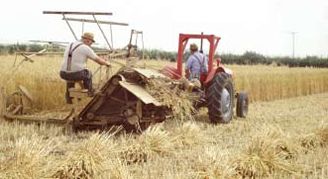
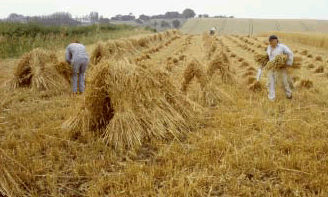
for use as thatch. The crop is cut with a reaper-binder (see Figure 4), which ties the straw into bundles that are ‘stooked’ in the field to
dry for 10-14 days. Many growers prefer to store the dry straw in a barn
or rick for several months to ‘season’ it before threshing, whereas others
thresh directly from the field. To produce long straw, the bundles are
fed into the drum of a threshing machine, which strips the grain from
the ears while leaving the straw bruised, but largely intact. In contrast,
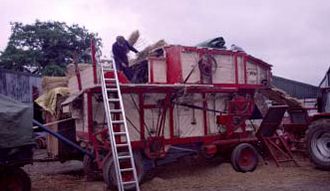
combed wheat reed is fed into a comber attachment which sits over the
drum of the threshing machine, strips the grain and leaves, and combs
out short and broken straw and weeds, without crushing the straw (Figure
6).
 |
|
| Figure 4 Cutting straw with a reaper-binder (Somerset) | |
 |
|
| Figure 5 Stooking straw so that it is thoroughly dried before being threshed (Somerset) | |
 |
|
| Figure 6 A threshing machine with a comber attachment for producing combed wheat (Devon) |
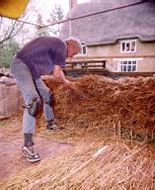
The key to producing high quality long straw lies in its preparation on the ground. Threshed straw is first shaken out into a large bed which is doused with water so that the straw becomes pliable. Water also provides lubrication which allows individual handfuls of long-stemmed straw to be more easily ‘drawn’ from the bed. The amount of water used to wet the bed varies depending on weather conditions and the type of straw being ‘drawn’: insufficient moisture will make the straw difficult to draw and more prone to breakage, whereas prolonged soaking reduces its durability. Double handfuls of straw are pulled from the bottom of the bed (see Figure 7) and formed into neat ‘yealms’ approximately 130mm thick and 450mm in breadth (5" x 18") (Figure 8). Five or six yealms are tied into a large bundle, or a forked wooden yoke, which is temporarily pegged to the roof so that the yealms are within the thatcher’s reach.
APPLICATION
Thatching
begins at the eaves. Prior to laying the first course, a series of tightly
bound ‘wads’ (also known as ‘bottles’) is tied securely to the lowermost
batten and rafter feet along the eaves and barges. Eave wads may also
fastened with horizontal hazel or steel ‘sways’ clamped to the rafters
with iron ‘crooks’. For additional security, the wads are pinned tightly
against each other with twisted wooden ‘spars’ (or ‘broaches’ and ‘spics’
as they are also known), which are driven sideways through one wad into
the next one. Setting a solid eave and gable is a critical first step
in the thatching process. On older buildings it is common to find the
spars fixing the original eave bottles imbedded into a layer of daub (essentially
mud and clay) along the wall top.
When long straw is applied to a new roof, the thatch is fixed directly to the rafters using steel thatching crooks and horizontal hazel or steel sways (the same method used to fix modern water reed or combed wheat reed). A weathered roof must also be made level and secure before it receives a new ‘spar coat’ of long straw. The yealms forming the brow course – the first course of thatch applied over the eave bottles – are sparred into position individually, or with a horizontal straw bond or hazel sway fixed with spars (see Figure 1). Further thatch is laid so that each course overlaps the one below it, providing a continuous depth of straw over the entire roof. The yealms forming the ‘gable stelch’ – the first course of weathering thatch over the barge bottles – are laid at the same angle as the underlying wads along the top of the gable, but are then swept towards the vertical as the course moves towards the eave.
|
|
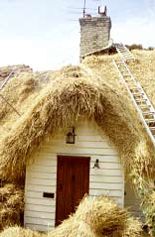
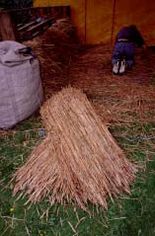
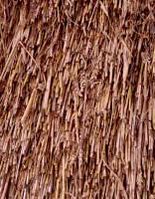
The weathering thatch forming the main coat work is applied in vertical strips (also known as ‘strake’ or ‘stulch’) approximately 100cm wide running from eave to apex. The total depth of the new coat may vary slightly over different parts of a roof, but a minimum depth of 35cm (14") is a reasonable standard for new work, with 25cm (10") providing equal coverage for spar coated work. Valleys and dormers are swept so as to avoid sharp turns that would cause water to flow into channels that will, in turn, gradually degrade into gulleys. Once applied, the thatch is combed with a large ‘side rake’ in order to remove short or unfixed straw, and to ensure that all of the surface straws are lying vertically. The eaves and gables are also fixed with external ‘liggers’ (see Figure 11) before they are cut with a long ‘eaves knife’ (see Figure 9). All long straw roofs carry eave and barge liggers, but some thatchers also add these fixings to combed wheat reed roofs in order to create a long straw ‘effect’. Extraneous straw is removed with shears, and some thatchers trim off ears lying on the surface in order to produce a very clean finish (Figure 10), although more ears will gradually be exposed once the surface begins to decay.
In the West Country, the first two or three courses of weathering thatch along the eave were traditionally stripped out at each rethatching. In long straw areas however, the new thatch was simply spared over the existing thatch which led to the build-up of large, overhanging eaves – a tradition that has, unfortunately, been abandoned in most areas.
RIDGING:
THE FLUSH RIDGE
Few
topics in thatching attract as much attention as ridging styles. All thatched
roofs must be ridged, and all must carry external fixings which hold the
ridging material in place over the apex of the new coat. By definition,
these fixings are exposed to the weather, degrade, and eventually lose
their ability to keep the ridging material in place. Ridges must therefore
be replaced every 8-12 years even if most of the thatching material forming
the ridge has not fully decayed. In practice, the wire netting that is
often applied over the ridge to keep out birds continues to act as a fixing
long after the primary wooden fixings have degraded.
On a weathered roof a new ridge roll is first fixed along the crest of the ridge (or is spiked or tied to the ridge beam on a new roof ). The tops of the yealms of the last course are folded back on themselves and pegged into this new roll. A second, smaller roll is then fixed onto the first, and further yealms of straw are applied on either side to form a solid base for the final ‘wrap over’. Handfuls of straw are then reversed as they are folded over the centre of the ridge in order to ensure that the exposed wrap over has an even width and thickness of 15-20cm (6"-8"). The wrap over is sparred onto the upper ridge roll in a straight line along its crest, and additional liggers are added on either side according to pattern (Figure 11). The ridge is either swept around the top of the barge to form a very small hip, or is built up to form a raised pinnacle.
In
older photographs cottages thatched with long straw almost invariably
carry simple flush ridges. The fashion for raised ‘block cut’ and patterned
ridges is largely a post-World War II phenomenon. West Country style ridges
formed of ‘butts up’ combed wheat reed are now commonly applied to long
straw roofs throughout England (Figure 12), eroding local thatch styles.
Whether composed of long straw or combed wheat reed, the surface of a
flush ridge runs in line with the surface of the main coat. Flush ridges
are easier and less expensive to apply, and also help ensure that water
runs evenly off the ridge, reducing the risk of gulleying. Many home owners
prefer a heavily ornamented ridge, but excessive ‘diamonding’ will also
increase the risk that water will be channelled into the core of the thatch
due to a misplaced spar. Fen sedge (Cladium mariscus) is another newcomer.
This ridging material does not appear to have been common on water reed
roofs until the 1930s, and has become a feature of long straw roofs only
in the past two or three decades. In some areas such as East Lincolnshire
clay ridge tiles have long been a popular ridging material on traditional
long straw roofs for generations.
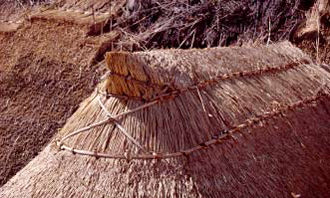 |
|
| Figure 11 Flush, wrap over ridge of long straw (Northants) | |
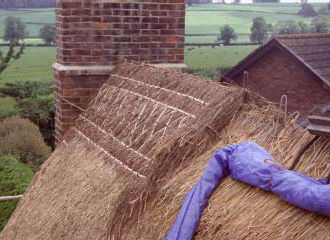 |
|
| Figure12 West Country style 'butts up' ridge (Somerset) |
CHANGES IN FARMING
The use of long straw thatch clearly predates the introduction of the threshing machine, but its subsequent popularity is obviously linked to mechanisation of cereal production that revolutionised British farming over the course of the 19th and early 20th centuries. At the same time, the wheat crop itself was being transformed by plant breeders who purified and hybridised wheat in order to create new varieties with greater yields and baking qualities. Increasingly, straw became a waste product, rather than a valued by-product, of grain production, and the quality of the long straw available for thatching plummeted. The stem height of popular wheat varieties also dropped, particularly in the 1930s and 40s with the release of the first successful semi-dwarf varieties. The new varieties were also bred to have more brittle stems when mature so that they could be harvested easily with the new combine harvesters. Growers who attempted to produce both high quality grain as well as thatching straw found that the high nitrogen inputs and production methods that generated bumper crops of grain inevitably produced poor quality thatching straw. Although there are notable exceptions, the long straw production sector gradually collapsed, encouraged by its dependence on ‘antiquated’ machinery, high labour costs, and the growing popularity of combed wheat reed and water reed thatching in traditionally long straw areas.
The use of long straw has declined steadily into the 1990s, its use discouraged by memories of poor quality straw and poor quality thatching witnessed by many thatchers who received their initial training in the 1960s and 70s. However, the overall quality of long straw thatch and thatching has increased over the past two decades, and long straw is currently witnessing a revival in many parts of the UK where it once predominated. This resurgence has been encouraged by local councils, government bodies, thatchers and home owners who have recognised that good quality long straw applied by a skilled long straw thatcher can outperform water reed and combed wheat in many situations. Preserving the tradition of ‘spar coating’ new long straw over weathered thatch also preserves historic base coats which can date back to the medieval period. These ancient roofs are a testament to the thatcher’s craft and to the success of traditional methods and materials.
Glossary |
| BED |
|
| CROOK/SPIKE |
|
| GABLE |
|
| LIGGER |
|
| PINNACLE |
|
| RIDGE ROLL |
|
| RIDGE |
|
| SPARS |
|
| STULCH |
|
| SWAY |
|
| WADS |
|
| YEALM |
|
Recommended Reading
- P Brockett and A Wright, The Care and Repair of Thatched roofs, SPAB Technical Bulletin 10, Eyre & Spottiswoode, Margate, 1986
- The Thatcher’s Craft, Council for Small Industries in Rural Areas (Rural Development Commission), Battley Brothers Ltd, Salisbury, 1960
- J Cox and JB Letts, Thatch: Thatching in England 1940-1994, English Heritage Research Transactions: Research and Case Studies in Architectural Conservation, 6, London, 2000
- Thatch and Thatching: a guidance note, English Heritage, 2000
- JB Letts, Thatching Straw: its history, production, quality and performance, Conservation of Historic Thatch (COHT) Committee and the Countryside Agency, the National Trust, Dorset County Council and English Heritage (forthcoming)
- JB Letts, Smoke-blackened thatch: a new source of late medieval plant remains from Southern England, English Heritage and The University of Reading, London, 1999
- J Moir and JB Letts, Thatching in England 1790-1940, English Heritage Research Transactions 5, London, 1999