
Low Carbon Lighting of Cathedrals
James Morse
 |
||
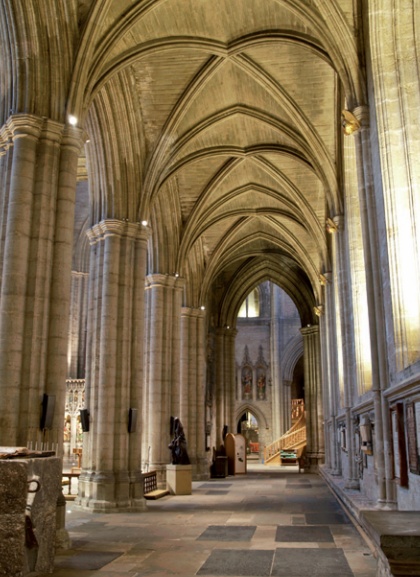
| The south nave aisle at Ripon Cathedral with fluorescent uplighting and tungsten halogen downlighting |
For centuries the cathedrals of England were lit by daylight and candlelight alone. Oriented from west to east with windows let into the clerestory and side aisles to the north and south, cathedral interiors were illuminated beautifully and dramatically by natural light in the daytime. After sundown, while candles provided some artificial illumination, these cavernous interiors must have been very gloomy spaces indeed.
Some improvement in night-time illumination came with the development of oil lamps, and by the latter part of the 19th century piped coal gas enabled the use of mantle-type gas lamps. However, it was not until the invention of the electric carbon and then the tungsten filament lamp that practical artificial illumination of church and cathedral interiors became possible. Nevertheless, the lighting provided by the tungsten lamp was still relatively crude, and it was the development of the tungsten halogen lamp in the 1960s that made the aesthetically pleasing and architecturally sensitive lighting of ecclesiastical interiors readily achievable.
Tungsten halogen lamps, and particularly the compact low voltage types, are still very effective when lighting sensitive and architecturally important elements of cathedral interiors. They have the added advantage of being easily dimmable in a linear fashion from maximum output down to zero.
However, a new and increasingly important factor has now been added to the lighting equation: energy usage. This is now a worldwide cause for concern, with compelling evidence of carbon emissions causing climate change, potentially leading to catastrophic drought and or flooding of large tracts of land. It seems sensible then that church authorities should take a lead in the quest to minimise energy usage in places of worship. An important component in that energy use is the provision of artificial illumination.
Currently there is a major drive to reduce energy consumption in domestic buildings through the use of low energy sources to replace the ubiquitous tungsten light bulb. There continues to be some resistance among homeowners to the use of the latest low energy lamps, based on a perceived reduction in the quality of the light and the capital cost of the lamps compared with tungsten filament types. Similar concerns, albeit on a grander scale, will be faced by the dean and chapter of a cathedral, where the quality of light is of the utmost importance, particularly for congregational acts of worship and other important public events such as concerts.
We have therefore two apparently conflicting requirements: the need to save energy, and an almost equally important need to render the cathedral interior as beautifully and sensitively as possible. It may be difficult to reconcile these requirements, but it is not impossible, particularly given some recent developments in light source technology.
It is worth looking at some of these sources and their characteristics in more detail, at the same time considering how and where they might be of use when designing new lighting systems for cathedrals.
LAMP PERFORMANCE BY TYPE |
||||
|
EFFICIENCY |
COLOUR |
LAMP LIFE |
|
TUNGSTEN |
 |
Low |
Excellent |
Short: |
TUNGSTEN HALOGEN |
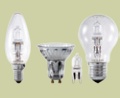 |
Low |
Excellent |
Short: |
COMPACT FLUORESCENT |
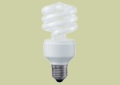 |
High |
Good |
Long: |
LINEAR FLUORESCENT |
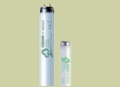 |
High |
Good |
Long: |
METAL HALIDE |
 |
High |
Good |
Long: |
LED* |
 |
Medium |
Intermediate |
Very long: |
The pictures are for illustration purposes only: the performance information shown relates to the lamp type and
not necessarily to the specific product shown.
|
||||
LAMP TYPES
The two most important lamp developments in relation to cathedral lighting are the availability of dimmable compact and linear fluorescent lamps, and the new generation of compact metal halide lamps with good colour rendering and colour stability. LEDs will become very important light sources in the future and may supersede all other types. It may be some time, however, before they reach the levels of performance required for large scale ecclesiastical installations.
LIGHTING SALISBURY CATHEDRAL
 |
|
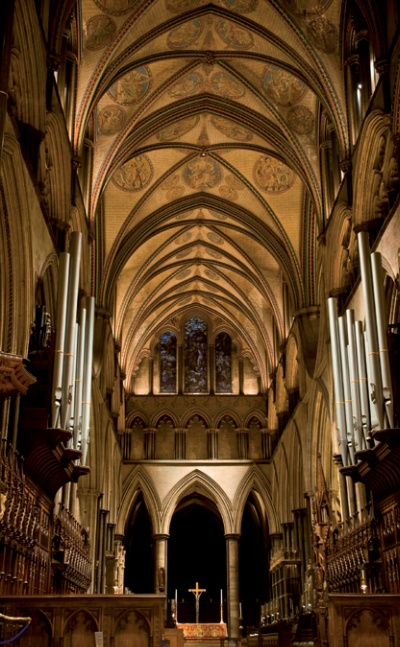
| Chancel of Salisbury Cathedral: fluorescent uplighting on the vaulted ceiling, with metal halide downlighting |
The nave, crossing, transepts and chancel areas of a cathedral require even levels of horizontal illuminance with a minimum of glare from the light sources. This can be achieved by mounting projector-type luminaires at clerestory level aimed down to the floor level. As the table (above) demonstrates, the most efficient source for this application is the metal halide lamp. With its compact size it is ideal for mounting in projector luminaires to give high levels of light over long distances. The downside is that they are not dimmable and take some minutes to reach full output. The approach taken at Salisbury Cathedral was to use these sources to provide low energy, low maintenance lighting for normal visitor days, each bay of the clerestory level having a single 150 Watt projector on each side. For services and concerts this arrangement would have been totally unsuitable due to the lack of dimming and programmability of lighting scenes. It was therefore decided to duplicate the downlighting with tungsten halogen versions of the projectors mounted adjacent to the non-dimmable metal halide types. These projectors use 575 Watt tungsten halogen lamps and provide fully dimmable downlighting with the best possible colour rendering properties. By this duplication of light sources we were able to give Salisbury Cathedral the options of low energy lighting for all uses outside of those where fully dimmable lighting is required and thus substantially reduce the running and maintenance costs of the installation.
Another equally important component of cathedral lighting is the rendering of the interior architecture in an aesthetically pleasing way. This is achieved by the use of uplighting to the triforium and clerestory levels and the vaulted ceilings of the nave, transepts, side aisles, and chancel. The requirements for this lighting are that it should be dimmable and have good colour rendering properties as well as being energy efficient. The obvious choice here was to use linear fluorescent luminaires equipped with dimmable control gear. The advent of the T5 fluorescent lamp with a wall diameter of 16mm (the 5 refers to the diameter, ⅝ inch or 16mm) and high light output, coupled with luminaires having accurate parabolic reflectors, has enabled the humble fluorescent tube to be used very effectively as an uplighting source. With a luminous efficacy approaching 90 lumens per Watt and the availability of these lamps in warm colour temperatures (2,700 Kelvin) it is at present the ideal choice, given that the luminaires can be concealed on triforium and clerestory walkways.
The main downlighting and the uplighting accounts for around 90 per cent of the electrical load associated with lighting in Salisbury Cathedral and is achieved with low energy, long life sources. The remainder of the lighting consists of accent lighting to the altars and important memorials and, given their visual importance, they were lit using tungsten halogen lamps to render them in the most pleasing way while retaining full control of the light intensity via the dimming system.
 |
 |
 |
|||
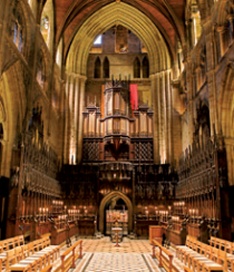
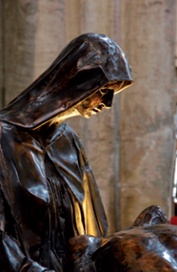
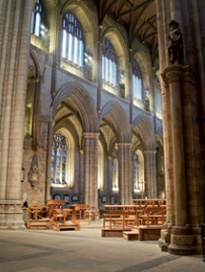
| The choir of Ripon Cathedral: the careful use of low energy sources enhances character and atmosphere with great efficiency | Detail of a monument in the crossing of Ripon Cathedral highlighted with a single 3 Watt LED spot | View of the nave at Ripon Cathedral with fluorescent uplighting and metal halide downlighting |
The other major component of a low energy lighting system is the incorporation of a fully programmable lighting control system. By means of programming it is possible to tailor the lighting to each of the cathedral’s various uses, switching off or dimming unnecessary lighting elements when they are not required. A further step in energy conservation is the introduction of daylight linking, where variations of daylight are electronically sensed and the lighting levels adjusted accordingly. During a visitor day, for example, the daylight component may vary considerably and the ability to automatically reduce the artificial light to compensate can result in significant energy savings. Light and Design Associates Ltd has specified this type of system at Ripon Cathedral and will be monitoring its effectiveness over the coming months.
Experience demonstrates that the most effective way to reconcile the need for low energy consumption with a lighting installation that meets the aesthetic and operational needs of a cathedral, is to carefully choose types of light source to fit particular applications, and include a state-of-the-art control system to closely tailor the lighting ‘scenes’ to the particular usage of the cathedral at any one time. When assessing the carbon footprint of this type of system, it is also important to appreciate that the total connected load is not the key factor. Rather, the assessment should consider the programming options and low energy states that are available to the vergers to help them minimise the electrical energy used to light each event or use of the cathedral space.