
The Management of Historic Parks and Gardens
Jane Wilson and Matthew Tickner
 |
|
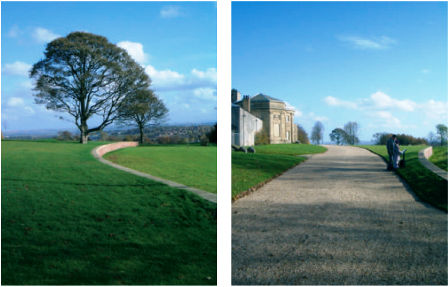
| Above left: Heaton Park, Manchester - the core of the 18th century park, including the ha ha shown here, has recently been restored with a grant from the Heritage Lottery Fund. Key to the restoration of this major public park was the removal of a large number of trees to recreate views to and from the house. Above right: the restoration included provision of discreet and carefully placed signage to help interpretation of important features. |
The term 'historic parks and gardens' encompasses a vast range of types, styles, sizes and ages, from major inner city public parks like Hyde Park in London or Stanley Park in Liverpool to the parks and gardens of country houses such as Stowe in Buckinghamshire or Sissinghurst in Kent. As well as these rather high profile examples there is also a great wealth of lesser known, but still highly valued historic parks and gardens throughout Britain. Planning Policy Guidance note 15 (1) notes that, 'England is particularly rich in the designed landscapes of parks and gardens, and the built and natural features they contain. The greatest of these are as important to national, and indeed international, culture as are our greatest buildings.' Many are included on English Heritage's Register of Parks and Gardens of Special Historic Interest and its equivalents in Scotland and Wales (2). Others are included on local lists, and many more are unlisted.
All these historic landscapes are sensitive to change and as dynamic assets they require careful maintenance (the day to day operations such as grass- and hedge-cutting), management (the longer term planning and policies and organisation of staff), and renewal (cyclical replacement of features such as herbaceous planting). If inappropriate changes are made to management and maintenance regimes, the design intention can be eroded. For example, self-sown trees might establish in an area where a grazing or mowing regime is stopped and thus alter the balance of the landscape by, for example, obscuring historic views.
A park is often the product of several centuries of history. It may have been established in the 15th century as a deer park, redesigned as a more decorative formal park in the 17th century, altered again in the English landscape style in the 18th, adapted for sporting use in the 19th century, with additions of recreational facilities in the 20th century. This often leaves a landscape rich in layers of archaeological remains and in features of great historic and ecological value such as veteran trees and ancient woodland.
Up to the end of the 19th century, the day-to-day management and maintenance of private parkland – trees, woodland and pastoral grassland – is likely to have remained fairly consistent. Changes during the 20th century have often been radical, both in altering the fabric of such landscapes and in their management. The early 20th century saw a decline in country estates, with many sites divided and sold. Change in use for these sites, often involving conversion to schools, hospitals or hotels, and sometimes accelerated by military requisition during World War I or II, had repercussions for the landscape, for instance in the imposition of new patterns of circulation, additional buildings and sports facilities, and in the sale of farmland. A key element of this was often the loss of the walled kitchen garden, an important part of the economy and purpose of private historic parks, which both sustained and required high levels of horticultural expertise. In difficult times, resources for maintenance were often greatly reduced, resulting in changes to historic maintenance regimes. These changes in use and management/ maintenance are likely to have had severe impacts on significant elements of the park or garden, some irreversible and others which it may be possible to mitigate or repair.
 |
|
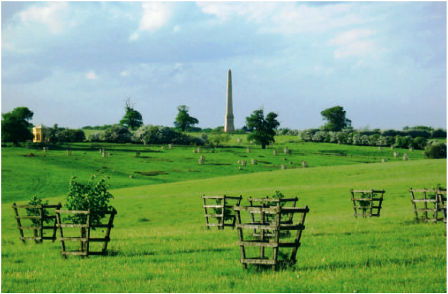
| New planting restoring the historic pattern of trees in the parkland at Stowe, Buckinghamshire. The work forms part of the ongoing restoration of the site by the National Trust. |
MANAGEMENT ISSUES
The many and varied elements of designed landscapes such as parkland planting, lodges, statuary, garden buildings, drives and rides, water features, pleasure grounds, formal gardens and walled gardens are all vulnerable in different ways. The pressure for development and the limited resources available for care of the landscape will always be major factors in the management of parks and gardens and are often at the heart of the key issues facing many designed landscapes in Britain.
The complex nature of managing historic landscapes can be illustrated by considering an avenue of trees that was originally planted in the late 17th century as part of an extensive formal layout centred on a large mansion. Over the following centuries the avenue has grown and matured, and many of the trees have died and been replaced by trees of different species, planted in differing alignments and spacing. The other avenues in the pattern have been removed and the original house converted to use as a hospital. Much of the context and meaning of the avenue has been lost as well as its physical fabric. However, the owners and users of the site still value the avenue as a remnant of a lost designed landscape, for the ecological interest of the surviving 17th century trees as veterans, and for the therapeutic benefits of the mature trees as visible heritage.
 |
|
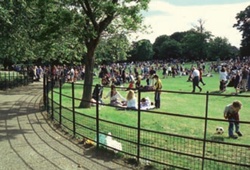
| At Manor House Gardens, a small public park in London, fencing appropriate to the historic landscape was put in place to control dogs – a common source of conflict in such sites. |
If no action is taken, the avenue will continue to deteriorate so the managers of the site need to make some difficult decisions regarding the future of the feature. Should they try to restore the avenue? Should they keep the trees as individual specimens? Should they replant the gaps with young trees? Should they take out the trees that were planted later or fell and replant so that all the trees are the same age and the original appearance of the avenue is restored?
Generally the conservation of surviving fabric, such as any remaining 17th century trees, would have top priority, along with recording evidence of past designs such as any archaeological remains indicating the positions of lost trees. Finally the repair of the avenue may be undertaken if appropriate. This might involve the removal of inappropriately planted replacement trees (species and/or location). However this again calls for careful decision making, as these trees may be mature specimens of considerable amenity and ecological value. In a public park in particular these issues are made even more difficult by the likelihood of a hostile reaction to tree felling from the public.
There is no simple answer to this kind of situation. Rather, there needs to be a considered approach to management of the whole historic landscape based on the best information possible and involving those who live in, use, own or are otherwise concerned with the site in making decisions on its future. Various management tools have been developed which can give a structure to this process and we will look at these next.
CONSERVATION MANAGEMENT PLANS AND OTHER MANAGEMENT TOOLS
Various methods exist to assist in managing historic sites and the most effective tool at present is the conservation management plan. The usefulness of this type of plan lies in its logical process and its inclusiveness. Fundamentally, a conservation management plan looks at what currently exists, lays out what is important about it - its 'significance' - and explains what is damaging or threatening this significance. Based on this analysis, it then sets out a vision for the future of the site and provides management policies that will conserve and enhance the significance of the site and form a foundation for its future management.
Determining the significance of the site is thus crucial. How is this done? There are some simple tests:
- Is the site on the English Heritage Register of Parks and Gardens of Special Historic Interest or one of the other regional registers?
- Does it contain listed buildings or scheduled ancient monuments?
- Is it linked with an important designer?
- Is it associated with prominent people such as sovereigns, politicians, writers or artists?
- Is it an early or particularly outstanding example of a particular style of designed landscape?
- Is it one of the few surviving examples of its type or age?
- Does it have other important qualities such as rich biodiversity interest?
- How is it used and valued by local communities and others?
If a conservation management plan were to be produced for the hospital site containing the 17th century avenue, its historical, ecological, visual and therapeutic value would be measured and balanced in the context of the whole site. The input of all the people with a stake in the future of the site (including owners, the local planning authority, English Heritage, Historic Scotland, Cadw or the DoE Northern Ireland, the Garden History Society, the relevant county gardens trust, and not forgetting residents, visitors, workers, neighbours and others involved with the site on a day to day basis) would be sought and a coherent, long term plan made for the future of the landscape and for the avenue within it.
This would lead to specific projects (such as replanting the avenue) to put into action the policies and, crucially, the production and implementation of a 'landscape management/maintenance plan', which sets out in detail the maintenance tasks needed to achieve the long term vision for the landscape.
Although all historic parks and gardens would benefit from conservation management plans, many do not have such a formal plan in place. The owners and managers are often aware of the site's importance and qualities, and might be conserving a site effectively, however a conservation management plan is a formalisation of this process and will be of benefit not only in day to day management but also more especially in the planning system and in obtaining grants.
As an initial stage it is often worthwhile to produce a 'conservation statement', a short simple version of a conservation management plan based on existing knowledge of the site. This is very useful in determining the fundamental issues about a landscape and gives direction to further investigations. It also assists greatly in discussions with local planning authorities, for instance in the early stages of getting planning permission for new development.
Other types of plan which relate to conservation management plans in their structure, content and purpose are 'heritage management plans' (touched on below), 'conservation plans' and 'restoration management plans'.
NEW DEVELOPMENTS
 |
|
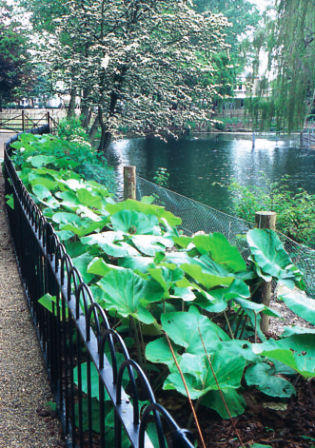
| Treatment of water bodies in historic landscapes needs to respect their historic character while ensuring the safety of users. |
The government has recently undertaken a review of heritage protection legislation and the decisions arising from this are outlined in the Review of Heritage Protection: The Way Forward (DCMS 2004). A key change is the opportunity for statutory management agreements to be employed as an alternative consent regime for some sites (replacing for instance the requirement for listed building and scheduled monument consent). These agreements would be in partnership with the local authority and, where appropriate, English Heritage and other interested parties.
The agreements would be of particular benefit for complex sites like registered parks and gardens which often contain a variety of historic and archaeological elements and so are affected by a number of different designations. The use of agreements should encourage coherent management of a site as a whole rather than as a number of separate components.
Trial agreements are being tested at a number of sites and feedback from this experience will assist in developing the proposals for change in heritage protection over three years (2004-7). In the meantime, the current system and level of protection are being maintained.
Another recent major change is the reform in the Common Agricultural Policy which has seen the replacement of production subsidies for keeping particular livestock or growing crops with a 'decoupled' Single Payment Scheme. To qualify for this scheme, farmers and other land managers need not keep stock or grow crops but must abide by basic standards of good agricultural and environmental management (known as 'cross compliance'). This change is likely to affect the management of historic designed landscapes that are wholly or partially in pastoral or arable cultivation. However, the long term effects of the reforms are far from clear as yet.
SOURCES OF FUNDING AND SUPPORT
There is a range of sources of funding and financial support for historic designed landscapes which are described briefly below.
The Environmental Stewardship Scheme (ES), which has now replaced the Countryside Stewardship and Environmentally Sensitive Areas Schemes, has two separate levels:
The Entry Level of ES is available to all farmers who agree to abide by simple measures that address issues such as pollution, farmland habitats, landscape character, and the protection of the historic environment. The scheme requires the preparation of a simple 'Farm Environment Record'. Land managers and farmers receive a flat annual payment of £30/ha (except in areas of unenclosed upland). Agreements last five years.
The Higher Level of ES, which has similar objectives to the previous agri-environment schemes, requires more ambitious environmental management. It is competitively funded and targeted to the conservation and enhancement of particular landscapes and habitats, according to separate targeting statements in each 'Joint Character Area'. The scheme requires the preparation of a detailed 'Farm Environment Plan'. A range of annual payments and capital grants are available. Agreements last ten years.
Tax relief: land owners can qualify for up to 100 per cent relief from inheritance tax under agricultural property relief or, in some circumstances, business property relief. In addition relief from both inheritance tax and capital gains tax is available to owners of heritage property providing that claimants and successive owners take certain steps. One such step is to prepare a Heritage Management Plan which requires the retention of the property, and the management of it, to be conducted in accordance with a set of agreed objectives. Guidance on preparing Heritage Management Plans is available from the Countryside Agency (see Recommended Reading below).
The Heritage Lottery Fund is a valuable source of funding for historic designed landscapes. The main relevant grant programme is the Public Parks Initiative (grants over £50,000) and this has already transformed many historic parks. Another programme, Heritage Grants, through which grants over £50,000 are available for projects to conserve and enhance heritage and increase access to and enjoyment of it, offers funding particularly to not-for-profits organisations.
 |
||
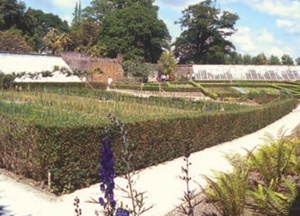
| Walled gardens have the potential to be popular visitor attractions as at Heligan Gardens, Cornwall. |
A further relevant grant scheme is for Landscape Partnerships. This is available to partnerships of heritage and community interests and aimed at enhancing landscapes of distinctive character valued by local communities and visitors. These applications usually encompass a portfolio of projects where elements of the landscape are likely to be in different ownerships. Between £250,000 and £2 million is available for partnership projects.
Finally the Local Heritage Initiative (£3,000 to £25,000) is aimed at community groups developing heritage projects and has potential to fund research and access projects for historic parks and gardens.
European Funding is funding available under the Interreg IIIB programme of the European Union for projects based on links between nations that enhance cultural heritage. A project based on a network of historic designed landscapes across various countries would have the potential to secure this type of grant.
This is a positive time for the management of historic parks and gardens. There is increasing public interest and support for historic landscapes. We have an established and effective methodology to form a base for future management, maintenance and repair at these sites. The innovations in the consent regime, in agri-environment schemes, and the continued support of the Heritage Lottery Fund offer benefits for historic designed landscapes and their owners and managers. These sites cannot stay the same forever, they need to adapt to the needs of the age but we can ensure, through our thoughtful care, that any changes celebrate and conserve this unique heritage of historic parks and gardens.
Recommended Reading
- K Clark, Conservation Plans in Action, English Heritage, London, 1998
- The Countryside Agency, Conditional Exemption and Heritage Management Plans: an introduction for owners and their advisors, 2004
- The Countryside Agency, Preparing a Heritage Management Plan, 2005
- Defra, Environmental Stewardship: an introduction note for staff and stakeholders, 2004
- The Heritage Lottery Fund, Conservation Management Plans: helping your application, 2004
- The Heritage Lottery Fund, Conservation Management Plans: model brief and checklists, 2004
- JS Kerr, The Conservation Plan, 5th edition, The National Trust of Australia, Sydney, Australia, 2000
Notes
(1) Planning Policy Guidance notes (PPGs) set
out Government policy on planning and
provide guidance to local authorities and
others on the operation of the planning
system. PPG 15 refers specifically to
planning and the historic environment.
(2)The Scottish Heritage/Scottish Natural
Heritage Inventory of Gardens and
Designed Landscapes of Special Interest,
the Cadw/ICOMOS Register of Parks and
Gardens of Special Historic Interest in
Wales.