
Reviving a Lost Art
Reconstructing Medieval Wall Paintings at St Teilo's
Tom Organ
 |
||
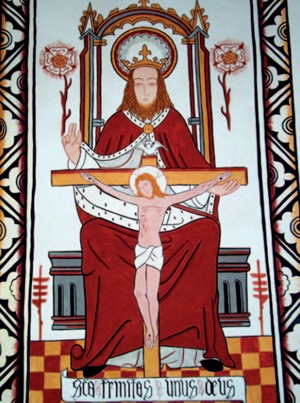
| Completed reconstruction of The Trinity wall painting (All photos by Tom Organ unless otherwise stated) |
In the 100-acre parkland of St Fagans Castle, a magnificent late 16th-century manor house on the outskirts of Cardiff, is one of the leading European open-air museums. Donated to the people of Wales by the Earl of Plymouth and opened in November 1948, over 30 buildings have been moved to the museum from various parts of Wales, re-erected and restored.
The castle and grounds, together with their fascinating collection, form part of the National Museum of Wales, commonly known as St Fagans, which chronicles the historical lifestyle, culture and architecture of the Welsh people.
One of the most impressive buildings in the collection is the small parish church of St Teilo, removed stone by stone from Llandeilo Tal-y-bont and restored over the past 20 years. Staff from St Fagans first visited the semi-derelict church in 1984 to find the windows boarded up, ivy covering much of the exterior and the roof stripped of its slates. Roughly a decade earlier, investigators from the Royal Commission on the Ancient and Historical Monuments of Wales had carried out a preliminary survey of the building and noticed what appeared to be traces of pigment or colour on one of the walls. Sections of limewash had fallen away where water had penetrated the building exposing areas of painted decoration beneath.
After careful detective work museum staff determined that sufficient evidence remained for St Teilo’s to be recreated as it would have looked just before the Reformation. Not only had the whole structure – the nave, chancel, north chapel, south aisle and porch – been re-built by this time, but there was exciting evidence for a complete scheme of wall paintings that had been executed only a few years before the Reformation, the majority sometime between 1490 and 1530. Many layers of post-Reformation limewash covered the medieval wall paintings at St Teilo’s, Llandeilo Tal-y-bont, protecting the paintings in the process.
THE ORIGINAL WALL PAINTINGS
The church was found to have wall paintings from at least seven identifiable periods. The oldest was an early 15th-century depiction of St Catherine, dated stylistically from her costume. Above this layer was the early 16th-century scheme depicting scenes from the story of the Passion along with paintings of saints and angels.
At the Reformation all the figurative paintings were obliterated with limewash. During the subsequent centuries a number of Biblical texts and inscriptions were painted including a massive Royal Arms, and the remains of an 18th-century Lord’s Prayer in English and the Ten Commandments in two large arched panels.
The paintings that are of particular interest are those painted between 1490 and 1530. The Passion scenes are the most detailed to survive in Wales and some of the most significant to be discovered in Britain from the late medieval period. The original paintings, detached, conserved and stored at the museum, form the basis for the recent reconstruction.
 |
 |
||
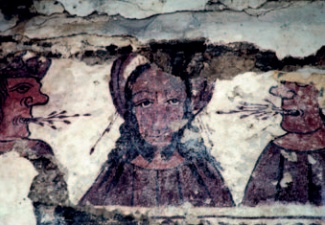
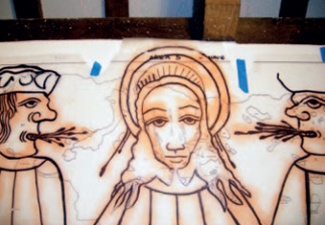
| Left: Original wall painting showing The Mocking of Christ, c1530 (Photo: St Fagans National History Museum) Right: The pounced cartoon for the reconstruction of The Mocking of Christ: the main outlines of the design (the ‘cartoon’) are pricked through (or ‘pounced’) using a needle or small spiked wheel to create a line of holes and a small cloth bag containing fine powder pigment is patted over it to transfer dots of pigment, and thereby the image, through the holes | |||
The original wall paintings were fragmentary and incomplete – the scenes do not form a linear narrative, but the elements of a Passion cycle were clearly to be found around the church. The recent restoration, based on fragments of original painting, has highlighted the power of the late-Medieval scenes. The Mocking of Christ at his trial, above the window in the middle of the north aisle, shows Christ’s head, blood from the crown of thorns dripping down his forehead and face, between two men in profile. They are deliberate caricatures of ugliness, with bulbous noses and exaggerated expressions of hatred, and they are shown spitting at Christ, drops of spittle falling from his face.
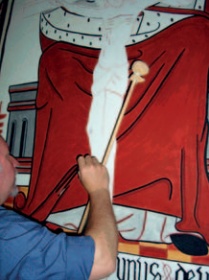
To the east of this scene were fragments of a figure seated on a throne with the right hand raised in blessing. An inscription below the panel is thought to read ‘… Sancta Trinitas…’ and the scene is therefore taken to depict God the Father seated on his throne, with the crucified figure of Christ between his knees and the dove above representing the Holy Spirit.
Opposite this, on the south wall of the nave, was the Image of Pity. A popular devotional image of the early 16th century, it shows Christ, seated on a stone-built tomb, and dressed only in a loin-cloth displaying the wounds of the Crucifixion, surrounded by the Instruments of the Passion.
At the east end of the south aisle was a painting of Christ before the crucifixion with the words Ecce Homo (‘Behold the Man’). Christ is depicted seated, wearing the crown of thorns. To the left of him are a ladder and a spear, two more of the Instruments of the Passion. His wrists, knees and ankles are bound with rope and near his feet is a large skull, a reminder that the crucifixion took place at Golgotha, ‘the place of the skull’. The other paintings from this late medieval sequence were saints and angels, architectural decoration and linking borders.
 |
||
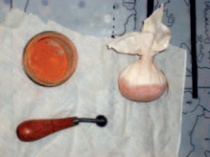
| Tools of the trade: red iron oxide powder pigment, a pin wheel for incising the design through the cartoon and a pouncing bag filled with pigment |
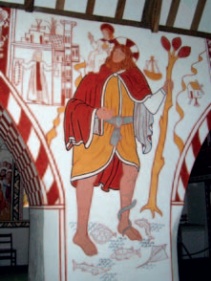
A massive St Christopher was placed in his traditional location immediately opposite the main doorway, although all that survived of the original painting was the haloed head of a child on the shoulder of the much larger figure of the saint. To the left was a church, with a robed figure carrying a rosary: the hermit who charged Christopher with the task of carrying travellers across the river.
Within several of the window splays, paintings of angels and saints were found: St Roche, St Margaret of Antioch (spearing a dragon beneath her feet) and angels carrying a shield with symbols of the Passion.
The original wall paintings at St Teilo’s church were executed a secco (painting onto a dry plaster or limewash layer) as opposed to a fresco, where the painting is executed onto a fresh or wet plaster. With buon fresco (literally ‘true fresco’), paintings are executed using powder pigments ground and mixed to a paste with water. They become bound with the wall surface through the carbonation of the lime in the lime plaster. Lime putty (calcium hydroxide) sets through a process of carbonation with the water element evaporating off and atmospheric carbon dioxide being absorbed into the plaster to form calcium carbonate. As this process occurs, minute quantities of lime pass into the pigment layer and carbonate, thereby binding the pigments.
REPLICATION
The reconstruction of St Teilo’s wall paintings was carried out in a number of stages. A series of colour-matching tests was carried out and a simple palette of colours determined so that batches of colour could be made-up for use.
The wall paintings had originally been executed onto a thick limewash ground and in such cases the pigments normally require an additional binding medium. However, where thick, freshly applied limewashes are present, it is arguable that the carbonation of the calcium hydroxide, which makes up the main component of this layer, would impart an element of ‘fresco’ binding to the pigments. Such effects are sometimes referred to as fresco-secco, a somewhat confusing and contradictory term.
 |
||
| Painting-in the figure of the crucified Christ in The Trinity |
The new wall paintings at St Teilo’s have been executed using traditional secco painting techniques, in this case using a casein binder. Casein is the principal protein in milk and has been used since Egyptian times to make a form of paint known as tempera. Casein is produced commercially by the addition of acid, which produces casein powder. This is mixed with water and ammonia, in the form of ammonium carbonate, to produce ammonium caseinate, an adhesive casein binding material that can be diluted and mixed with traditional powder pigments. These are ground together to form a paste, which can then be applied in thin glazes. Several applications may be necessary to build up the colour, but the matt finish produced by this method is ideal for large mural subjects.
During the Medieval and Renaissance periods, wall paintings in Britain were, for the most part, executed using a very basic palette of readily available and relatively inexpensive earth pigments: red and yellow ochres, lime white and carbon black. While the range of colours available to the artist included pigments such as red lead, white lead, vermilion, green earth, malachite, azurite and lapis lazuli (natural ultramarine), these pigments were often too expensive for the average rural community, and so their use tended to be limited to the finest and grandest schemes, such as those which survive in a number of cathedrals and palaces.
Most of the powder pigments used at St Teilo’s were sourced from Clearwell Caves in the Forest of Dean, Gloucestershire. The Clearwell Caves are among the earliest, as well as one of the last surviving, producers of natural earth pigment (ochre) in the British Isles. Ochre is thought to have been mined here since the Middle Stone Age, more than 7,000 years ago, and the Forest of Dean mines were once famous for good quality, rich pigments, particularly shades of red and purple. Purple ochre is an unusual natural earth pigment; similar colours are usually only available in synthetic forms. For the project at St Teilo’s, some of the Clearwell pigments were mixed with other natural pigments obtained from L Cornelissen & Son, established in London as an artists’ colourman in 1855, in order to obtain close colour matches to the pigments found in the original wall paintings.
To set out the scheme, first life-size photographic prints of the surviving wall paintings were located in their original positions on the walls of the reconstructed church. The outer borders and other architectural elements of the design were then copied and painted onto the recently limewashed walls. Within these areas the surviving figurative scenes were transferred as ‘cartoons’ (the outline designs, illustrated on the previous page top right, and subsequently painted-in.
 |
||
| The reconstruction of the giant figure of St Christopher carrying the infant Christ |
Many of the original wall paintings had been set out using rough, incised sketches made in the fresh limewash using a blunt point. This initial sketching is clearly seen in some of the surviving original fragments of wall painting, and the soft edges of the incised lines show that the limewash was still wet and plastic at the time. (With a dry limewash layer, the incised lines would have jagged, broken edges.) The paintings were then executed quickly with free-flowing outline sketches, blocking in of the main colours and final outlines added last.
The techniques employed to reconstruct the murals were almost identical to the original techniques, the main exception being that the designs were first copied as outline cartoons, the images then being transferred to the wall by ‘pouncing’. Pouncing is a traditional technique, which can be identified on many Renaissance wall paintings. Here, the main outlines of the design, the cartoon, are pricked through using a needle or small spiked wheel to create a line of holes and a small cloth bag containing fine powder pigment is patted over it to transfer dots of pigment, and thereby the image, through the holes.
The result, in this case, was a transferred cartoon image made up of a series of small red ochre dots. The unbound powder pigment was then overpainted, and mixed in, with the thin preliminary ochre outlines, sometimes referred to as sinopia. This term refers to the red oxide colour used for cartoons and under-drawing in fresco and secco painting and was described in the 15th century by Cennino Cennini in Il Livro del Arte as ‘a natural colour known as sinoper, or porphyry, [which] is red…’. Once the preliminary sketches had been finalised, areas of flat or background colours were blocked in. Details and other colours were added layer by layer until the whole image was complete. It could then be given a final outline where necessary.
COMPLETING THE MISSING AREAS
Initially only the fragmentary ‘islands’ of surviving colour were painted. These were then used as the basis for reconstructing the missing areas. In some cases the subject matter was clear, even though relatively little of the original remained. One of the best examples of this was the giant figure of St Christopher. Of the original, little more remained than the head of the saint turned to his right and facing towards a much smaller haloed figure, perched high on his shoulder. In the background was a small figure holding a lantern and a rosary, standing in an architectural setting. Combined with the traditional location opposite the south door, these clues provided clear evidence that the scene depicted St Christopher, the patron saint of travellers.
Having determined the style of the original artist, it was possible to look for other examples to provide source material on which to base a reconstruction of the missing areas. The main form for the figure of St Christopher was taken from a fine example at Llantwit Major, Glamorgan while other elements were copied from a very fine survival of the saint at Llanynys, Denbighshire. The latter provided good source material for common decorative details often found in murals that depict the St Christopher story – in this case, the fantastic fish swimming around the saint’s massive legs and for details within the landscape such as the windmill.
 |
||
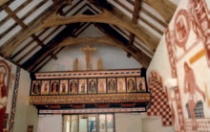
| View of the east end of the nave |
In some instances the subject matter of the original wall paintings could clearly be made out, even though the majority of the detail was missing. Such was the case with the Royal Arms on the south wall of the nave. Here, the quartered arms survived, surrounded by a garter and one of the two supporters (in this case, a dragon), but much of the heraldic detail and other information was missing. Fortunately, a late-medieval example of heraldic wall painting discovered some years ago at Cullacott farmhouse, Werrington in Cornwall, provided a good source of comparable material because of the close stylistic similarities.
There are important differences between wall paintings and other art forms, such as carved stone and wood, manuscript paintings and tapestries, and while some of these may provide good examples depicting the desired iconography from the right period, the stylistic variations can cause problems. Using the Cullacott Arms as the basis for this reconstruction, it was possible to overcome these problems and paint convincing lions passant and fleur de lys on the shield surrounded by the motto honi soit qui mal y pense (often translated as: ‘evil be to him who evil thinks’). The Cullacott examples also provided missing details on the dragon supporter, which in turn informed the reconstruction of the lion on the opposite side.
The successful completion of the wall painting scheme not only required detailed investigation of the likely iconography, but also the sourcing of good comparative material. A wide range of source material had to be collected, analysed and digested in order to ensure that the new images contained details that are both iconographically and stylistically correct. More important, however, was the ability of the modern painters to obtain the right ‘feel’ when executing the reconstruction wall paintings, something that requires an insight into the world of the original artist.
Typically, conservation work focuses on the preservation of murals in situ. The opportunity to reconstruct a series of medieval wall paintings was presented at St Teilo’s by the highly unusual circumstance of the building’s relocation to the museum.
The reconstructed interior provides a unique opportunity to experience the rich iconography and colour of pre-Reformation churches. The discovery of the rare 16th-century scheme of murals highlights the fact that schemes like these survive to varying degrees in churches throughout the British Isles hidden beneath layers of limewash. The reconstructed wall paintings at St Teilo’s illustrate the importance of these schemes and the need to consider carefully the effects of routine repairs, decoration (especially paint stripping) and the installation of services through old plasterwork.