
Historic Methodist Architecture and its Protection
Ian Serjeant
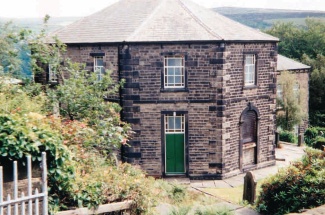 |
| Heptonstall Methodist Church, West Yorkshire, 1764 (photo provided by the local managing trustees) |
Methodism has long had an interest in buildings. Indeed, John Wesley’s preference for an octagonal shape is well known: the legacy can be seen at Yarm, Heptonstall (right) and St John’s, Arbroath. But buildings were then seen essentially as tools for preaching and mission, not as objects for veneration in their own right. Pure functionality was the original driving force for their design, and this is the main pattern that has continued. There is evidence that, as Methodism became more established, there was increasing awareness of architectural dignity and proportion. As a consequence, the simple vernacular forms gave way to buildings in the classical tradition, especially in urban areas. Such an example is Walcot, Bath (illustrated further down this page) designed by the Revd William Jenkins and which opened in 1815.
Towards the middle of the 19th century the issue of an appropriate style for Methodist architecture arose. In a series of papers advocating a preference for the Gothic style, the Revd Frederick Jobson (who trained as an architect) argued for beauty and perfection in design and execution without unnecessary adornment (see Recommended Reading below). His papers were presented to and adopted by the Methodist Conference, the governing body of Methodism. The influence of his writings was such that Gothic became the predominant style, particularly within Wesleyan Methodism. A typical building of this era is Altarnun, Cornwall, 1854.
The legacy of this development is a stock of about 700 chapels listed as being of architectural or historic interest. The concern over such buildings, however, stretches back well before the introduction of the current ecclesiastical legislation. In 1976 Listed Church Buildings was published by the then Methodist Division of Property (the department responsible for all building matters nationwide[1]), primarily as a response to European Architectural Heritage Year, 1975. Written largely by the Revd George Dolbey, who was General Secretary of the Division and an architect and planner, the report reminded everyone that 'the careful preservation of such listed buildings as the Church possesses is part of the Church’s contribution to the culture of our generation and should be encouraged, providing the buildings subserve the work'.
Just before this report was published, the House of Lords reached a verdict in the case of the Howard Memorial United Reformed Church in Bedford which clarified that ecclesiastical exemption from listed building consent applied to all ecclesiastical buildings in use and not just those of the Church of England. In following years, the wholesale destruction of many important interiors led to a growing clamour for the exemption to be withdrawn.
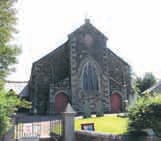 |
| Altarnun, Cornwall, 1854 (photo: Ian Serjeant) |
During this period the Methodist Church recognised that it had to establish clear policies relating to listed buildings for the guidance of the managing trustees of such buildings. A working party was set up and its report was contained within the publication A Charge to Keep? – a Methodist Response to Listed Buildings and Conservation, written by the head of the Property Division and his deputy. The Methodist Conference accepted the report and adopted a series of resolutions recognising the tensions between the demands of conservation and the need to adapt buildings for mission purposes. A Charge to Keep? examined how the Methodist Church should respond to the impact of conservation legislation. It also set out procedures for schemes of alteration to listed buildings.
While these issues were being debated within the Methodist Church there was ongoing debate with the Department of the Environment on the consultation paper Ecclesiastical Exemption from Listed Building Control which was published in 1989. When the resulting Code of Practice was issued in 1992 the formal response of the Methodist Church was that it wished to retain the exemption.
The Methodist Conference of 1993 therefore asked the Property Division to:
- Introduce procedures in conformity with the Government’s suggested Code of Practice
- Propose such changes to Methodist Standing Orders as were necessary, and
- Administer the code through the appointment of an Assistant Secretary (now titled Conservation Officer).
A financial allocation was made to cover the cost of implementing this system. At the 1994 Conference the necessary changes and additions to the Standing Orders were made to bring procedures in line with the Code of Practice. The most significant addition was a section in Standing Orders which established the necessary process before the Methodist Connexional Property Committee could approve a scheme for ‘listed building works’.
By the time The Ecclesiastical Exemption (Listed Buildings and Conservation Areas) Order 1994 came into force, the Methodist Church was fully prepared and its system (as described below) became operational. The full story can be found in Heritage and Mission (see Recommended Reading).
THE OPERATION OF THE EXEMPTION
Incoming schemes affecting
listed Methodist church buildings are divided into four categories by
the conservation officer:
- Minor schemes where the impact on the building is insignificant
- Schemes of alteration where formal consultation is necessary
- Possible controversial schemes where an informal consultation is carried out on the emerging proposals
- Major schemes to be referred to the Listed Buildings Advisory Committee (LBAC).
The LBAC is a body appointed by the Methodist Church to give advice on listed building matters. It consists of 11 people chosen for their expertise in relation to the wide range of disciplines involved in the conservation of historic chapels. They are not necessarily Methodists; neither are they the nominees of any particular body. They are, however, subject to annual re-appointment.
The consultees are sent a copy of the list description, scheme drawings and photocopies of photographs, together with a written description of the proposed work. Where schemes of any significance are proposed, the applicant church is required to submit a Statement of Significance and a Statement of Need. Consultees have 28 days to respond.
The comments of the consultees and of the LBAC are then reviewed by the conservation officer, who then prepares a report which describes the proposal, summarises the views of the consultees and makes a recommendation to the Connexional Property Secretary who acts under delegated powers from the Methodist Connexional Property Committee. The scheme is then either approved, approved conditionally or refused. The applicant church and the consultees are then notified of the decision and a copy of the report is sent to them.
COMMON ALTERATIONS
Alterations are often
required by congregations to make their buildings more welcoming or more
useful. These often include alterations to the entrance, steps and other
access-related features, seating arrangements, and the introduction or
improvement of facilities such as toilets. As around ten listed chapels
close each year, the pressure for their retention often means that local
authorities will allow significant internal change if the external form
can be kept.
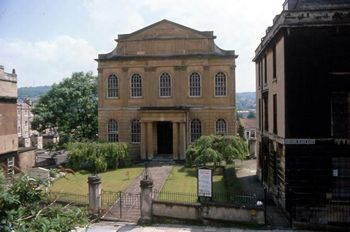 |
| Walcot, Bath (1815) |
Alterations to entrance areas are generally acceptable, particularly when they are sited under galleries. This is partly because chapels were generally designed to be seen when seated and looking forward, mitigating the affects of such alterations on the interior character.
The total removal of all pews (or all ground floor pews) usually results in some objections, particularly when the pews are of an early date. The removal of later pews is often regretted because of their contribution to the character of the interior, but seldom results in a strong objection, particularly when representative examples are retained.
Accessibility is an issue of continuing significance. Many older chapels were badly designed in terms of providing access for all, and finding ways of overcoming shortcomings may not be straightforward.
THE STRENGTHS OF THE SYSTEM
The greatest strength
of the Methodist system is its consistency. The same criteria are used
from the Shetland Islands to the Channel Islands. This is especially important
given the nature of the ordained ministry in Methodism where ministers
usually move to a new church every three to five years. Such consistency
is not found in the secular system which, in many authorities, is operated
by staff with no qualifications or experience relevant to conservation.
The dual nature of the system whereby external alterations require planning
permission from the local authority and the equivalent of listed building
consent under the ecclesiastical exemption process can cause problems.
On many occasions we have required changes to schemes that have received
planning permission but failed, in our opinion, to meet a satisfactory
standard for external alteration to a listed building.
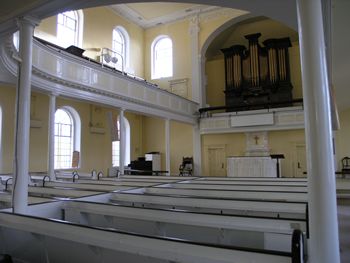 |
| Walcot, Bath |
The value of a national system is reffected in the establishment of the single advisory committee. The LBAC is of the highest calibre and contains considerable expertise across a range of relevant topics. Such expertise could not be reproduced at local or even regional level if a different system were to be introduced.
The Methodist system also gives control over the alteration of high quality interiors in unlisted chapels in conservation areas, something that the secular system could not do. There is also a policy precluding the use of PVCu windows in conservation areas. In two cases, PVCu windows, installed without consent, have had to be replaced with timber windows to the original pattern.
Two cases where the listed building enforcement procedures have been used are in the removal of aluminium windows at Reading and the removal of PVCu rainwater goods and their replacement with cast iron at Scarborough. An appeals system is now in force. The first hearing was held recently where a church applied for retrospective consent to retain window guards erected without permission. The scheme was refused and the appeal dismissed.
When the first review of ecclesiastical exemption was carried out by John Newman in 1997, the Methodist Church was found to have ‘a control system which is comparable with the secular system and is efficiently administered…'. In the most recent review of the exemption, the Department for Culture, Media and Sport also acknowledged the strengths of the systems built up by the exempt denominations. With the continuing refinement of our systems we believe that John Newman’s comments are as valid today as ever. The system works well, ensuring that the contribution made by Methodist church architecture to the heritage of this country will be maintained for future generations to enjoy.
Recommended Reading
- G Dolbey, The Architectural Expression of Methodism, Epworth Press, London, 1964
- G Dolbey and P Kerridge, Listed Church Buildings, Richmond Press Ltd, Wilmslow, 1976
- F J Jobson, Chapel and School Architecture, WHMS Publications, 1850: facsimile reprint by Methodist Publishing House, Peterborough, 1991
- K E Street and I Serjeant, Heritage and Mission, Methodist Publishing House, Peterborough, 2000
- K E Street and I D Johnson, A Charge to Keep? – a Methodist Response to Listed Buildings and Conservation, Methodist Church Property Division, Manchester, 1990
[1] 'Division of Property', 'Property Division' and 'Connexional Property Committee' are the successive names by which this body has been known in recent years.