
Structural Movement
Is it really a problem?
Clive Richardson
 |
||
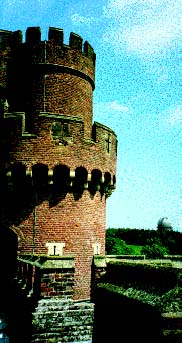
| Herstmonceux Castle (1440). The machicolated battlements were last rebuilt in c1932 and are now leaning again. Curved walls are particularly prone to leaning outwards at their tops due to cyclical thermal and moisture movement leading to creep distortion of the masonry. |
The last 50 years have seen the extremes of people's reaction to movement in buildings. In the immediate post-war years, when we were grateful for any accommodation which had survived the Blitz, attitudes to odd cracks were relaxed. Whilst redecorating my father would summon us children with glee to see finger-wide cracks discovered beneath the wallpaper, before ceremoniously plugging them with newspaper and Polyfilla. No panic attacks for him, whereas nowadays structural engineers are increasingly called out to pronounce upon hairline plaster cracks dramatised by white emulsion paint.
People's expectations of building performance have become unreasonably high and everything is too precious nowadays. It is time for reactions to be tempered by considering the issues.
The forces of nature are capable of breaking down mountains, so we must assume that a building will also not last indefinitely. Regular maintenance and occasional structural intervention is essential to slow the process of deterioration and to extend the life of its structure. Intervention may be aimed at preserving the building indefinitely, but a more realistic view may also be taken with finite expectations for both original fabric and repairs.
WHAT IS STRUCTURE?
Those parts of the building fabric which confer significant strength, stability, and integrity, such as roof carcassing, floors, walls, frameworks, and foundations form the principal structural elements. Non-structural fabric such as plaster, render, windows and doors can also help stiffen a structure but their contribution is not to be relied upon in a significant way.
WHAT IS STRUCTURAL MOVEMENT?
Subsidence, settlement, heave, sway, bouncy floors, bulging walls, cracks, expansion and contraction are all forms of structural movement. Such movement occurs all the time, and usually its magnitude is so small it passes unnoticed. Only when distortions and cracks threaten the use or safety of the structure need we be concerned.
CAUSES OF STRUCTURAL MOVEMENT
New structures are designed to carry their own weight and imposed loads so that strains are kept within reasonable limits; safety factors are included to cater for variations in quality of materials, design and construction inaccuracies, and random or accidental forces. In historic structures detrimental movement results from inadequate design and construction, decay and ill-considered alterations.
INADEQUATE STRENGTH
Before the advent of calculus and 'modern' engineering, early historic structures largely succeeded due to generations of craftsmen constructing buildings in accordance with what they knew to have worked previously, and avoiding construction that had failed to perform. In other words, safety factors were incorporated by experience rather than calculation. Nevertheless in medieval structures it is common to find that secondary floor joists are often larger than they need be, whilst primary beams are undersize and sagging excessively. Apart from this, and some more singular problems, it is perhaps surprising that inadequate strength is generally not a problem.
From the start of the Industrial Revolution, the increasing involvement of the engineer, first with grand buildings and latterly more humble structures, ensured more adequate sizing of structural members. Exceptions include domestic buildings with timber floors overloaded by office use.
|
|
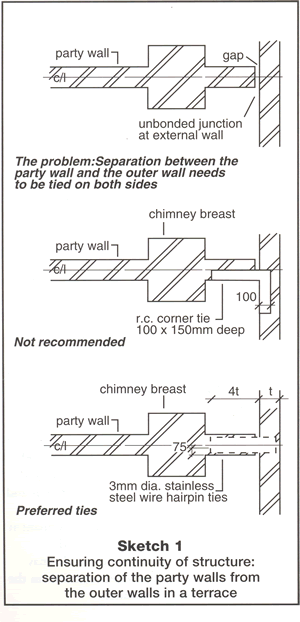
LACK OF CONTINUITY OR 'TOGETHERNESS'
The vast majority of the nation's structures are low-rise unframed buildings, where the individual components are predominantly held together by friction and gravity. Most such structures (speculative Georgian and Victorian housing for example) have out-performed the expectations of their constructors without the involvement of engineers and despite the two World Wars. However, as buildings relax and become frail with age, the single kindest way of increasing their longevity is to tie them together. Conversely the lack of continuity leaves the structures vulnerable to disproportionate damage.
MATERIAL DECAY
Water is the principal agency effecting the decay of most structural materials, causing:
The battle against water can largely be won by giving the building a good roof; by ensuring that driving rain is thrown clear of the building by generous drips, throatings, over-sailing copings and bonnets; and by preventing rising damp either through a damp-proof course (dpc) or by ensuring that the ground is well drained.
DIMENSIONAL INSTABILITY
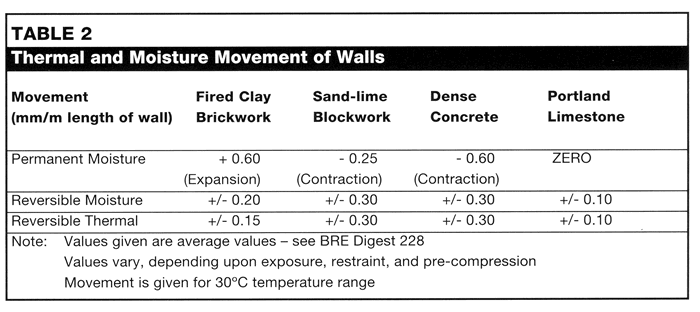
All crystalline materials (stone, concrete and brick for example - see Table 2) expand and contract with changes in moisture-content and temperature. The resultant strain must be accommodated by the structure, or permanent deformations and cracks will occur. If movement is cyclical, then such cracks may grow due to the 'ratchet' effect of debris in the cracks preventing full closure.
In most structures in the UK the principal load bearing element is the masonry. Different types of masonry move at different rates, and sometimes in opposing directions (Table 2). This can give rise to differential movement and distortion (see illustration of Herstmonceux Castle). Fortunately most walls constructed before 1914 were set in lime mortar, which can accommodate considerable amounts of movement without cracking due to creep (continual strain under constant stress), whereas more modern walls require the frequent provision of movement-joints.
SUBSOIL AND FOUNDATION INADEQUACIES
Early medieval timber buildings had their main posts dug into the ground, but almost all buildings which still survive had sill beams resting on low masonry plinths. Medieval masonry buildings had walls which were built straight into the ground without any attempt to disperse the load over a broad foundation: latterly the walls were sometimes stepped out, or 'corbelled', to provide a wider distribution of the load on the soil.
In good ground, corbelling continued until the First World War, latterly with a shallow strip of concrete first cast into the trench, about 500mm below ground. In poor ground, short timber piles were sometimes driven before commencing the masonry. With the advent of modern mild steel and reinforced concrete at the turn of the century, foundations became more sophisticated.
Movement of shallow spread foundations is commonly caused by normal constructional settlement, mining, leaking drains, shrinkable clay, tree-roots, changes of water-table, additional loads and tunnelling. Flexible historic buildings are often better able to cope with movement than modern rigid structures, thanks to the prevalence of soft lime mortar, massive walls, timber-frames, arches, and vaulted construction. Modern structures with slender walls set in hard cement mortar with brittle plaster and no cornices, will show every crack.
OVERALL INSTABILITY
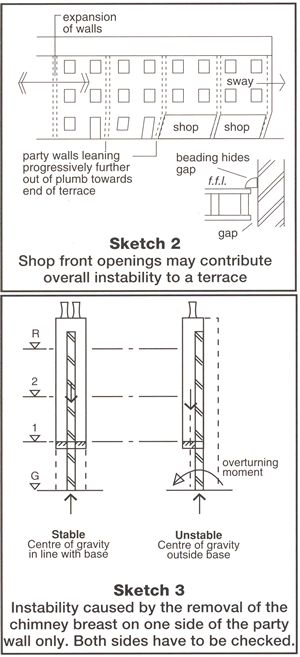
A lack of bracing can ultimately lead to collapse. Many a medieval church, for example, has had a gable end rebuilt following movement of its unbraced roof: this was prevented in more elaborate construction by diagonal wind-braces which were inserted in the plane of the rafters. Victorian shop-fronted terraces are also prone to falling over, being perched on slender columns (see Sketch 2 above).
ALTERATIONS AND MISUSE
Notched floor joists for services, doorways cut through trussed partitions, partly-removed chimney-breasts and overloaded floors are the most popular abuses of buildings. Many such alterations become obscured over the years, and it is only investigative work that will uncover the cause of the distortion (see Sktch 3).
ASSESSMENT AND CONCLUSION
Against this background of potential movement, it is hardly surprising that buildings seldom perform perfectly, and rarely acquire true stability. But is this important? If a building has sufficient commodity, firmness, and delight then the odd distortion can be part of the charm, the patina, of an historic structure.
Although intervention by engineers may be unnecessary for the odd symptom of distress, it is too easy to rely on the assumption that a building will last indefinitely simply because it has survived the last 200 years, while the building tiptoes to disaster.
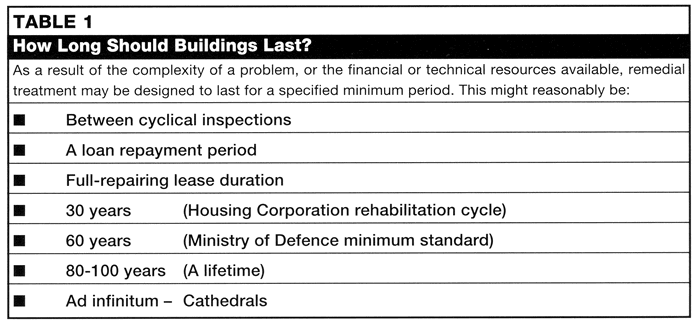
Structural movement is serious when the safety-margins of strength, stability, or integrity have been significantly eroded, or the movement is progressively leading to failure within a specified period. For a relatively modest structure such as a house, no action may be considered necessary unless the structure is likely to fail within a period of perhaps five years, but for a cathedral a much larger safety margin would be necessary, of perhaps fifty years due to its scale and the high cost involved in carrying out major works. Expectations for the duration of a repair may also vary (see Table 1).
An engineering assessment of the seriousness of any particular symptom of structural distress is not just by calculation, but also through an understanding based on practical experience of the performance of old structures, and the intangible contribution of the non-structural fabric, such as the stiffening effect of horsehair in old plaster.
The Building Research Establishment offers some guidance on the seriousness of crack-widths but this must be used circumspectly. Cracks should be examined to determine their cause, not rigidly filled in to see if they reappear, as this may restrict cyclical movement causing the problem to escalate. Careful examination can reveal the direction of movement, and whether movement is ongoing. In particular:
-
look at crack faces - how have they come apart?
-
are the arrises fresh and clean?
-
is there old paint or filler in the cracks?
-
how old are the decorations?
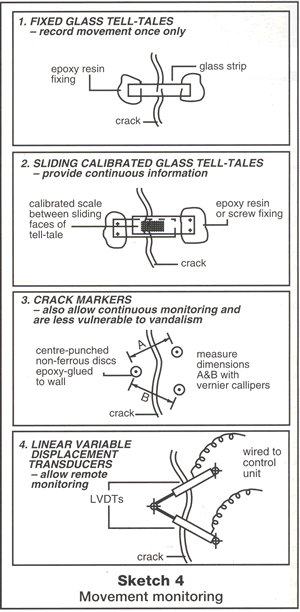
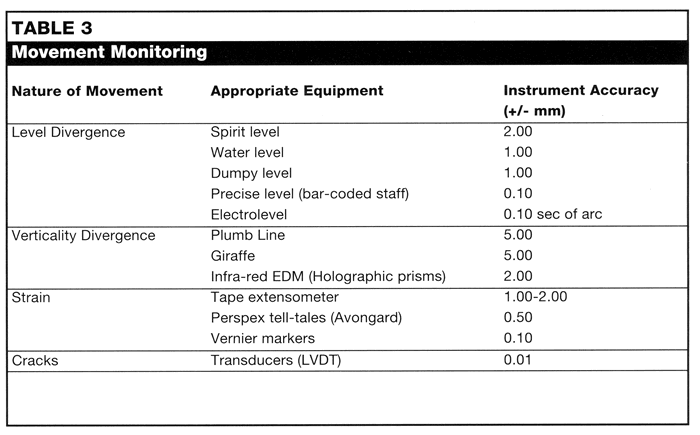
If the probable cause of the structural movement is still unclear, or if the movement is suspected to be progressive, then movement monitoring is warranted (see Table 3). Monitors are aids to diagnosis and prognosis, not a substitute to understanding structures.
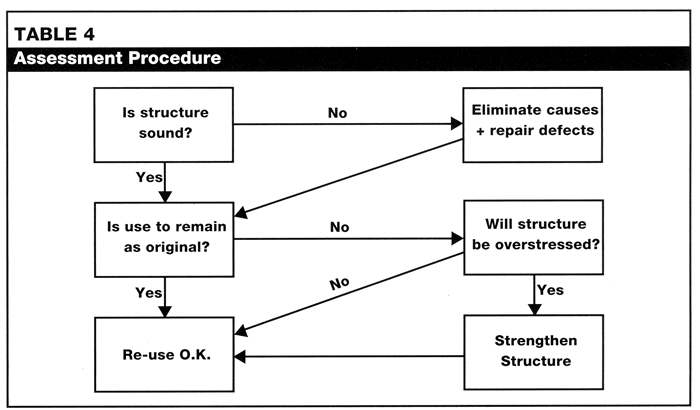
Hopefully the days have long gone, when well-intentioned but misguided builders stuck glass tell-tales across cracks with disfiguring blobs of resin, in the vain hope that their demise would explain the cause. Mostly the glass would come unstuck, or schoolboys would break the glass for fun. The arsenal of equipment available today is vandal-resistant, and when used wisely, gives meaningful results (see Sketch 4 above). Once the causes have become clear, it is straightforward to eliminate them and make repairs (see flow chart, Table 4).
Structural movement need not be a problem when considered rationally. Although structures rarely acquire true stability, cracks and bulges are not always serious, and crack-monitoring is not automatically necessary. What needs to change is people's expectations.
The Victorians had the right idea; cornices to conceal movement between ceiling and wall junctions, woodwork painted chocolate brown to camouflage joint shrinkage, and stretchy Lincrusta wallpaper to obscure random cracks.
|
Recommended Reading
-
C Richardson, The AJ Guide to Structural Surveys, AJ:26.6 - 24.7.85
-
C Richardson, Bulging Walls: Survey, Assessment and Repair, AJ: 3.1.88
-
JE Gordon, Structures, or Why Things Don't Fall Down, Penguin Books Ltd, London, 1978
-
Structural Renovation of Traditional Buildings, CIRIA report no 111: 1986
-
HJ Eldridge, Common Defects in Buildings, Dept of the Environment, Property Services Agency, HMSO, London, 1976