
Nails and Wood Screws
Jonathan Taylor
The use of nails and screws can give an indication of the age of joinery or its fittings and provides a useful insight into a building's history
 |
|
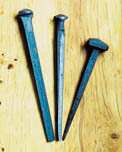
| Reproduction rose-head nails of approximately four inches long: Left and Centre: two machine-cut nails, one turned on its side to show two parallel sides (left) and two tapered sides (centre) Right: a hand-wrought nail with a tapered shank and large rose-head. (Nails supplied by IJP Building Conservation) |
Hand-Forged Nails Nails were among the first metal objects made by mankind, indispensable or such everyday items as doors and roof coverings, shoes, buckets and barrels. Early nails were usually square in section and the earliest were individually forged by hand from iron. The head of the nail was formed either by simply turning it over to form an L-shape or by striking a hand-held mould or 'bore' over the end of the shank to produce a shaped end such as a 'rose-head', a simple four sided pyramid shape. However, being hand-forged, the variety of shapes and forms are infinite. These nails were expensive to produce and were used sparingly.
Early Cut Nails The introduction of cut nails dates from the late 16th century with the advent of water-powered 'slitting mills'. After hammering (or, from the late 17th century, rolling) the hot iron into sheets, each sheet was slit into long, square-sectioned bars by rollers which cut like a shears. Bars of the requisite thickness were then made into nails and spikes by 'nailers'. Only the head and the point were forged, so these nails, which were common from the 17th to the early 19th century, can be distinguished from earlier ones by the sharp regular profile of the cut section.
Machine-Cut Nails The first machined nails were flat and headless. From 1811 these were produced from rolled sections of plate iron, cut into strips of the same width as the length of the nail. The strip was then placed under a powerful guillotine which cut off a single nail on an angle. Then the sheet was turned over and the next was cut. As a result these nails taper to a point on two sides only, producing a square point (see illustration), and are easily distinguished from earlier cut nails.
Stamped Nails A machine capable of incorporating a simple head was introduced in the 1840s, and by the late 1860s nails had begun to be stamped, with several nails being produced at a time.
Wire Nails The wire nails which dominate the market today date from the late 19th century, although cut nails remained the principal form used until the 1930s, and are still common.
Early Screws Although the principle of the screw is ancient, the wood screw - essentially a round nail with a threaded shaft and a slot in the head to aid its removal - seems to have developed in the mid 16th century when they were used in locks and clocks in particular. However, these early, hand-forged screws were expensive to make and they were not used for ordinary joinery work.
Machine-Made Screws By the late 18th century screws with blunt ends were made by machine, and in the 1840s George Nettlefield began to produce the modern pointed screws at his factory in Birmingham, initiating their widespread use in joinery.
RESTORATION AND REPAIR WORK
The appearance of the head of hand-forged and cut nails is easily distinguished from modern fixings, and for restoration and repair work it may be necessary to use modern reproductions. As with all reproductions, it is important to match the originals closely, as fixings of a different period may be mistaken for originals in the future, confusing the history of the building.
Recommended Reading
- H Bodey, Nail Making, Shire Publications Ltd, Princes Risborough, 1983
- G Jenkins, The Evolution and History of the Metal Wood Screw
- GR Taylor, The Inventions that Changed the World, RDA, London, 1982
Publications on tools and trades can be obtained from specialist antiquarian book dealer Roy Arnold, Tel 01449 720110