
MOTs for Organs
David Knight
 |
|
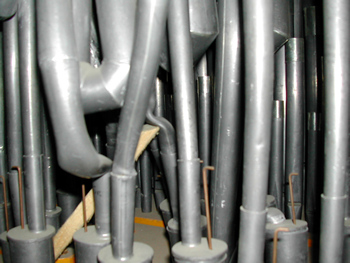
| Buckled metal pipes found during routine maintenance (Photograph by Harrison & Harrison Ltd) |
‘It’s a mystery’ is the understandable response of many churchwardens and organists in response to a problem occurring with the organ. If the problem results in a note sounding and refusing to go off, the impact of what could be only a small problem can be considerable. Pipe organs contain a great number of delicate parts behind an apparently impenetrable facade. In fact, after consideration of the complexity of even a modest instrument, the amount of regular and reliable service that can be obtained from most organs for an extremely modest amount of routine maintenance is remarkable. An organ is usually the largest and most expensive furnishing in a church and, properly cared for, a well-made instrument will give service for many years. Century-old organs in good working order are still relatively common.
To ensure the organ works reliably, some regular maintenance is necessary. Few parishes would question the need to service the heating annually; after all unreliable heating is distracting to the congregation. An unreliable organ can be just as distracting and regular maintenance is equally appropriate. A visit from an organ builder to tune the organ and carry out small jobs of routine maintenance can cost between say £60 and £200 pounds for an average church, which is a small amount in comparison with the cost of a major overhaul or restoration of many thousands of pounds. It is also tiny compared to the cost of a new instrument. Investment in regular maintenance is good for the organ, for the worship of the church, good for the morale of your organist and makes long-term economic sense. It is frustrating to play an organ this is not in good repair, but too often organists are provided with instruments that are not fully functioning and expected to make music with them. The fact that many skilled people manage to make a faulty organ sound acceptable is not a reason to put off for a few more months a much-needed visit from an organ builder.
WHAT ARE YOU PAYING FOR IN ROUTINE MAINTENANCE?
The organ is a wind instrument with a separate pipe for each note of each stop. A parish church organ may well contain over 1,000 pipes. Organ pipes are mostly made of a tin-lead alloy which is resistant to corrosion but sensitive to physical damage. Each pipe needs to be individually tuned to put the whole instrument in tune. An organ without reed stops (such as Trumpet, Oboe, Clarinet, Tuba) will usually stay in tune for at least a year: reed stops, however, need more frequent tuning because they react to temperature changes in a different way from the remainder of the instrument and may need tuning twice, and occasionally more than twice more than twice, each year. As the pitch of an organ is particularly sensitive to temperature change, tuning in the winter should only be carried out when the building has reached the temperature at which the organ would normally be used.
Organ tuners should make minor adjustments to the action as part of their work. It is good practice to have a tuner’s log book for the organist to record any faults in tuning or mechanism and for the tuner to note that he or she has attended to them. Minor faults, such as notes that are either not sounding or sticking on, or noisy wind leaks, should be taken up with the tuner in the first instance – it may be a problem that can be fixed inexpensively.
WHAT CAN YOU DO TO HELP
An
environment that is good for the organ will be good for many other furnishings
in your church and it is good practice to put time into achieving it.
Organs work best when kept away from extremes of heat and humidity and,
in particular, from rapid changes of heat and humidity. Organs in parts
of the world with stable temperate weather stay in good condition far
longer than those subject to extreme environmental conditions. Heating
systems that quickly raise the temperature of the church, especially those
that introduce large volumes of hot dry air, will increase the chances
of the organ being damaged. If the building is then left to cool rapidly
when the heating stops it will compound the problems. An organ is mainly
built of wood with many of the moving parts made of leather: neither of
these materials will respond well to extremely low humidity or extremely
damp conditions. The warm and damp conditions brought on by the use of
bottled gas heaters can promote mould growth in organs, as well as elsewhere
in the church, causing damage to painted surfaces, roof timbers and much
more. A sustained high temperature inside the church throughout the winter
can also be damaging, especially if the organ is in a gallery to where
the hot air from lower down has risen. The effects of continuous heating
can sometimes be reduced by the installation of an organ humidifier –
your organ builder will be able to advise you.
The regular maintenance of your church will benefit not only the organ but most other furnishings, and in the longer term will save large repair bills. A roof leak, possibly caused by one slipped tile, can cause expensive damage if it is over the organ, and a blocked gutter on the outside wall by the organ chamber is a potential source of expensive damage to the organ as well as the building. Windows in the organ chamber, like those elsewhere in the church, should be weatherproof.
Casual damage can be caused by other works in the church. Organs should be protected if decorators are working above them and when building works generate significant amounts of dust. Your organ builder will be pleased to advise. A few hours spent in providing suitable protection could save weeks (or months) of expensive cleaning. Using the inside of the organ as a cupboard to store cleaning materials, flower pots or unsold goods from the Christmas bazaar is not good practice and is potentially damaging in addition to being a fire risk; it will also make it more difficult to gain access to the organ for routine maintenance. Keeping the organ clear of junk will also help to discourage insects and rodents. Mice do find the wood and leather in the organ attractive, and the presence of woodworm should be checked occasionally.
Major changes in the building can also have an impact on the organ, as well as other aspects of the fabric. The installation of carpet can have a particularly detrimental effect on the sound of an organ, in addition to the problems to the building that can be caused by trapping damp in the floor under a foam-backed carpet.
ORGAN BUILDERS
It
is relatively easy to cause expensive damage to an organ and only suitably
qualified people should be allowed inside an organ. Organ builders, like
many other professionals employed by your church, have an accreditation
body, the Institute of British Organ Building (IBO). Accredited organ
builders have their work inspected every five years in order to maintain
their accreditation. It is important to employ an organ builder with relevant
qualifications and appropriate insurance against damage to the organ and
to your buildings. The IBO operates a complaints service in relation to
the work of accredited organ builders, and will act as an impartial arbiter
in disputes.
Recommended Reading
- Berrow, Jim and Norman, John, Sounds good, London 2002
- Bordass, William and Bemrose, Colin, Heating your church, third edition, London 1995
- Gwynn, Dominic, Historic organ conservation, London 2001
Useful Contacts