
Braving the Elements
Painting Outdoor Wood and Metal
Colin Mitchell-Rose
 |
||
We tend to think of paints and other finishes in terms of how they are applied to the interior or exterior of our homes; but paint has a valuable role to play in protecting and decorating garden buildings, features and ornaments. This brief article considers the uses of paint, in its widest sense, on the most commonly painted garden surfaces: wood and metal.
WOOD
Outdoor woodwork can have a very attractive, natural appearance but it is soon attacked by insects, fungi and mould and will decay into an unsightly and structurally unsound state. Depredations such as these are outside the scope of this article but there is another agent which attacks bare wood. The ultraviolet (UV) radiation in sunlight attacks the outer surface of wood, killing the cellulose and leaving a layer of grey dead cells. There are several long-established treatments that protect wood while still giving a clear finish, such as oils which ‘feed’ the wood and replace the natural oils bleached out by the weather. Varnishing wood can protect the surface from such weathering and from physical damage and often enhances its natural beauty. But all of these clear treatments will eventually fail as the UV radiation penetrates the clear coating, attacks the wood beneath and causes the resulting layer of grey dead cells to throw off any remaining varnish layers.
To prevent this happening, colour or pigment could be added to the oil or varnish to give a slightly coloured finish which reflects the UV radiation. ‘Earth colours (predominantly iron oxides) like ochre, umber or sienna are ideal since they are colourfast and unaffected by sunlight (1). These tinted oils, now usually called ‘wood stains’, penetrate the wood rather than forming a skin over the surface. They were popular in many gardens on the Continent, but were not widely used in the UK until quite recently.
Of course, the best way to prevent UV attack of wood is to add enough colour or pigment to make the varnish opaque; in other words, a paint. This forms a tough film which should adhere firmly to the wood but also move and flex with it. It should also have a certain degree of microporosity to allow water vapour to move in and out of the wood, while preventing excess moisture being absorbed into the wood.
 |
|
 |
|
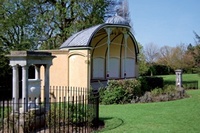
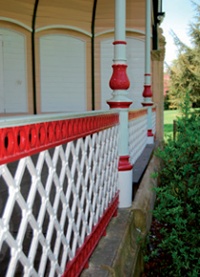
| A bandstand in Victoria Park, Bath, recently repainted in its original colour scheme. The paint surfaces provide protection from sunlight (UV radiation), rain, condensation and general wear and tear. (Photos: Lisa Oestreicher) |
Historically, the most important type of paint applied over wood used linseed oil (from flax) together with white lead (basic lead carbonate) as the pigment. The white lead not only gave the paint a nice creamy white colour which could be used as the basis for many shades; it also reacted with the linseed oil to give a wonderfully flexible film that adhered well to the wood while still allowing some microporosity. As the paint aged, the colour would mellow to a pale cream colour and the surface would lose its gloss to a low sheen or matt finish. This wonderful paint was widely used for many centuries but had one serious drawback. White lead is highly toxic and when absorbed, can build up in the blood stream with serious health results. During the last 200 years, a great deal of research has been devoted to finding a suitable alternative. For a while zinc oxide was used, but it was only in the 1950s, when the ‘brilliant white’ pigment titanium dioxide became available and affordable, that the use of white lead in paint virtually ceased. Today the use of white lead paints is restricted to the most important listed buildings (Grades I & II* in England and Wales, category A in Scotland).
Unfortunately, many of the modern alternatives to white lead and linseed oil paints have their own drawbacks. Although they dry more quickly and give a harder, glossier finish, they tend to become very brittle within just a few years. Wood absorbs and releases moisture from the atmosphere very gradually and this, together with temperature variations, causes it to expand and contract in size. To allow for this, any paint must have a degree of flexibility otherwise it will crack and flake off: an all too familiar sight on window sills where modern hard gloss paints have been used. That said, some very good exterior paints are available which retain their flexibility as they dry and age. Some of these use older, more traditional technology (though without the use of toxic white lead), while others employ the latest water-based emulsion technology to achieve long-lasting results. For garden structures such as glasshouses or orangeries where regular repainting is a particular problem, long service life will be of prime importance.
Because of questions over the continuing availability of white lead and recent changes in EU regulations over VOCs (‘volatile organic compounds’, which act as solvents), a series of independent exposure trials is planned which will, it is hoped, be funded by several major conservation bodies. The aim of these trials is to find a range of suitable alternative paints for exterior timber (and also to identify less suitable types). The trials should assist architects and specifiers in selecting suitable paint systems. It is hoped that the trials will start in early 2011; further information will appear on the website of the Traditional Paint Forum (www.traditionalpaintforum.org.uk) as it becomes available.
METAL
Many different metals are used in the garden; not just iron and steel, but also copper, lead, aluminium, brass and many other alloys. All are subject to decay to a greater or lesser extent and can require specialised treatment and painting. Iron and steel are probably the most common metals and both are very prone to corrosion when the hard strong metal reacts with moisture and oxygen from the air to become weak, friable and coated with unsightly rust. Sound preparation and the right paint can go a long way towards preventing this.
Good preparation is essential as any traces of rust still remaining on the metal will continue to corrode under any paint layer. For ornamental ironwork, particularly older, more delicate pieces, careful preparation is necessary to avoid any unnecessary damage. Shot blasting or a wire brush and hammer may well end up doing more harm than good. Any reputable restoration company or painter should be able to advise on the most appropriate methods from the wide range available.
 |
||
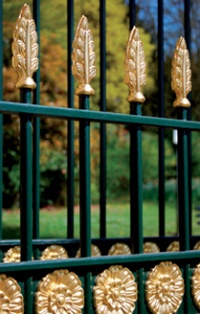
| Entrance gates in Victoria Park, Bath in their original 19th century colours: dark green with gilding. (Photo: Lisa Oestreicher) |
One advantage that metals have over wood is that they do not absorb moisture so they do not move nearly so much in response to temperature fluctuations. This means that the flexibility of the paint film is not as critical as it is when painting wood and a much wider range of paint types can be used. As well as modern hard gloss paints, it is possible to use high-tech modern two-pack coatings which will give an excellent service life. However, these will only work well if all of the older paint is carefully stripped off and the new paint applied to the bare metal as per the manufacturer’s instructions. This will lead to the loss of the previous layers of paint and all the history and information they contain. If it is decided that any sound earlier layers should be retained, then it is important to choose a new paint system that is compatible with the older layers. Many of the modern two-pack paints use powerful solvents that can soften or even strip off older paint layers. Again, a reputable restoration company or painter should be able to advise.
When painting metals, after good preparation, the use of the correct primer is just as vital. For iron and steel the traditional primer was red lead, but like its cousin white lead it also presents problems with toxicity. Modern metal primers use pigments such as zinc phosphate as a safer alternative. For other metals and alloys, the choice of primer can be a little more complicated. Some, including copper, zinc and aluminium, need a specialised two-pack primer; for safety always seek the advice of a reputable painter or manufacturer. Some metals such as brass or copper are often left unpainted and protected either with a clear lacquer or varnish or, as in the case of copper, left to weather to wonderful verdigris. This can sometimes be encouraged by the use of patination oils.
While the colours used in gardens and parks were often dictated by the ‘Estate colour’, railings and other ornamental ironwork were often painted in particular colours. Beginning in the 17th century, ironwork was usually painted with white lead in linseed oil but tinted with black to give a darker ‘lead’ colour. Later, a blue colour, using a finely ground cobalt blue glass called smalt, was very popular. Ironwork was sometimes painted in a stone colour to match the surrounding buildings. Technical developments allowed the use of green as a colour, either as a dark ‘bronze green’ colour or sometimes as an ‘invisible green’ to camouflage the railings against the background foliage. The use of black for railings does not, sadly, relate to the mourning of the death of Prince Albert as sometimes claimed, but, more prosaically, followed the introduction of modern faster drying gloss paints in which black pigments slowed the drying of linseed oil paints to a usable extent. Of course, there have always been those for whom the use of gold leaf (or gold paint) enabled an ostentatious demonstration of wealth.(2)
There are many other surfaces found in parks and gardens which need painting that have not been dealt with here. The painting of statues, both lead and marble, in polychrome colour was once popular but this is a specialised field best left to the experts.
There are certain principles that are true for all exterior painting and which are worth remembering:
- preparation is the key to a successful job; painting over rotten wood, peeling paint or rust is a waste of time
- seek advice from a reputable restoration or painting contractor or paint manufacturer; make sure you explain all the facts and circumstances so you get the correct advice
- establish a regular inspection and maintenance regime: a ‘stitch in time’ will save heavy repair costs later.
~~~
Notes
(1) Finely ground powders can be added to varnish to reflect UV radiation without visibly colouring or dimming the appearance of the clear varnish; these are often found in good quality marine, yacht or spar varnishes.
(2) For more information on the colours used in ironwork, see Patrick Baty’s excellent article in Traditional Paint News, Vol 3, No 1, 2010.
THE 2005 PAINT PRODUCT REGULATIONS |
Following a 2004 EU directive, the Volatile Organic Compounds in Paints, Varnishes and Vehicle Refinishing Products Regulations 2005 were introduced to limit the amount of volatile organic compounds (VOCs) such as white spirit and ethanol which a paint can contain. For the conservation of historic buildings, perhaps the most significant change affects the oil paints and varnishes which can be used to protect woodwork and metalwork. Since January 2010, when the final stage of the phased changes in standards came into force, the maximum VOC content of solvent-borne ‘interior/exterior trim and cladding paints for wood and metal’ is 300 g/l, and for varnishes and wood stains it is 400 g/l. Non-compliant products manufactured before 1st January 2010 are not allowed to be sold after the end of 2010. VOCs are a problem because they accelerate the rate nitrogen oxides react with sunlight to create ozone. Low level ozone can cause serious respiratory problems, particularly in the elderly and young children, and it is responsible for damage to crops, trees and biodiversity in general. Traditional oil-based paints and varnishes are diluted with organic solvents to control their drying and to reduce their viscosity, enabling them to be brushed on smoothly and easily. The oils, usually alkyd resins, dry through solvent evaporation and film formation. The latter occurs as a result of a complex process of oxidisation in which smaller molecules cross-link with the help of catalysts in the paint to form the long chains required for the paint (or varnish) to form a film. It is these films which bind the pigment together and exclude rain and condensation. Emulsions, in which oil droplets are carried as a suspension in water, form a film in much the same way, and some manufacturers are now supplying gloss paints which are water-borne. Others have reduced the VOC content by modifying the viscosity of the oils used so that they flow more easily with less solvent. Either way, the drying properties of the paint will be affected by the modifications, and this is likely to reduce the durability of the paint film. While traditionalists will inevitably view the use of an emulsion gloss with some suspicion, at this stage the paints have not been around long enough for us to be certain of their performance in use. The EU recognised that the new regulations could pose problems for historic buildings and vintage vehicles. The Paint Products Directive therefore included a provision for member states to introduce licensing schemes that would enable strictly limited amounts of non-compliant paint to be supplied for these uses. However, as Defra’s Guidance on Implementing the Paint Products Regulations in the UK explains; ‘because of the administrative complexities of setting up such a scheme and the burdens on those to whom it would apply, it has been decided not to do so, but to rely on local authorities taking a proportionate approach to enforcement’. NOTE: This summary was prepared by the Editor of The Building Conservation Directory, Jonathan Taylor. |
 |
| (Photo: Alex Hinds) |