
The 'Paxton' Pavilions
Joe Rowntree
 |
|
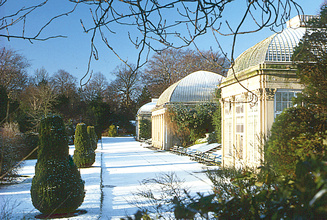
| The three curvilinear domes photographed on a snowy winter's day (Photo: Meg Jullien) |
Over the past eight years since the inception of the National Lottery and the introduction of the Heritage Lottery Fund, some major restoration projects have been enabled which previously could not even have been contemplated. One of the largest and most remarkable of these is the restoration of the Sheffield Botanical Gardens and the huge Victorian glass pavilions which stand at their centre, the Paxton Pavilions.
SHEFFIELD'S BOTANICAL GARDENS
The Sheffield Botanical and Horticultural Society was formed in 1833 to establish a botanical garden. Robert Marnock (1800-1889), who previously worked at Bretton Hall (now the Yorkshire Sculpture Park), won a competition to design the garden. In 1834 he was employed to implement the design and, as the first Gardens Curator, he managed the Botanical Gardens until 1840.
The design for the 19 acre site was revolutionary, adopting the new style known as 'Gardenesque', where each plant was displayed individually for its best attributes or grouped together within organically shaped but angular beds. Marnock's plan had a strong T-shaped junction on a south facing slope ideal for a focal point such as a glasshouse, and the idea took root.
THE GLASS PAVILIONS
A
second national competition was held in 1834, this time to design a glasshouse
for the Sheffield Botanical Gardens. Sir Joseph Paxton (1803-1865), who
was later to design the Crystal Palace, acted as one of the competition
judges. Although his name has become firmly attached to the pavilion,
there is no evidence that Paxton was otherwise involved, but he was the
Duke of Devonshire's head gardener at nearby Chatsworth House and he did
have an obvious interest in glasshouses.
Robert Marnock won the first prize of £10 but his design appeared too complicated to construct and the glasshouse was in fact designed by Benjamen Broomhead Taylor a City Architect and winner of the £5 second prize. It was opened in 1836, the same year that construction of Paxton's Great Conservatory at Chatsworth House began.
BB Taylor's design consisted of a simple Palladian arrangement of a central pavilion with smaller pavilions on either side connected by ridge-and-furrow glasshouses. Further ridge-and-furrow extensions were added to the pavilions 12 years later. Structurally it was a pioneering application of wrought iron and glass which brought together developments made by others, notably JC Loudon and Richard Turner.
The three pavilions were constructed with curvilinear wrought iron and glass domes supported by the fine ashlar columns which formed the outside walls. None of the original glazing has survived, but the domes were probably constructed with cylinder glass. The wrought iron glazing bars, which have survived, were based on a system invented by JC Loudon, although BB Taylor managed to achieve a span greater than the maximum set by Loudon by incorporating tie bars.
The ridge-and-furrow system used for connecting the pavilions and for the later extensions was also being developed by Loudon as early as 1816 and later perfected by Paxton. Its advantage was that the roof planes were angled so that the rays of the midday sun fell on the panes of glass obliquely, dissipating their strength through reflection and the depth of the glass, while the morning and evening sun struck at an angle perpendicular to the glass, passing through more directly. As Paxton explained in a lecture given to the Society of Arts in London, when correctly oriented, this design produced greatly improved growing conditions.
The cost of glass fell when the duty charged on it was removed in 1845, providing an incentive for the production of larger panes of machine-made cylinder glass. This enabled later glasshouses such as Glasnevin, Belfast and the Palm House at Royal Botanic Gardens Kew, to be built using fewer glazing bars, increasing the light levels and encouraging better plant growth.
PLANTING WITHIN THE PAVILIONS
Originally,
the central pavilion was a tropical palm house, with the two ridge-and-furrow
glasshouses and the smaller connecting pavilions housing temperate plants.
John Law, the Gardens Curator after Robert Marnock, produced a catalogue
in 1847 of the prized plants contained within Sheffield Botanical Gardens
and a further catalogue in 1849 of more general collections contained
within the Botanical Gardens. The Friends of the Botanical Gardens Sheffield
have obtained a copy of the 1849 catalogue but a copy of the 1847 catalogue
has yet to be found.
In 1850 the giant water lily Victoria amazonica was flowered in the west extension. Drawings of the plant made by early botanical travellers had stirred the imagination of Victorian collectors, although it was not until 1837 that the first live specimens were brought back by Sir Robert Schomburgk, exploring British Guinea for the Geographical Society. It was the great challenge of the Victorian horticulturist to persuade it to bloom. Seed planted at the Royal Botanic Gardens Kew in 1846 failed to prosper but by the 1850s proper pond houses had been built at Chatsworth House, Syon House, the Royal Botanic Society at Regent's Park, the Veitch's nursery at Exeter and on the Dalkeith estate, as well as at Sheffield Botanical Gardens.
THE DECLINE
By
1898 the popularity of the Botanical Gardens was fading. The Horticultural
Society asset-stripped the gardens, selling off prized collections to
raise funds. They even considered selling the Botanical Gardens for building
land. Thankfully, the Sheffield Town Trust stepped in and paid off all
the shareholders. Nevertheless, the ridge-and-furrow extensions had to
be demolished because they were considered to be unsafe, and the remaining
sections were demolished in the early 1900s because the timber components
had decayed badly, particularly under the valley gutters. Horticultural
apprentices built a colonnade between the middle and east dome in the
1920s to provide shelter for the garden visitors.
Sheffield City Council took on the management of the Botanical Gardens in 1951. By then the three domes were in extremely poor condition and in danger of being demolished. The City Council immediately took steps to preserve them. Repairs included the replacement of a number of the wrought iron glazing bars with aluminium, replacement of broken panes of glass, repair of the stone columns and the application of a protective layer of mortar to the stonework below. In 1961 the east dome was made into an aquarium and, a few years later the middle dome was converted into an aviary leaving only the west dome as a plant house. Unfortunately although the restoration efforts were undertaken in good faith and prolonged the life of the glasshouses, some of the techniques used have harmed the structure. In particular, the stone masonry was covered with an ordinary cement render with the inevitable result that the stone could no longer breathe, causing it to decay; and the valley gutters were relayed with asphalt, trapping moisture against the wrought iron causing the feet to rust away.
The combination of errors made in the 1960s restoration was compounded by poor maintenance. By the mid 1990s plants were growing out of the top of the walls of the domes, the stone pillars on the outside of the building were crumbling, there was extensive corrosion of the glazing bars, and much of the glazing had been smashed. Funding cutbacks over the past 20 years had also taken their toll throughout the Botanical Gardens and a substantial investment was required for their repair, restoration and regeneration, which was far beyond the means of the City Council.
GLASS DOMES
Work
commenced in July 2001 when the contractors, Weaver Construction Limited
(now Strata Construction Limited) started work by gutting the building,
removing window frames, doors and all internal fixture and fittings.
The repair work to the pavilions was subcontracted to Shepley Engineers Limited in Barnsley who have also worked on Sefton Park and Glasnevin. The glass from the domes was removed before the wrought iron (and aluminium) structures were unbolted and lowered to the floor. The base plates were removed from the top of the walls on which the domes sit and were laid out on a factory floor. Each piece of the domes was restored and then fixed to the base plate in the workshop, enabling adjustments to be made prior to reassembly on site. The domes are being reglazed with hand blown cylinder glass made in France by one of the few remaining companies in Europe capable of making glass by the methods used at the time. For safety reasons dictated by new building regulations, toughed glass will be used for the remainder of the pavilions and the ridge-and-furrow. Air vents that were not part of the original design are to be incorporated into the domes to provide better growing conditions - a modification agreed by English Heritage.
THE RIDGE-AND-FURROW SECTIONS
The
colonnade which had replaced one of the original ridge-and-furrow links
served little practical value and, in particular, the lack of a link to
the west prevented the use of the three pavilions as a unified whole,
threatening its viability. The decision was taken to remove the colonnade
and to construct new interconnecting glasshouses. The question was what
should the new section look like?
Modern conservation philosophy frowns on speculative reinstatement of missing components and, in this case, there was insufficient evidence to support an accurate reconstruction of the original. However, the horticultural advantages of a ridge-and-furrow form remains as valid today as it did in 1836. Sheffield City Council's design team therefore concluded that a modern version of the original structure was most appropriate, using a light and unobtrusive steel structure to span the available space, with structural gutters supported on load-bearing columns which would also serve as rainwater pipes, as originally built. The design also had the advantage that condensation on the underside of the glass roof would drain into the gutters.
It was also decided to use lead sheathed steel patent glazing bars which allow easy reglazing, are of proven longevity in this environment, and are also very much in keeping with the historic nature of the site. Full-height glazed timber doors were chosen for the front façade to integrate with those of the pavilions.
EXTERNAL STONE WORK
When
the pavilions were built, the building stone of the supporting columns
had been incorrectly laid with its 'bedding plane' (the plane in which
the sedimentary layers of the rock had formed thousands of years ago)
oriented vertically, so that stresses ran along the bedding plane, not
across it, causing it to sheer. Where repairs had been made in the past,
the hard cement render used had caused further deterioration. Part of
the repair work has involved slicing away the front of the stone and replacing
it with new stone. New pilasters have been also been hand carved and lowered
into place. All the hard cement repairs and render have been removed and,
where necessary, they have been replaced with an appropriate lime-rich
mortar.
ENVIRONMENTAL CONTROLS
There
have been considerable improvements in climate control since the early
days of opening and closing air vents and stoking boilers. The pavilions
will be totally automated except for the front windows, the sliding doors
in the ridge-and-furrow and the watering regime. Climate control equipment
will be housed in a new building behind the middle dome. Water will be
collected from the roofs of the ridge-and-furrow and stored in underground
tanks to be used as required in the pavilions and around the Botanical
Gardens.
THE GLASS PAVILIONS' INTERIORS
Many
historical photographs of the exterior of the glass pavilions have survived,
but none of the interior. There is no documentary evidence for the original
interior layout. A new layout has therefore been designed incorporating
a meandering walk among raised beds and the floor of the pavilions has
been lowered to accommodate access for disabled individuals and wheelbarrows.
FUTURE PLANTING PROPOSALS
The
glass pavilions will be planted in Autumn 2002. The collections will feature
plants from the Southern Hemisphere. The eastern dome will house an information
point and planting from Asia around the edge and in the central bed. In
the linking ridge-and-furrow there will be two central beds with plants
representing Himalayan and Canary Island floras. The central dome will
feature the Australasian flora around a central fountain, as seen in the
artist's impression. In the following ridge-and-furrow the planting beds
will not be raised and will contain plants representing the floras of
New Zealand, Mediterranean and America. The west dome will also house
plants from the African flora. Plants used by mankind - ethno-botanical
plants such as coffee, bananas and many others - will also be grown.
The glass pavilions are an architectural treasure. For them to have survived is astounding.
The Heritage Lottery Fund has given the Botanical Gardens a fantastic opportunity to undertake an authentic restoration, adapting the design to accommodate the needs of the garden visitor and modern management with reduced labour input. It is hoped that the current restoration has rectified mistakes made in previous repairs and in the original detailing. The future of the pavilions is now assured and, provided regular maintenance is undertaken, it is hoped they will never again require such extensive restoration.
~~~
Recommended Reading
- J Carder, The Sheffield Botanical Gardens: A Short History, 1986
- GF Chadwick, The Works of Sir Joseph Paxton 1803-1865, Architectural Press, London, 1961
- GF Chadwick, The Park and the Town, Architectural Press, London, 1966
- J Hix, The Glasshouse, Phaidon, London, 1974
- JC Loudon (ed), The Landscape Gardening and Landscape Architecture of the Late H Repton, London, 1840
- R Marnock, Floricultural Magazine, Vol 1, Sheffield, 1836
- M Woods & AS Warren, Glass Houses: A History of Greenhouses, Orangeries and Conservatories, Rizzoli, New York, 1988