
The Fire at Peterborough Cathedral
Julian Limentani
 |
|
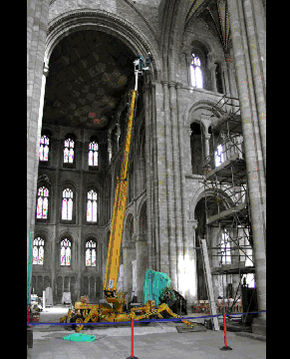
| The main walls being vacuum cleaned from the cherry picker |
Early one evening in November 2001 a stack of plastic chairs stored behind the choir stalls at Peterborough Cathedral burst into flames. The fire brigade was immediately called after verger Nigel Long spotted the flames at one of the cathedral windows. The blaze was quickly extinguished, but not before the fire had destroyed part of the organ casing and one window, and had sent a dense pall of smoke through the building, covering every surface. Twelfth century arcaded stonework at the seat of the fire was also badly damaged when water from the firefighters' hoses caused it to cool rapidly.
It is believed that the fire was caused by someone who lit a votive candle and set in a pile of plastic chairs during evensong. It would have taken about half an hour before the plastic caught fire.
It might have been even worse.
At 8.30am the following morning a staff meeting was held, primarily to decide whether the cathedral would stay open. It was decided that it would, if only to a limited extent, and that all scheduled services would take place, except for a large memorial service later that day.
By 9.00am it was possible to make a tour of the building to see the extent of the problem. It became obvious that there was only limited physical damage to the cathedral structure at the east end of the north aisle, where the window had lost most of its glass. Below it the damage to the arcaded stonework was found to be superficial but significant, destroying some fine carving, and the screen behind the choir organ was charred to a depth of half an inch. There was also quite a lot of water in this part of the organ. About 200 of the plastic chairs had been lost, together with a few other pieces of furniture, all of which were modern.
The major problem was the soot, which was everywhere from the roof voids down to the crypt. As the scaffold was still in place from recent works, it was possible to take a close look at the painted timber ceiling of the nave which dates from 1220. Phase four of five phases of conservation work to it had just been completed. This too was found to have a thick coating of soot over the entire surface, and all of it would need to be cleaned again. This was most disheartening but the soot seemed to respond well to cleaning with the sponges that had previously been used for this purpose.
While the Dean spent the day in the cathedral giving one interview after another, the conservation team was allowed to get on with the work of recovery. We were all in a state of shock which must have lasted for at least a week after the fire.
Later that morning the cathedral insurer, Ecclesiastical Insurance Group (EIG), arived for a meeting with the loss adjusters that they had already appointed, Cunningham Lindsey. Many hours were then spent with them, first agreeing that the cathedral was fully insured, and then discussing how the restoration should proceed. I, as cathedral architect, was keen to retain as much control over the work as possible. Much of the cleaning would need to be done by conservators, and it would be important to be able to have a direct relationship with them rather than dealing with them through a main contractor. The relationship would be supported by engaging a clerk of works to help supervise and co-ordinate the contracts.
The insurer agreed to this probably because it would be cheaper in the long run. This it has indeed proved to be so, although it meant more work for me.
The result of working this way meant that there we be about 12–15 different contracts, and we would have to go out to tender on all of them. Then, having prepared all the tender documents, a snag arose: the Health and Safety Executive (HSE) were not happy. Their representatives wanted a main contractor, and would not budge on this. To get around the problem it was decided that the Dean and Chapter would be the main contractor with a ‘site co-ordinator’ acting as their representative on site. This the HSE accepted and since then all has worked well and smoothly.
Geoff Sayers was appointed as the site co-ordinator. He was a member of the cathedral’s congregation who had run his own building firm, and was familiar with this kind of work. He had also been a retained fire fighter in the past, indeed, head of the local volunteer fire brigade.
A planning supervisor was also appointed, who prepared the Pre-Construction Health and Safety Plan, to which Sayers responded with the Construction Health and Safety Plan, which was modified for each sub-contractor and has proved to work well.
During the first morning after the fire a local firm was engaged to clean the floor, furniture and lower walls of the nave so that services could be held. The firm, suitably named ‘Reclaim’ came in immediately and worked from that day, which was a Friday, through until Saturday evening to enable a large service to be held on Sunday at which the Duke and Duchess of Gloucester were present. This was a very positive event which helped to give everyone at the cathedral the strength to get on with the job.
One of the first things to be organised after the fire was a chemical smoke analysis in order to find out how much damage it could do. Luckily, the chairs which had burnt were made of polypropylene. It transpired that soot from this material has a neutral pH in the range of 6–8. Had it been timber burning, the soot would have been acidic. Soot from polychlorides (uPVC for example) would have been worse still. This was particularly important as all the ceilings are of timber and several are painted: acidic soot would have caused a lot of damage to them.
Next, various conservators were invited to report on the various items in the cathedral which had been affected so that I could decide what needed to be done first. These included Richard Lithgow to advise on wall paintings and painted timber, Hugh Harrison on timberwork, Trevor Proudfoot on stonework, Richard Green on glazing, Caroline Bendix on books and parchments, and The Textile Conservation Centre on tapestries and textiles such as altar frontals and vestments. Once all these reports had been digested, it was possible to determine the order in which the work should be done. The first major thing to be cleaned was the ciborium, the canopy over the high altar, as this richly sculptured feature included a lot of alabaster, a material which tends to absorb soot quickly. The ciborium was then kept covered while all the work above it was carried out. Otherwise, cleaning has generally proceeded from the roof spaces downwards.
It was decided early on that there should be a small team to oversee the progress of works and decide policy. The team consisted of the loss adjuster, a member of Chapter, the chapter clerk, myself, the quantity surveyor, the site co-ordinator, and the planning supervisor, making a total of seven. This was a small manageable team which worked well together, so that meetings lasted about 1-112 hours, initially on a monthly basis, but latterly on a two monthly basis. On several occasions a member of the insurance company was also present.
The Cathedral has had a good working relationship with the insurer and its loss adjuster from day one. They have been very supportive and have paid out for the works on a regular basis keeping the cathedral financially solvent.
One of the things agreed early on with the insurer was that anything that was required for the Cathedral to do in order to obtain permission for the work would be paid for by the insurer. Anything else, like additional work not necessary in order to clean the area, would be paid for by Dean and Chapter. So if paint or loose plaster needed to be stuck back before it could be cleaned, the insurer would pay. However, when the Presbytery bosses were found to have some dubious tenons, the Dean and Chapter paid for all the bosses to have stainless steel straps added to them so they could not fall. This has been a fairly easy demarcation both to work with and to verify.
When a number of sub-contractors work on site together, thorough co-ordination is crucial. As a result, the site-co-ordinator has been on site for short periods almost every day for the past two years and has carried out the liaison work superbly, not only coordinating contractors so that they did not get in each others way or undo what someone else had just done, but also by liasing with the cathedral staff, and in particular, the vergers. You can imagine the difficulty in keeping the life of the cathedral running while major building works are ongoing. Every area of the cathedral has been scaffolded at one time or another, including a major scaffold in the central tower from which flying scaffolds were built to clean the presbytery and transept ceilings. This scaffold was in place for about six months. Over 200 tons of scaffold has been moved in, moved around and eventually moved out, with at least three scaffolders permanently at the cathedral for these two years. Organising the installation and removal of each scaffold for the appropriate time has been quite a feat. To do this we have had regular meetings with the scaffolders and other contractors.
The firm of scaffolders, Merlin Services Ltd, has done a tremendous job during the period concerned, and has only dropped one beam in the whole time. This accident resulted in minor damage to the cathedral floor, but more significantly, changed the working practices so each piece of tubing or beam was from then on clipped on to the hoist to raise or lower it – a system which must be all but foolproof.
Another thing that has helped the project run smoothly is a diary which is produced by the Cathedral and circulated to each subcontractor on a monthly basis. It now goes to a member of the conservation team in addition to cathedral staff. A diary meeting is held first thing every Monday morning at which everything is gone through and events highlighted. I have been present at these meetings over the past two years and have been able to keep cathedral staff informed as to what work was happening and where, so any problems that might arise could be ironed out in advance. I have also been asked, as the vergers are, to comment when events were being booked, as to what impact, if any, it would have on the works.
With this intensive work going on, communication has been of major importance. On the whole, things have worked well except for one incident when the BBC caused problems by trying to change things.
One other area in which we have learnt a lot is housekeeping. It is very easy to leave something around just because it will be used in a few days. However, it is important that everything should have its place, preferably locked away, and when not in use, it should be in its place. There should be a register of all items of furniture and other items and where they are stored.
The other important aspect of housekeeping is rubbish. All rubbish in the cathedral must be cleared at the end of each day and all waste paper bins should be emptied, as arson is the most likely cause of fire at low level. The rubbish must then be kept well away from the cathedral so that, if it is set on fire, it cannot do any harm. Contractors’ rubbish and indeed equipment is the most difficult thing to keep track of, not least to make sure it is not blocking either a doorway or an escape route where it can cause either a fire hazard or an escape hazard. This is an area where continual vigilance needs to be maintained. Ignoring it can be fatal.
For many years the Cathedral has had a fire safety committee which meets twice a year. On it are heads of departments, the shop and the café, the head gardener, the estates manager, vergers, myself, and representatives from the fire brigade and the ElG. Through this committee we have steadily tightened up on safety and encouraged the fire brigade to carry out familiarisation exercises at the cathedral which they do regularly, with all the different watches being involved. These exercises proved very useful as members of the brigade knew exactly how to vent the smoke out of the building and which doors to open when fire struck.
Over the years the cathedral’s fire detection system has steadily been improved. Further improvements are again being made this year, and the Cathedral has tried to implement every recommendation made by the fire brigade. We have also tried to have realistic evacuations, despite the clergy’s resistance. So far we have only succeeded in having one, and this was before the fire. The evacuation was very instructive and everyone learned a lot. More are now being planned for larger services such as a Sunday Eucharist.
To conclude, for a smooth recovery from a disaster, the most important requirements are good communications and constant vigilance.