
Evaluating English Pews
Informing the Re-ordering Debate
Charles Tracy
 |
||
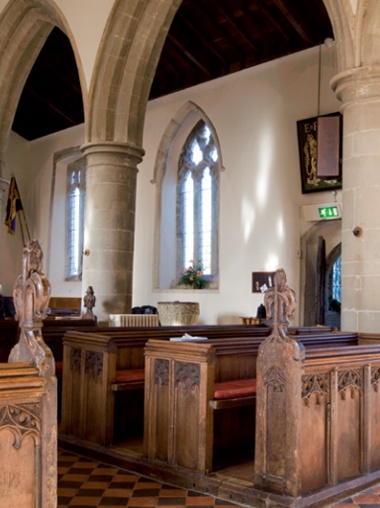
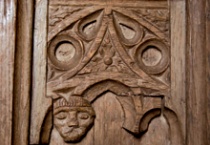
| St Mary's Church, Haddenham, Buckinghamshire (above) and pew detail (below right) |
Describing the changes that were made to English parish churches over 100 years ago, Frank Howard and Fred Crossley wrote:
It is amusing to note how, when an almost complete clearance of the old benches has been made, the few survivors have been relegated to the rear [of the church] for the use of the poorer parishioners, while the aristocracy of the village use the new and hideous seats, or naked chairs, which have taken their place.
This somewhat jaundiced statement was published in 1917 as the wholesale or partial destruction of several of the finest Gothic cathedrals in northern France, along with their historic furnishings, was taking place. The events described by Howard and Crossley and those occurring in First World War France retain a certain currency today. They represent the two extremes of church furnishings lost either voluntarily by those responsible for them or violently against their will. Of course, these are not new concerns; English parish churches have been subject to decay, destruction and re-ordering since the day they were built.
Naturally, a furniture historian deprecates the degradation of a church’s historic environment whatever its cause, but sometimes the evolving liturgy, and perhaps the very survival of the building as a functioning space, has to take precedence. Thankfully, churches continue to be visited by all manner of folk, and church tourism makes a financial contribution to the upkeep of many of them. Moreover, most clergy are aware of their responsibilities in caring for an outstanding collection of historic furnishings.
If, for any number of liturgical or practical reasons, a parish decides that it needs to move or remove an object or group of objects, specialists can be called in to evaluate the artefacts concerned. The clearer understanding of the historical and artistic significance of a church’s furniture that such experts can provide is vital to an informed and sensitive reordering debate.
The three recent case histories discussed below may provide some insights into the delicate and sometimes controversial process of evaluating church furniture. People are often surprised at the specimens of ecclesiastical joinery that are sometimes singled out for preservation. Historicity, artistic quality and conservation are not mind-sets readily accessed by everyone, but, in combination, they will reveal the kernel of a robust significance rating.
 |
|
In general, parishes are unlikely to seek to remove objects of well-established historical or artistic importance. The churchwardens of Fressingfield or Ufford in Suffolk, or Alternan in Cornwall will know that permission for the removal of their benches would never be granted. As objects of considerable pride in the parish and beyond, their presence is integral to the way that parishioners and visitors experience and enjoy these churches.
More problematic are the sets of furniture which could be designated as having considerable significance or some significance. In these cases there is likely to be a high restoration content. After 400 years or so of constant use, even with regular maintenance and repair, original benching would become completely unserviceable.
A valid significance rating usually hinges on an archaeological evaluation of the quality and authenticity of the furniture en masse. A sound judgment requires the assessor to burrow beneath the carapace of the furniture’s design and decoration. A good bench is a satisfying blend of architectural design, sculptural ornament and skilled joinery. It incorporates several different components: bench-ends, seats, seat backs, and fronts. Joinery principles are a key factor in a value assessment. In the highest ranked examples, the quality and refinement of the joinery should be on a par with the design and decoration. If a bench-end is decorated, the quality of its carving is as important as its subject matter and iconography. Heraldry on benches can open a window onto patronage and date of manufacture, and supplement the body of information upon which a rating can be based. A grasp of the maker’s background, affiliation and level of ability can also be illuminating: the finest church furniture is the product not only of artful execution but also of access to specialist knowledge, aesthetic sensibility and exceptional design skills. A specialist assessor, weighing all these factors together should be able to establish whether the furniture was made by an urban or itinerant workshop, or by the village carpenter.
Ancient benches are nearly always a patchwork of historic restoration, the quality of which can be variable. The ubiquitous Victorian and early 20th-century refurbishments of our forefathers usually set a high standard in competency and discernment. At that time great efforts were usually made, as far as contemporary tools would allow, to follow the original construction principles, even when it was feasible only to retain a few of the ancient components. One could describe this factor as ‘historical integrity’.
The first of this article’s case studies concerns St Mary, Haddenham, Buckinghamshire. Here the monumental late 13th-century village church was found to be still almost fully pewed-out. The parish had proposed to remove most, if not all, of the nave benches. It was suggested that some of the oldest pews could be retained, by being placed ‘either along the side walls or along the side of the chancel area’. In fact, they were all of the same age, and comprised a complete set, formerly en suite with the displaced chancel screen. A compromise along these lines is often proposed, but, in practice, is rarely satisfactory.
 |
||
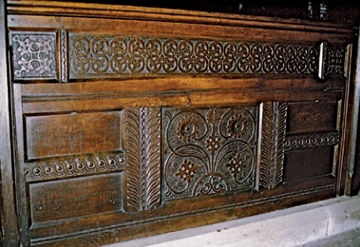
| Decorative 17th-century panel assemblage in the chancel choir-stall desking at St Andrew, Kildwick, West Yorkshire (Photo: Charles Tracy) | ||
 |
||
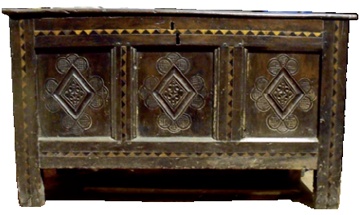
| Oak chest at St John the Evangelist, Leeds (Photo: The Churches Conservation Trust) |
It was calculated that the nave seating capacity would originally have been in excess of 274 places. Given that the parish population in around 1525 was probably little more that 100, one would wish to investigate this historic gross over-provision.
The benches in the smaller eastern blocks of the nave showed more evidence of restoration than those in the western block, which is, perhaps, not surprising. Many are wholly 19thcentury replacements. A major refurbishment was carried out in about 1860, when the central and side aisle nave flooring was replaced by the red and black encaustic tiles that survive today. The arcaded desk-fronts at the head of each block, as well as the rear seat-backs of both blocks, were mostly authentic, with their panels interspersed with plain stiles and tracery consistent with late 15th-century designs.
To the untutored eye this might seem to be something of a hodge-podge, but the quality of construction and design of these early 16th-century benches was exceptionally good, and markedly better than that found on most other pews of this date in the same region. It was often necessary to crawl around underneath the benches to assess them, but the joinery practices these efforts revealed were quite sophisticated. They were also an advertisement for the best and most sensitive kind of Victorian restoration. After 500 years the pewed-out nave was still virtually complete, with the central portion of the coeval chancel screen surviving, albeit removed to the west end. The decorative carving on both benches and screen was found to be still completely Gothic in form.
The other two case histories lie on either side of the Pennines. St Andrew, Kildwick, West Yorkshire, possessed a plethora of pew and pew-associated timberwork, most of it ex situ. Portions of the mid 19th-century benching at the front of the nave, which the parish wished to remove along with the 20th-century benching behind it, incorporated decorative panels from the now almost wholly destroyed 17th-century box pews. The chancel choir benches and stalls, which were again a mixture of 17th and 19th-century components, were also due for removal. They contained on their fronts more of this important collection of 17th-century West Yorkshire decorative panelling from the same source. Such incorporation is a good example of the Victorians’ desire to conserve the art of the past.
It is not possible, in the space of this article, to do justice to Kildwick’s rare and charming Eltoft family pew of 1633, but, in passing, a quotation from Jonathan Swift’s withering couplets on such structures, cannot be resisted:
A bedstead of the antique mode,
Compact of timber many a load,
Such as our ancestors did use,
Was metamorphosed into pews;
Which still their ancient nature keep
By lodging folks disposed to sleep.
With regard to the implications of the reordering proposals at Kildwick, it was important to weigh-up the value of this collection of vernacular 17th-century decorative panelling, incorporated in the assorted mainly 19th-century furniture forms. The latter, per se, are of unexceptional artistic value, but, perhaps, deserved to be retained mainly for their utilitarian function as display frames. The same can be said of the mid 19th-century nave front benching, with its display of 17th-century panels. The rest of the nave benching was well made, functional, but of little intrinsic interest.
Assessing the significance of this eclectic assortment of pews and congregational benching was challenging, but it was clear that the dismantling of the later panel frames would have put at risk the conservation of this uniquely important collection of regional vernacular carved panelling. It is only because this material had been reused in this way, as part of the church’s furnishings, that its art-historical value had been overlooked. Such inspired incarceration had saved it from destruction.
The catalogue of an exhibition of oak furniture from Yorkshire churches held at Temple Newsam in 1971 demonstrates the high quality of much of the Kildwick material. The framed three-panelled oak chest from St John, Leeds, which was shown on that occasion, although similar in design, is, in fact, of inferior quality to the chest at Kildwick. The Leeds chest has similar foliate crosses within a lozenge with exterior lobes, but the latter are cross-hatched, whereas Kildwick’s were spiralled. Cross-hatching was not found at Kildwick, although there was some inventive stippling, which probably indicates an early 17th-century date. The different dated inscriptions on the Kildwick panelling, meanwhile, demonstrate that the former box pews were supplemented throughout the 17th, 18th and 19th centuries.
Kildwick Church, then, contains a superb array of classically-derived, as well as plenty of pseudo-naturalistic, ornament. It is a veritable treasury of Yorkshire decorative vernacular wood carving, mainly from throughout the 17th century. As such, it is an important cultural resource which deserves to be better known and more widely studied. With the help of the inscriptions and a comparative analysis, it should be possible to create from this remarkable collection an invaluable chronology of the regional ornament style for the period.
 |
 |
|||
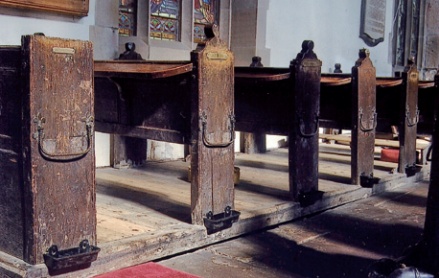
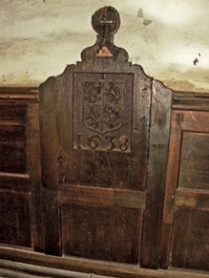
| Above left: St Mary the Virgin, Deane, Lancashire; view of the north aisle benches from the west (Photo: Charles Tracy); above right: family pew-end at St Mary and All Saints, Whalley,
Lancashire displaying the coat of arms of the
Sherburnes of Stoneyhurst and dated 1638
(Photo: Clifford Ball) |
||||
And so, finally, to St Mary the Virgin, Deane, near Bolton, Lancashire. For most of its medieval life this ‘long, low and embattled’ church was a modest chapel of ease, subject ultimately to Whalley Abbey. The church was fully pewed-out with a mixture of oak benches of the same design but of two different dates, the later being early 19th-century. The original bench-ends and seats could be recognised by the thicker scantling (or cross section) of the timbers, and from the fact that they were hand, as opposed to machine, finished. The profile of all the bench-ends was a characteristic pair of reversed scrolls, with a three-quarter round moulding at the top and simple round mouldings on each side. The two campaigns could be recognised most easily from an inspection of these bench tops. The later benches must be the product of the documented 1833 re-ordering, some of them with brass plates engraved in a copper-plate hand with the name of the lessor of a particular family pew. They also have typically Victorian decorated brass stays and metal troughs (now painted) attached to the ends for the storage of umbrellas. Of the 98 extant benches, 54 are more or less ancient. Unlike the carved ends at Haddenham, Deane’s bench-ends were plain.
The call for a significance analysis in this case was prompted by the parish’s proposed reordering of much of the furnishings. There had been a discussion about the approximate age of the older benches, with proposed datings ranging from late medieval to 17th century. In fact, research has turned up another church in Lancashire with a set of benches executed by the same workshop. It is at St Mary and All Saints, Whalley, where the suite of furniture includes the carved arms of the Sherburnes of Stoneyhurst on a bench-end originally near their family pew and now mounted on the church wall. Conveniently, this is prominently dated 1638. Whether the link with Deane is coincidence, or in some way related to the church’s medieval ties with Whalley Abbey, we shall never know. The pew sets are not quite identical. At Whalley the profile of the bench-end tops has an extra roll moulding.
With the 1833 cloned 17th-century pews at Deane, we find a nice example of the Victorian historicising tendency, this time applied to a set of early-17th-century benches. By dint of careful observation and research, the argument over dating is settled, and an attractive, although not aesthetically outstanding, set of furniture is found to contain an unexpected historical significance. The decision that is finally taken in Deane’s case should now, at least, be better informed, if no easier to take.
~~~
Recommended Reading
- Margaret Aston, ‘Segregation in Church’, in WJ Shiels and D Wood (eds), Women in the Church, Studies in Church History, Vol 27, Ecclesiastical History Society, Oxford, 1990
- J Charles Cox, Bench Ends in English Churches, OUP, Oxford, 1916
- Fred Crossley and Frank Howard, English Church Woodwork, Batsford, London, 1917
- Arthur Gardner, Minor English Wood Sculpture, 1400-1500, Tiranti, London, 1958