
Repairing Historic Roof Timbers
John Hoath
|
||
|
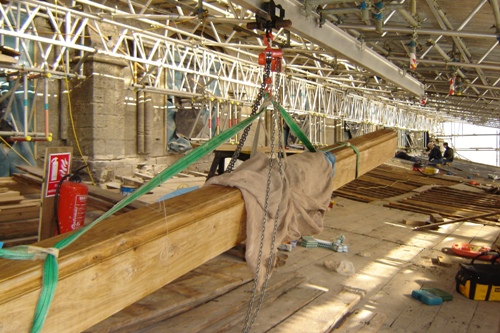
The repair of structural timbers in historic buildings, and especially churches, can be demanding and controversial. Most church roofs are visible from below, they are often of considerable historic and aesthetic significance, and all demand a thorough understanding of the principles and techniques involved in order to effect a suitable repair strategy. This must not only successfully restore the structural integrity of the timber framework, but it must also satisfy complex aesthetic and historical requirements.
Despite appearances, much of the timberwork on view in a typical parish church is likely to be of Victorian origin even if the church itself is medieval. In some cases the timbers will have been hand worked or wrought, salvaged from earlier work and reused, usually during some drastic restoration. In other cases the timber will be found to have been hewn using machinery contemporary with the restoration, in some cases from the earliest days of the industrial revolution.
The choice of repair type needs to take into account the character and the age of the original timber to be repaired, and it should be sympathetic to the actual building itself as well as to the repairs that may have previously been carried out during an earlier repair programme. All contribute to the historic interest of the building's fabric.
Effective timber repair needs careful investigation, specification and execution.
TYPICAL PROBLEMS
Timber failure may be attributed to insect infestation, fungal attack, or shakes and splits caused during the drying out of unseasoned timber.
The three most common repair types would usually deal with:
- beam end repairs, due to timber being embedded or in contact with damp masonry
- losses of cross sectional area due to fungal or insect attack
- longitudinal cracks appearing due to changes in moisture content of the timber.
The repair regime will usually be decided on through consultation with experienced practitioners and professionals.
Repair can take the following forms:
- like-for-like repairs using timber from an appropriate source
- 'honest' repair, where steel strapping or plates are used
- resins, which although controversial in certain circumstances, can have a place.
LIKE-FOR-LIKE REPAIRS
The choice of repair will depend largely upon discussions over the exact philosophy and approach taken to each individual project and whether a decision has been made to repair, restore or conserve. There are many ways of repairing timber structures and sometimes a mix of repair types may be appropriate.
When carrying out a repair using timber it is important to select material of the same species, preferably from a reputable source and, most importantly, with a moisture content which matches to within one per cent that of the timber being repaired. If this condition is not met, the different drying rates of the timber may cause problems with the repair joint.
 |
 |
|
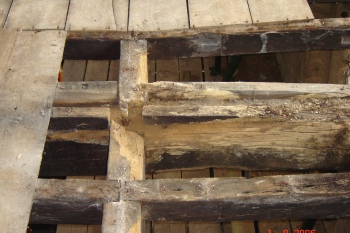
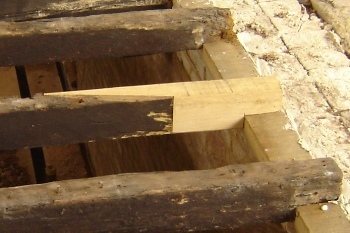
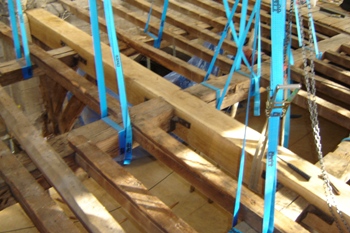
| Typical timber repair: the structural timber of the principal beam had suffered from fungal decay, while the connection of the purlin had suffered from insect attack, as a result of a leaking lead roof. | Rafter end repairs: a traditional like-for-like approach to repairing a rafter end, using a spliced scarfe repair to retain as much of the original rafters as possible. | |
 |
 |
|
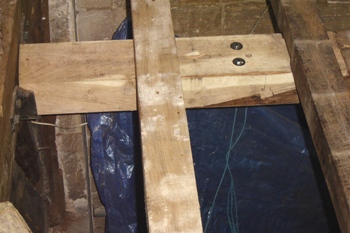
| Wedged scarfe joint: in this typical detail the new end of a purlin is spliced to the existing with a wedged scarfe and fixed with stainless steel bolts. The square end of the wedge can be seen between the heels of the joint. | A replacement beam: in some cases the extent of decay prohibits any solution other than replacement. |
Scarfe joints (see top right illustration, above) are commonly used where the ends of timbers have decayed, for example in a damp exterior wall. This approach, which enables the decayed timber to be cut out and replaced with sound material, depends on careful joint detailing for its structural integrity. Scarfe joints are usually fixed using stainless steel bolts or screws with traditional wedges or adhesives used between each timber surface.
To adopt the philosophy of 'conserve as found' is always the best starting point, and where like-for-like repairs are to be used, scarfed repairs allow the maximum amount of original timber to be retained. However, there are occasions where a timber beam has deteriorated to such an extent that the only possible solution is to replace the complete member.
When deciding on whether to replace a complete structural member or not, it is important to take into account the perceived life span of the particular timber.
The illustration above right shows a situation where a 15th century oak principal beam had suffered from insect infestation to such an extent that there was a serious danger of its collapse. It was noted that particular problems appeared around the area of the mortice slots in the beam, where the purlins were tenoned. A previous repair, carried out during the latter part of the 19th century, had resulted in the introduction of wrought iron straps, in effect carrying the ends of the purlins. These were re-connected as historic evidence of this past repair.
Replacing an entire beam can entail significant logistical problems and complex access issues which need to be overcome. The replacement of the principal beam illustrated on the first page posed many difficulties, not least sourcing a beam of the correct length and section, suitable moisture content and correct species.
Too much emphasis can be placed today on the country of origin. In this case European oak (Quercus robor) was selected as a suitable replacement as at the time of procurement a suitable beam was not available from English oak stock.
HONEST REPAIR
Reinforcing timber with metalwork has historical precedents dating back to the Middle Ages, and in many instances can be seen as having the advantage of being reversible.
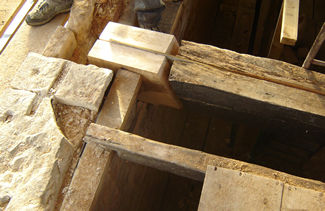
The removal of large chunks of historic fabric during some timber repair strategies is viewed as destructive and invasive, and consideration must be given to the use of metalwork in some instances. Although perceived as altering the way in which various members of a timber frame interact with one another, metal plates can provide an engineered and cost- effective way to repair timber. One of the most common uses of this approach involves inserting a flitch plate to reinstate the end bearing of a beam (illustrated below, left).
 |
 |
||
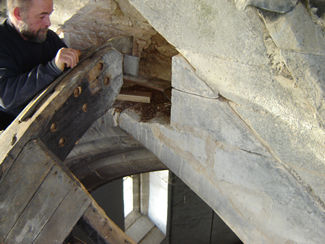
| Left: Flitch plate repairs: the decayed end of a principal beam is shown with repairs in progress. Right: Reinforcing a ridge beam: this beam on the raised end of a roof had moved and pulled out of the stonework. In order to reinstate its bearing capacity a stainless steel flitch plate was inserted into a pre-cut slot in the timber and built into the masonry. | |||
Whether this technique or a like-for-like repair is chosen, it must be remembered why the end of the beam has rotted in the first instance. Timber in contact with damp masonry sets up the conditions for fungal decay: timber with moisture content of less than 20 per cent does not seem to suffer, and ideally, the moisture content of all timber should be closer to 15 per cent.
When reinstating the beam end it is good practice to allow air circulation around the end of the beam and to provide a membrane between the timber and any masonry that will provide support. The use of lead sheet or a lead-based damp-proof membrane is preferable. Modern impervious membranes are best avoided, as airborne moisture will be retained in the void behind the beam, setting up conditions for re-contamination.
|
||
|
||
|
||
|
||
|
||
|
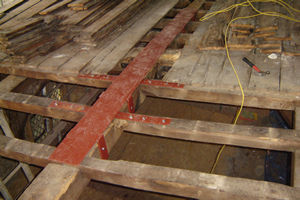
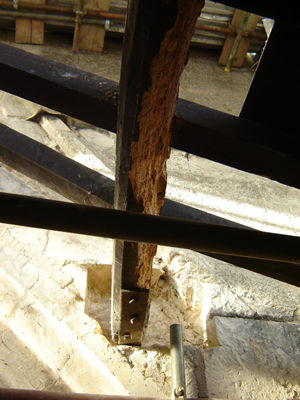
Another common example of an honest repair is the use of steel plates. A complex example of this approach is shown in the illustration, right. In this 15th century aisle roof a typical connection detail between a purlin and a principal beam was weakened due to the insect infestation of the mortice and tenon joints at the intersection. A mild steel plate was fixed to the top of the purlin and supported over the principal beam. This plate provided addition support to the purlins below via stirrup cradles welded to the side of the mild steel upper plate. All that was visible below were the cradles supporting the purlin.
RESIN REPAIRS
One of the most controversial repair methods in conservation today must be the use of resin for structural timber repairs. Prejudices often stem from the lack of knowledge and understanding of this technology. However, there are risks attached: timber treated with resins can become stiff and impermeable and may not be subject to the usual moisture and thermal related movement of the adjacent timber. It is possible that this could eventually impair the structural performance of the timber, but as resins are a relatively recent innovation, their long term affects remain uncertain.
In order to proceed with a resin repair certain justifications may be necessary in order to convince interested parties of the suitability of this type of repair in a particular situation.
Perhaps the most common example of its use is for replacing decayed beam ends. Simple beam ends can be partially or entirely replaced by cutting away the infected timber, inserting reinforcing rods into the timber ends and pouring resin into a pre-formed mould box, thus re-forming the original profile.
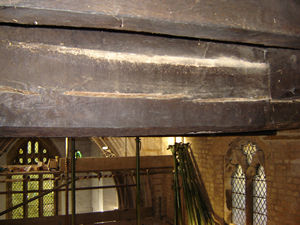
Cracks and fissures in timber beams which threaten their performance may also benefit from the use of resins, as they are rarely deep enough to warrant more drastic measures. Longitudinal cracks caused by drying (see illustration, right) may be simply repaired by drilling vertical holes at right angles and through the fissures at appropriate centres; rods can be fixed into these pre-prepared holes with injected resin. Reinstatement of the shear transfer of the upper and lower section of the beam is thereby restored. A simple timber plug on the underside makes this repair inconspicuous.
Another common problem which can benefit from the use of resins is the loss of a significant cross sectional area of a timber beam due to fungal or insect attack. In many instances the decay is confined to a relatively short section of the beam and does not warrant wholesale replacement.
In this situation a combination of a number of technologies may be appropriate. In the case of an oak roof purlin beam of 18th century origin (see illustration, opposite), which was curved in both plan and section, it was decided that the most cost-effective solution to the repair was to glue laminated 20mm strips of seasoned oak timber to the side of the beam. These laminations were held in position with addition stainless steel rods. Once set the timber could be shaped and planed to the correct profile.
ON BALANCE
There is a wide range of interventions available should repairs become necessary. Timber repairs are the favoured solution, not least for reasons of compatibility of materials.
The use of metals can be less intrusive structurally. However, care must be exercised in the choice of metals and the interaction with the natural resins and tannins within the timber species.
Resins repairs are frowned upon in some quarters, partly because insufficient time has passed since their introduction to ascertain the life expectancy of the bond between the resin and the mortar under different environmental conditions. However, in certain circumstances resin systems are worthy of consideration.
It is important to bear in mind that timber repairs are usually necessary because a building has been neglected. Churches are notoriously damp and poorly ventilated places, providing perfect conditions for fungal and insect attack. In the past, large amounts of money were spent on flooding the surfaces of a building with some chemical concoction or other, however current thinking dictates a rather different approach. By environmental control of the micro-climate within a building, for example through increased ventilation and the eradication of excessive amounts of moisture, the conditions for setting up the agents of decay are minimised.
Regular maintenance and monitoring regimes need to be in place in order to avoid or minimise costly repairs.