
Safe Access and the Maintenance of Historic Buildings
Richard Maddison
When dealing with historic buildings it is often difficult to resolve the conflicts that arise between their form and the requirements of health and safety legislation, especially with regard to safe access for inspections, maintenance and repairs.
Over recent years it has become increasingly recognised that good management of an historic building and its fabric requires an informed programme of repair and maintenance based on regular inspections - usually carried out every four or five years. Historically, quadrennial and quinquennial inspections, as these are known, have been mainly associated with ecclesiastical buildings, but this form of inspection has increasingly been applied to all forms of historic buildings and structures.
This development has coincided with the emergence of an ever-increasing assortment of health and safety regulations which have a bearing when contemplating works to any building, and the following legislation should be considered before carrying out the inspection, maintenance or repair of historic buildings:
The Health and Safety at Work Act 1974 requires the building owner to provide a safe place and systems of work to its employees, contractors and members of the general public.
The Management of Health and Safety at Work Regulations 1999 ensure the health and safety of employees, contractors and visitors by carrying out risk assessments, providing information, instruction and training with provision of health surveillance and management. The regulations require employers to carry out risk assessments to all processes, work activities, equipment and areas, make arrangements to implement necessary measures and appoint competent people.
The Workplace (Health Safety and Welfare) Regulations 1992 require employers to ensure that every workplace under their control has suitable space, equipment, safe systems and welfare facilities.
The Construction (Design and Management) Regulations 1994 (CDM) introduce a control framework covering all facets of construction from commissioning to the demolition of buildings, with regard to significant risks to workers and others. Generally, for works of maintenance or minor repair, the full scope of the regulations will not apply, but the building owner or manager should always seek advice prior to commencement.
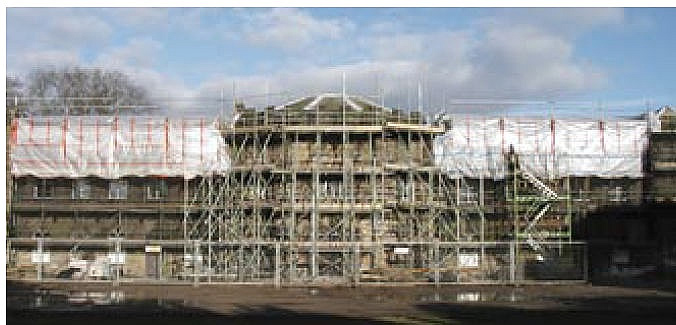 |
|
| Access scaffold erected to allow roof repair |
The Confined Spaces Regulations 1997 place a duty on the employer to ensure safe working in confined spaces, that is to say where there is a risk of death or serious injury from hazardous substances or dangerous conditions.
The Control of Substances Hazardous to Health Regulations 2002 (COSHH) implement the control, prevention and protection of exposure to hazardous substances by identifying the risks, assessing the risk and controlling exposure. In the context of historic buildings there are many situations where these regulations could apply, for example the use of lead or lead-based paints, or the use of toxic substances in the control of timber decay.
The Control of Asbestos at Work Regulations 2002 place a duty on building owners to identify sources, control exposure or remove sources of asbestos by licensed contractors. The majority of historic buildings have had works carried out or services installed when the use of asbestos was common practice. There is a requirement on all building owners to identify any asbestos contained within their building, and to set up an asbestos register detailing the location of any asbestos, and the procedures for its control or removal.
The Control of Lead at Work Regulations 2002 place duties on employers to assess the health risks created by work involving exposure to lead. This regulation has an obvious impact where any works are carried out involving the repair of lead sheet, or in the use of lead-based paints.
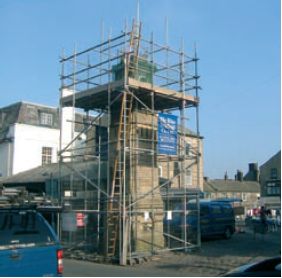 |
|
| Access scaffold erected to allow for inspection and repair of clock tower
|
The Work at Height Regulations 2005 were implemented to ensure the safety of employees while working at height. The regulations apply to all work at height where there is a risk of a fall likely to cause personal injury. All work at height must be risk-assessed, and safe and suitable systems of work must be used to access the workplace, whether for inspection, repair or maintenance. The regulations also place a requirement on designers to consider means of providing permanent safety measures at high level, for example permanently fixed access stairs, hatches and guard rails, to remove the need for temporary access equipment.
In the light of all this recent legislation the provision of safe access to carry out repairs, maintenance or the inspection of the buildings must be carefully considered, and implemented following the assessment of the risk and the production of a safe system of work.
Before carrying out work at a high level, contractors must first assess whether it is reasonable and practical to carry it out at ground level. For example consider prefabricating lead chutes and other detailed leadwork, or the cutting and tooling of masonry, before lifting it to high level and setting it in place. Works must also be postponed while weather conditions endanger health and safety.
When selecting equipment for work at height contractors and consultants must use the most suitable equipment, give collective protection measures (guard rails, for example) priority over personal protection measures (safety harnesses, for example), and take into account working conditions and risks to the safety of all those at the place where the work equipment is to be used.
A third of all reported 'fall from height' incidents involve ladders and stepladders (currently 14 deaths and 1,200 major injuries per annum). Ladders should therefore only be considered as a last resort where all options have been considered and there is no other safe system available. Any single operation that exceeds 30 minutes duration must not be carried out from a ladder. For guidance, reference should be made to the Health and Safety Executive (HSE) publication Use of Ladders and Stepladders: an Employers' Guide.
Safety restraint and safety harnesses will arrest a fall, but there is still a risk of serious injury, or even death, should an operative remain suspended in a harness for more than 20 minutes following a fall. Therefore safety restraint should only be used where guardrails or safe working platforms cannot, within reason, be provided. The installation of secure fixings will have an impact on the character of a historic building and ferrous fixings may also harm its fabric. So, where their installation is considered necessary, they should be made from stainless steel and their location should be agreed following consultation with the relevant authorities, having obtained listed building consent, where required.
Where suitable firm level access is available around a building, the use of mobile platforms may be considered a more reliable solution. Mobile platforms comprise either a telescopic boom (a 'cherry picker') or a scissor lift. Both have their uses for carrying out inspections of a building's external fabric and for carrying out high level maintenance, such as clearing out gutters or undertaking minor repairs. A mobile platform cannot however be considered as a safe means for obtaining high level access to other parts of a building, for example for gaining access onto roof areas.
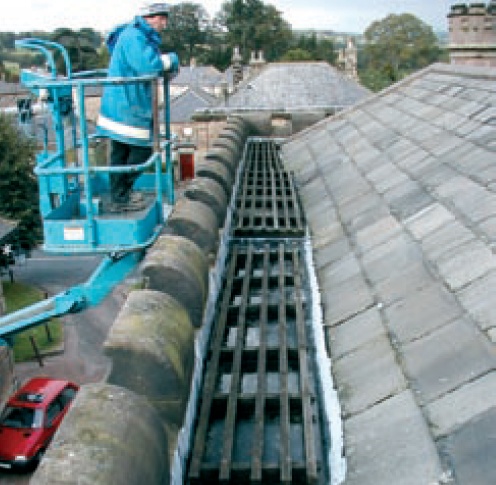 |
|
| Mobile platform used to inspect roof coverings and gutters |
A tower or 'zip' scaffold is a quick and easy method to provide access to a workface, but the guidelines laid down by the manufacturer and HSE must be followed. Thought should be given to the tower height and plan form, wind conditions, horizontal forces, access, overloading, and the position of overhead services.
Generally, access scaffold is the safest method of gaining temporary high-level access to carry out works of inspection, repair and maintenance, but it is not without risk. The scaffold should be erected by a suitably qualified and competent contractor and installed in accordance with the guidelines set out by the HSE. Once erected, a completion certificate must be obtained before any operative is given access to the scaffold, and, for construction work, when using any form of platform from which a person could fall more than two metres, employers must ensure the platform is inspected in place before use.
When working on historic buildings, the contractor must also be familiar with the conservation issues, including the need to use the minimum number of fixings to the historic fabric, and the need for the scaffold to be selfsupporting wherever possible. If anchors are considered essential then only stainless steel fixings should be allowed. All tube ends must be covered with plastic caps to prevent damage to the historic fabric, and must not rest on or abut the building. New or good condition scaffold tubes should be used to avoid the risk of rust staining to the walls. Any artefacts below the area of work should be protected or temporarily removed.
Ideally a building should be designed to remove the need for temporary access, and thereby reduce the risk of falls from height. In a new building, this can be achieved through the introduction of features such as guarded walkways, roof access points and permanent fixings for hoists. However, where an historic building is concerned, it may be impossible to provide such features without having an adverse affect on the character and appearance of the building or structure. Therefore a balance needs to be sought between the need to provide safe access for specialists to inspect, maintain and repair the building, and the need to protect historic fabric and its intrinsic character.
Safe access can often be achieved through small changes. For example, the introduction of roof access hatches into valleys or onto flat roof areas removes the need for temporary access to inspect and maintain roof areas, and the introduction of guardrails to a roof's perimeter allows the safe clearing of gutters from the roof area. The advantages of sympathetic access alterations include not only a safer working environment but also a likely increase in maintenance. Obviously, the impact of any changes on the character and historical or architectural importance of a building needs to be carefully considered, and will be subject to listed building consent where such consent is required.
In the past there has been a generally accepted premise that the listed status of a building holds precedence over the requirement to comply with health and safety legislation, where any works arising from such legislation would have an impact on the character of an historic building. Today, placing our architectural heritage above a person's wellbeing is no longer an option, and owners of historic buildings must therefore realise the impact that the various health and safety regulations have on the procurement and management of building works, and the burden they place on the building's owner when implementing those works.