
Conservation by the Seaside
Ashley Pettit
 |
|
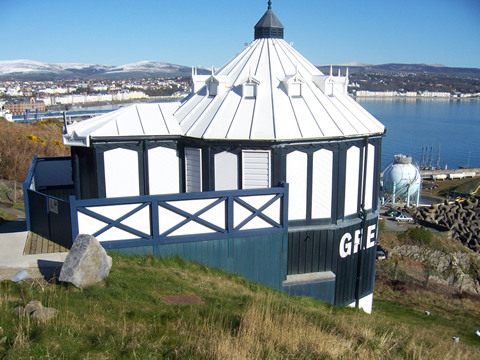
| The restored camera obscura on Douglas Head |
The architectural historian Lynn Pearson in her lectures on seaside architecture describes how each season in seaside towns, share certificates were sold to visitors for the next season's attraction and how then, if sufficient capital was collected, a new, more extravagant structure would appear to entertain the masses. No wonder these rapidly-produced delights were not designed with longevity in mind. However, by association with holidays and fun, these structures became culturally significant and, with age, worthy of conservation.
Prior to the discovery of the benefits of sea air and the exciting prospect of immersion in seawater in scant attire, it had been usual for our seaside buildings to turn their backs to the prevailing wind wherever possible, and they showed a great deal of experience and skill in keeping dry. Our more recent enthusiasm for living by the seaside often engages a similar folly to the seaside attractions built by public subscription and are designed with little regard for the effects of climate. A conservationist sent to recover a crumbling but much-loved building can face repairing a feature that was ineffective from day one.
This article concentrates on experience gained in the Isle of Man. Here, in the middle of the Irish Sea, buildings are constantly exposed to high winds and wet weather. There are five towns, each with a sea front developed from fishing villages in the Victorian tourist boom, when the island attracted countless visitors from the North of England. On the island there are very few surviving examples of the seaside excesses of the Victorians. One particularly fine exception is the Gaiety Theatre in Douglas designed by Frank Matcham, which opened in 1900 and was restored under the guidance of its manager, Mervin Stokes, in the 1990s. Another survivor is a timber camera obscura on Douglas Head overlooking the harbour, which was restored under Ashley Pettit Architects (APA)'s supervision.
THE CAMERA OBSCURA
 |
|
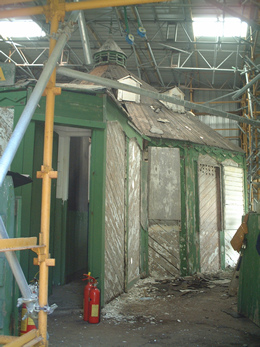
| Conservation of the camera obscura in progress: many of its problems had been caused by poorly specified repairs. |
Whilst most of the cast-iron follies of the Victorian holiday boom have been dismantled, one unique building survives on Douglas Head. Constructed completely of timber, the first camera obscura on this site had been manhandled up steep slopes in 1887 to take advantage of the spectacular sea views. However, it burned down in its first year and the present structure dates from its reconstruction in the 1890s.
The building remained in private ownership for the next 100 years and each season temporary repairs were made to keep the building open. However, by the 1990s it was leaking, wet and very vulnerable. The building was 'registered' (the Manx equivalent of being listed) and was given to the government to ensure its future. It was protected in a scaffolding enclosure and Bournemouth University was invited to advise on a suitable restoration programme. The project leader, James Strike, involved Richard Harris from Singleton Museum, and APA was involved as the Manx enablers. The final restoration was carried out in 2003 using a local firm of contractors.
The building comprises three elements: an undercroft which created a flat platform; the eleven camera lenses and the mirrors that projected the images; and the timber enclosure built to create a box office and a dark display space. This building is unique in having views displayed in sequence so, once set up, the whole operation required only a single cashier and, progressing from one view to the next, the visitor was led naturally to the exit. It was a beautifully conceived object but, exposed to the extremes of Manx weather, it had long passed its natural lifespan.
After negotiation with the planning authorities it was agreed that the undercroft would be completely replaced with a steel frame to stabilise the building, and that the emphasis would be on conserving the timber box above. This box had developed leaks at most major joints and they in turn had led to timber decay. The worst area was where a concrete screed had been laid over the entrance deck, immersing the base of the main building in damp, further exacerbated by run-off from the pathways. The building was buffeted by high winds and needed to be flexible. It was also inevitable that some water would find its way in and would have to be drained back to the outside.
 |
|
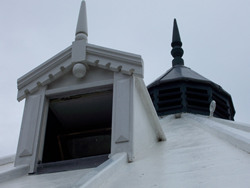
| Complex flashing details around the dormers were solved by using the original roof covering, canvas. |
At Singleton Open Air Museum, Richard Harris had used Compriband successfully in timber buildings. This sealant, which is designed to fill the vertical expansion joints in long walls of brickwork, takes the form of a strip of compressed waterproofed foam, supplied on a roll. Once removed from its packaging, the strip is quickly installed into the joint where it slowly expands in situ to fill the void. Still partly compressed the sealant then holds firm against even the strongest wind. Richard Harris's technique was adopted for the timber panels of the camera obscura, which were rebuilt using salvaged timber with movement joints protected by these inserts. The timber was sealed with lead stopper and finished with lead-based paints for flexibility and to minimise maintenance. Lead flashings were added to protect important joints and ensure water was directed away from vulnerable areas.
The felt roof covering had failed and around the lens housings the complex roof form presented a substantial challenge to make it entirely watertight. Further close inspection revealed traces of the original canvas roof material similar to that used on Victorian railway carriages. This was confirmed by the Railway Museum in Derby. A canvas covering used on the restoration of the museum’s timber carriages was therefore adopted. This moulded very easily into the shapes needed to seal the roof and, after two years, is still performing excellently.
Another weakness was sealing the lens dormers when the building was closed. After considering a variety of mechanisms, close examination of the lens housing revealed that the mirrors were so arranged that they were designed to jam the doors shut in the closed position. All this was controlled by cords at the back of the viewing panels. It was a simple well-considered solution which had only failed through lack of maintenance.
The principle adopted throughout was to ensure that the building could shed water and had no internal conduits to retain water. This principle should be applied to any window or wall situation, especially in exposed positions. Failure at the base of timber window frames, for example, can be the result of a poorly applied mastic seal, if it prevents water which finds its way in at a high level from escaping. Often the water enters at the top of the seal, where it is more difficult to apply, and if the mastic is not applied in a way that will allow water to drain out, the water will rot the window at the base, away from the source of the problem. Too often the timber frame takes the blame for what is a maintenance issue.
 |
|
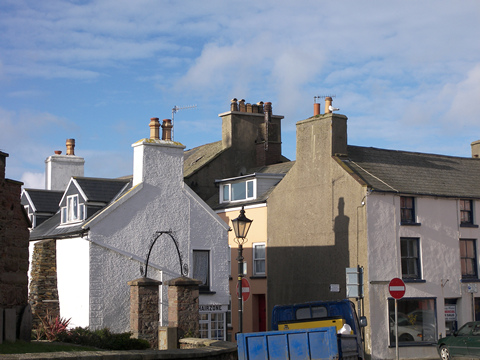
| Typical parapet gables in Douglas, Isle of Man: traditional lime renders have, over the years, been replaced with cement. |
MATERIALS
The obvious marine condition of salt attack does affect the choice of metals, paints and other finishes. There are marine-quality stainless steels which can be used as fixings. Cast iron, when available, performs well but aluminium castings need to be carefully protected by well specified and maintained coatings. High-specification paints are essential in a marine environment (see Colin Mitchell-Rose's article 'Paint, Wood and Weather', also on this site).
Traditionally, masonry walls were protected by a lime render. However, the fashion for exposing stonework has encouraged the removal of these soft, permeable finishes. Many have been cement pointed, resulting in the usual damp problems associated with water trapped in the structure. Elsewhere they are replaced with cheaper cement renders in an attempt to reduce maintenance and to copy the hard flat renders found on the later Victorian buildings in the larger towns. We have had good success removing cement pointing and replacing it with a weak mix of hydraulic lime and sharp sand. The marine environment provides us a fairly frost free winter and pointing can be a year round activity, providing screens are used to prevent wind damage.
We have been more cautious when replacing renders. The original Victorian renders were generally softer than our modern cement
 |
 |
||
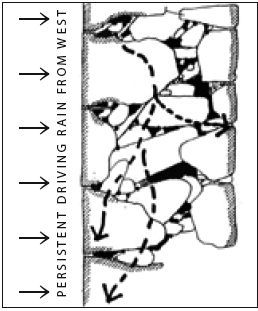
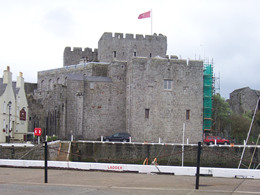
| Above left: the island's more successful buildings have solid walls and no core. At Castle Rushen the walls have narrow joints and look solid, but as this diagram shows, they have a loose core which collects water rather than shedding it back to the surface to dry naturally. Driving rain can enter the fine joints and then percolate downwards through the core causing damp (Diagram: John Ashurst). Above right: Castle Rushen gatehouse: 18th century alterations included castellated parapets which allowed water to enter the wall core at roof level and track down inside the wall. | |||
renders and were regularly painted, sealing joints with windows and gutters with successive thin layers of flexible paint. The modern renders are both harder and less flexible, losing their bond with the weaker substrate. The subsequent cracks let in water, which becomes trapped. The original lime mortar underneath becomes saturated and the integrity of the wall becomes threatened. In addition, the quality and porosity of Manx stone is very variable and we know when we take off a cement render that we will be faced with both of these problems. Technically, a traditional lime render should protect the masonry from salt damage sacrificially, since the damaging effects of salt crystallisation take place within the render. In a marine environment there is greater opportunity for this, and its vulnerability may have been one reason for the previous generation to look for an alternative. For these reasons conservationists in the Isle of Man have been reluctant to advocate the removal of Portland cement renders and their replacement with lime until we have had an opportunity to see how a few test buildings perform, and in particular whether the presence of salts in this constant drying cycle becomes an issue. We are also watching the Welsh churches renovated by Adam Voelcker, where new lime renders have been used in very exposed marine environments.
The island's wind and rain tend to test public opinion on limewash finishes, as more often than not the wall finish appears patchy in the morning following overnight rain, before the wind has had the chance to dry the lime out. As a result, modern masonry paints remain the most popular. One alternative is to use the more porous and vapour-permeable silicate paint systems such as Keim. These have given good results, but they can struggle on cottage walls of earth and lime.
 |
|
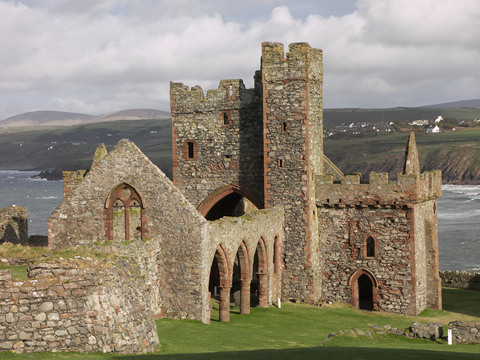
| Gable walls at Peel Castle were cleverly detailed so that only the outer face rose above the roofline, protecting the inner face from the elements. |
Where renders have been stripped, a good compromise which fits well with our rural buildings is to flush point and then limewash the stone and pointing to produce a single coloured finish. This has the advantage of producing a porous finish, with the fine particles of the limewash giving maximum surface area for drying, without having the specialist skills required to make an external lime plaster finish adhere to a variable and uneven substrate.
CASTLE RUSHEN GATEHOUSE
The Isle of Man also has numerous formal buildings, including some very carefully detailed Georgian lighthouses, industrial building such as the Laxey Wheel and various castles and other fortifications. Castle Rushen gatehouse is one of these. Built in the 14th century, and constructed from limestone blocks, it was restored in the 18th century under the direction of Lord Raglan and the architect, Armitage Rigby. A new window was installed on the sea-facing elevation and the roof was altered by the introduction of castellated parapets with a lead valley and lantern roof behind. This has resulted in the building becoming very damp as water could now enter the wall core at roof level and track down inside the wall. Where the new window was inserted, the water was coming in at the head. The window design also
 |
|
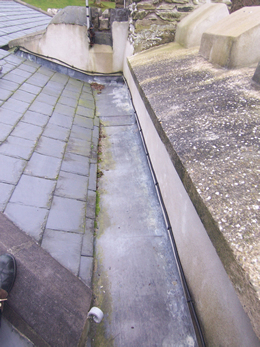
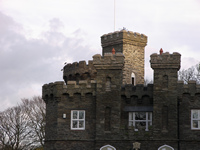
| Harold Towers (above and below right): castellated parapet details provide a large surface area for water ingress |
relied on the outer wall as weather protection and in severe conditions water can be driven in through the joints (see John Ashurst's illustration, above left). Such core walls are unusual on the island: by tradition, construction relies on a solid core to continually drain the water entering the joints back to the external wall surface and away. Peel Castle on the West Coast uses this solid construction and is a much more adaptable building as a result. Most of the remaining building stock follows the Peel example rather than Castle Rushen's core wall. Cavity wall construction has similar problems to core walls in our extreme climate and brickwork is particularly vulnerable to wind-borne water jumping cavities at perp joints.
MASONRY DETAILS
The detailing of masonry is important. It is inevitable that some water will enter the structure and should be dealt with and directed to the outside as soon as is practical. Historically exposed gable walls on the island have parapets such that the outer face of the wall rises above the roof covering, forming a step on the inner face, into which the roof timbers are built. This detail allowed the battens supporting the roof covering to be fixed securely. The front part of the wall was then completed with a sandstone coping bedded above the level of the slate roof. This both stopped the high winds blowing slates off and stopped water being blown under the slates by high winds. Any water entering at the junction between slates and parapet was, as a result of this step, entering the wall towards the outer face and could be drawn out by a drying wind, without entering the main structure.
The origins of this detail were discovered during work at Peel Castle. We do not have any dating evidence to show how long it took this detail to develop but it has translated from this major building down through farmhouse and other vernacular buildings, where the sandstone coping is retained, to the present where jobbing builders insist on finishing gables with a band of concrete cast on
 |
top of the verge course of slates and finishing it in with the external render. This can be effective providing the concrete remains attached to the slates, which is usually long enough for the property to change hands and the handshake guarantee to expire.
Parapet gutters are equally effective at stopping high winds driving water back up the slope from the gutter and under the slates. Where they are removed and replaced with external gutters, it is common to find that water has entered the top of the wall and tracked down behind what is now a hard rendered surface. However, parapet gutters can prove difficult to seal, and this becomes totally impossible where the parapets have since been castellated. This detail, which is still popular in the domestic market, has created the fairly insoluble problem of stonebuilt parapets with a much greater surface area and lots of open joints adjacent to valley gutters. Lime renders can be used as poultices to draw moisture out of the structure, but the whole detail is so problematic that in more northern exposures any external solution needs to be further protected by a well-ventilated roof
 |
|
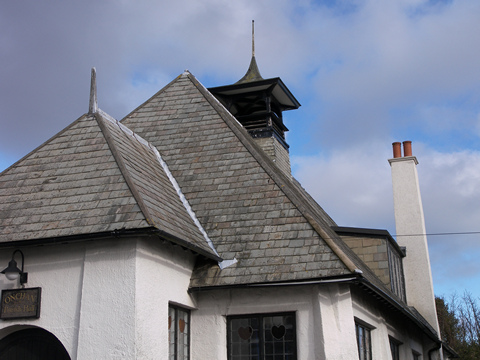
| Onchan Village Hall, a very distinctive early Baillie Scott building with tall, rendered chimneys |
void and, where possible, lime plaster ceilings and cornices with porous paints. On Harold Towers, APA were originally approached when a newly replaced plasterboard ceiling failed. We advised that it was not a new roof leak but due to the fact the old lime ceiling was better able to cope with the rate of moisture ingress from the original detail.
In similar cases but when the buildings are rendered, we have resorted to rebuilding and inserting a damp-proof course at roof level. This was done very successfully at Onchan Village Hall, a very distinctive early Baillie Scott building. The brick chimneys were saturated and had been re-rendered in cement. By rebuilding we were also able to replace the original profile based on illustrations published shortly after the building opened.
Severe maritime conditions exaggerate the stresses that are present in all buildings. It is not sufficient to accept normal practice. Believe in water running uphill and in loose sections of render pumping water into the building under wind action. Look to well-tried solutions from historic buildings and use breathable materials to improve the chances of success. Our experience is that most failures are the result of sealing structures in an attempt to keep water out. In a maritime environment the chances of doing that successfully over a period of time are slim.
~~~