
Secondary Glazing
Jonathan Taylor
 |
|
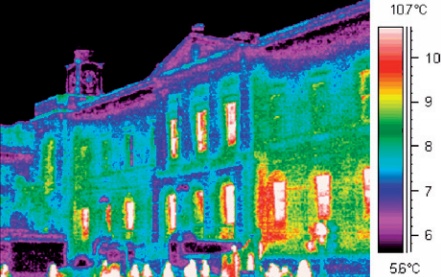
| A graphic illustration of heat loss from a building in Edinburgh: most of the windows are single-glazed and are emitting more heat than the thermal imaging camera can record (the white areas); six windows on the top floor (the green areas) have secondary glazing and are cool. (Image: IRT Surveys and Storm Windows Limited) |
Double glazing is arguably the most pernicious alteration to historic buildings since the introduction of central heating. Unlike central heating, however, it offers no real benefit when compared to alternatives.
THE CASE FOR ALTERATION
Human activity is, at the very least, making a significant contribution to climate change. ‘Greenhouse’ gases, especially carbon dioxide (CO2), trap heat from the sun, contributing to an accelerating rise in average global temperatures. If CO2 emissions can be reduced quickly enough it might avert some of the worst consequences predicted by scientists.
Add to this the rising cost of fuels, our dependency on foreign oil supplies, and the potential energy shortfall as petroleum resources decline, and the argument for reducing energy use is about as compelling as it gets. For all these reasons the UK government has committed us to reducing our CO2 emissions by 80 per cent by 2050.
The built environment will play a crucial role in this commitment, as existing buildings account for around 45 per cent of the UK’s carbon emissions, chiefly through the energy used to heat them. The solution lies partly in providing energy sources that produce less greenhouse gas, including more nuclear-fired power stations, and green energy sources such as solar collectors, but it also relies on making buildings more energy efficient. It is estimated that only 30 per cent of our existing building stock could be renewed by 2050, leaving some 26 million existing homes to be upgraded by then, 20 per cent of which predate 1914.
Where owners of historic buildings improve the energy efficiency of their buildings, single-glazed windows are the most commonly replaced element. The change inevitably affects the historic significance of the building. Owners should first ask whether altering the windows is necessary and, if so, whether double glazing really is the best solution.
The most recent analysis, which was carried out by Heriot-Watt University for Historic Scotland in 2008, looked at heat loss in traditional Scottish homes. The study found that, in a traditional detached house, half of all heat loss was through the roof and through air infiltration/ventilation (28 and 22 per cent respectively). The windows accounted for just 15 per cent of the heat loss, rising to 19 per cent for a flat1. This clearly shows that the focus for remedial measures should always be on insulating the roof and controlling ventilation, but it is also obvious that the role of windows must be addressed too.
IMPROVING THERMAL PERFORMANCE: THE OPTIONS
Another study commissioned by Historic Scotland looked at the improvements that could be made to a typical sash window to reduce its heat loss. The tests, which were carried out in 2008 at Glasgow Caledonian University, included the original single-glazed window which had been draught proofed using the Ventrolla system and augmented by the following:
- traditional timber shutters
- modified timber shutters with a thin layer of insulation in the panels
- secondary glazing using a proprietary aluminium system fitted tight to the existing sash
- heavy curtains
- a traditional blind
- a blind with a low emissivity (low-E) plastic film applied to the side facing the window
- a Hunter Douglas ‘Duette’ honeycomb blind which has two layers that enclose air pockets.
After the tests were completed, the window was re-glazed using slim-profile low-E, argon-filled double-glazed units and tested again. (Slim-profile sealed units were chosen because they can be fitted within the glazing bars without obscuring the sight lines.) The results were as follows:
| Reduction in heat loss | U-value | W/m²K | |
| Single glazing (centre of pane) | – | 5.4 | |
| Heavy curtains | 14% | 3.2 | |
| Modern roller blind | 22% | 3.0 | |
| Victorian blind | 28% | 3.2 | |
| Duette honeycomb blind | 36% | 2.4 | |
| Modern roller blind with low-e film | 45% | 2.2 | |
| Shutters | 51% | 2.2 | |
| Double glazing (slim profile) | 55% | 1.9 | |
| Modified shutters | 60% | 1.6 | |
| Secondary glazing system | 63% | 1.7 |
The findings showed that the chosen secondary glazing system actually outperformed the chosen double glazing system, with a U-value that was more than adequate for current building regulations.
Several combinations were also tested. Of these, the use of secondary glazing with heavy curtains is the most likely to be encountered in homes at night, achieving a U-value of just 1.3 W/m²K, and a heat loss reduction of 66 per cent over single glazing.
The findings do not mean that secondary glazing is always more effective than double glazing, as many factors affect its performance. For example, the spacer bar around the perimeter of the pane of a double-glazed unit will conduct more heat than the centre of the unit, so a double-glazed small-paned window such as a six-over-six sash window will be less efficient than one with a single pane. Nevertheless, the analysis does show that, from a heat performance perspective, the use of properly installed secondary glazing provides perfectly adequate levels of insulation which can often be more effective than double glazing.
DESIGN CONSIDERATIONS
Listed buildings (around 2% of building stock) require special consent for alterations such as window replacement. Within a conservation area, planning consent may also be required for the replacement of windows in unlisted buildings.
Windows are key to the character of historic buildings. A minor change like increasing the thickness of glazing bars can have a dramatic impact on the character of a window. Reflections are also extremely important: in a small-paned window, each pane reflects at a slightly different angle, resulting in broken reflection lines across the window. This variation is lost when dummy glazing bars are planted onto the face of a large sheet of glass. Old glass itself has a unique character: crown glass has radiating ripples and is widely found in small-paned Georgian windows, while the cylinder glass commonly found in windows made after 1845 has parallel ripples. Both distort reflections across the pane, adding character to the appearance of the building.
 |
||
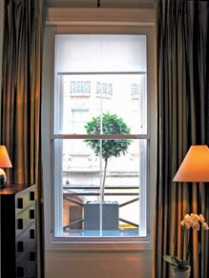
| Secondary glazing in Brown’s Hotel, Mayfair: the system operates in the same way as the sash window behind, providing natural ventilation when needed. (Photo: Selectaglaze Limited) |
Double glazing a window not only results in the loss of its old glass, but also adds more weight. This can cause problems for small and often fragile timber sections, and is generally best avoided. If the building is listed, consent is unlikely to be granted for an alteration which, as Historic Scotland’s research showed, is generally unnecessary.
From the perspective of historic and aesthetic significance, secondary glazing solutions have the advantage over double glazing systems that they are reversible: the window can be returned to its original condition in the future if required. Almost the only permanent alteration is the fixing holes where a frame is secured, and otherwise the original details remain undamaged.
As secondary glazing systems are usually fixed on the inside, the exterior remains unaltered, except for the inevitable double reflection. Seen from the inside the impact on the interior character of the room can be significant. In addition to the reflection across the face of the window, the frame can be an ugly intrusion on the clean lines of the original joinery. Getting the design right requires meticulous attention to detail, to ensure that the sight-lines through the window are not obscured, and to ensure that the only line visible on the frame of the secondary glazing is where the frame meets the glass. If the details are clean, a small well made frame can usually be coloured to blend in with the surrounding joinery.
Shutters present a further problem for the design as, when closed, they almost always fit tight to the window frame. Nevertheless, there is often room for a simple aluminium-framed system within the reveals. The example used in the Historic Scotland study fitted between the staff beads of the sash window, and incorporated one fixed pane and one vertical sliding sash.
SECONDARY GLAZING SYSTEMS
Essentially there are two alternative design approaches: fixed systems which remain in place and removable systems which are stored in the summer months when they are not required. The latter are usually clear sheets of polycarbonate or acrylic plastic, which are tough and light enough to be easily carried, and are fitted with magnetic strips on both the sheet and the window frame. These systems have a typical U-value of around 2.7 W/m²K.
 |
||
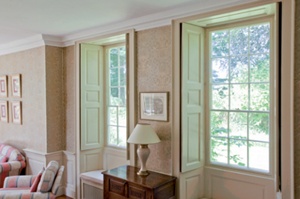
| The fine Georgian shutters of this house at Wickwar, Gloucestershire, are unobstructed by the secondary glazing system which is neatly fitted within the depth of the staff beads. Apart from the reflection off the glass, the system is practically invisible. (Photo: Storm Windows Limited) |
The main disadvantage of removable systems is that they can be awkward to open to ventilate the room, so they tend to be used in the coldest months only. Removable systems are best used in conjunction with fixed systems with opening lights so that each room can be ventilated when required.
Glass systems tend to be permanent as they are much heavier. As they can be low-E coated, their performance can be improved significantly. (Low emissivity coatings work by reflecting the long wavelength heat from radiators and room surfaces back into the interior, while allowing in short wavelength solar energy.)
Fixed systems vary widely but usually consist of aluminium casements fitting into aluminium or timber secondary frames. Lights which open may be hinged or sliding, and include draught-exclusion brushes and seals. Vertical sliding systems are available with weights or springs, designed to mirror traditional sash systems, so that the secondary frames disappear against the frames and meeting rail of the original.
CONDENSATION
Whichever system is chosen, condensation on the cold face of the original window should be taken into account. Even with draught stripping, some air leakage will enable warm, moist air from the interior to enter the cavity between the primary and secondary glazing, particularly through those windows away from the prevailing winds. Studies carried out by English Heritage point to the use of trickle ventilators to bypass the airflow from the interior into the cavity, one-way trickle ventilators on the windows themselves to prevent reverse airflow, and the use of stack ventilation or mechanical ventilation to ensure that air travels from the outside to the inside through the cavity, preferably combined with heat recovery systems.
As so often in conservation, a solution for one problem raises further issues. Designing a successful programme of thermal improvements requires a holistic approach to the interior environment of the building by a specialist who understands how historic buildings work. There is no single answer. Each situation needs to be considered individually.
~~~
Recommended Reading
P Baker, Improving the Thermal Performance of Traditional Windows, Historic Scotland and Glasgow Caledonian University, 2008
C Wood, W Bordass and P Barker, Research into the Thermal Performance of Traditional Timber Windows: Sash Windows, English Heritage, 2009
(1) David Jenkins, Energy Modelling in Traditional Scottish Houses, Historic Scotland/Heriot-Watt University, 2008